Thursday, December 29, 2011

My Digital Workflow

Step 1 Ingest
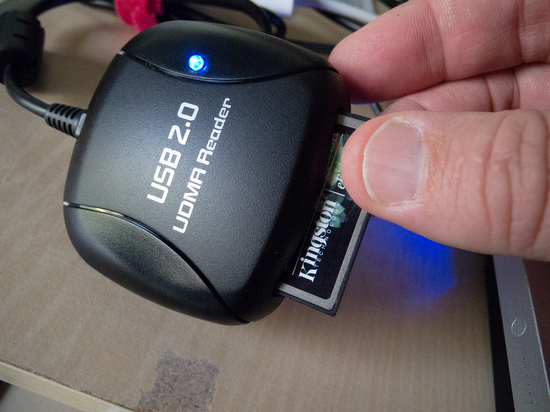
Step 1 - I ingest the images from my Compact Flash Card or SD Cards. My settings for the camera are RAW and I normally use the ExpoDisc to get custom white balance. I shoot in ADOBE RGB color space as well. All the settings give me images that are the best possible for editing. Color is almost perfect because of the custom white balance and can be modified easily since they are in RAW format.

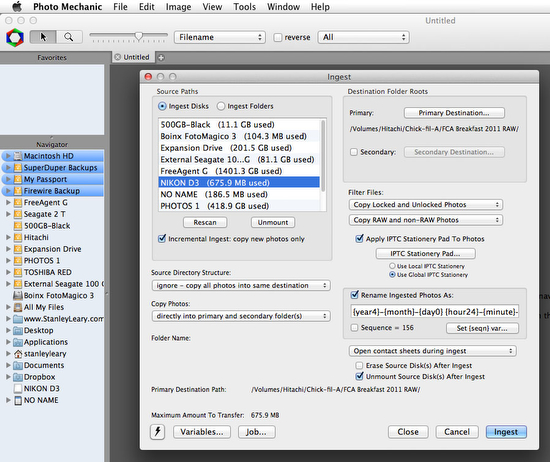
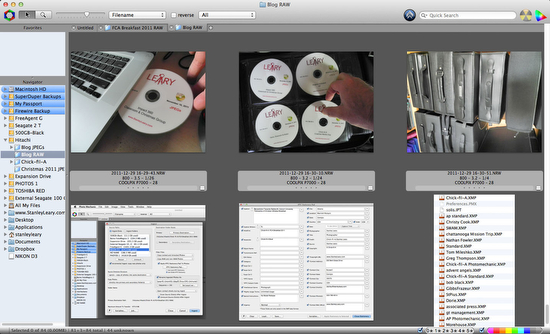
Step 2 Use PhotoMechnic for ingesting software
Step 2 - Ingest using the software PhotoMechanic.  I select the card and then I select the destination for all the images. I use + RAW
Step 3 - the destination is an external hard drive
Step 3 - External Hard Drive is chosen so that the wear and tear is not so great on my main hard drive of the computer.  If you shoot as many images as I do you will burn out a hard drive quickly if you use it all the time.
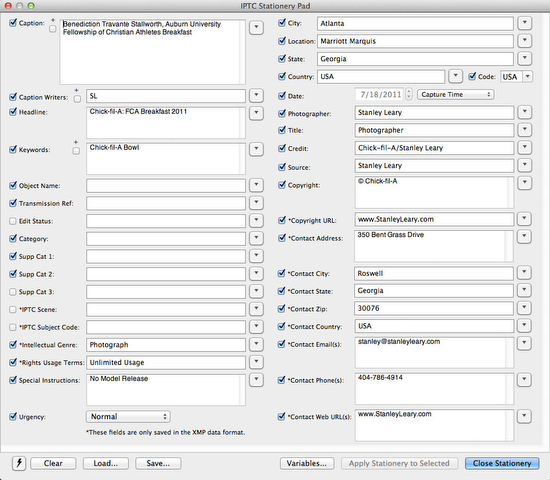
Step 4 - IPTC Information added
Step 4 - Add IPTC information that will go onto every photo from the photo shoot.  Adding the bulk metadata to the caption and keywords as well as embedding credit, copyright and contact information.  I also add information about the location of where the photos were taken.
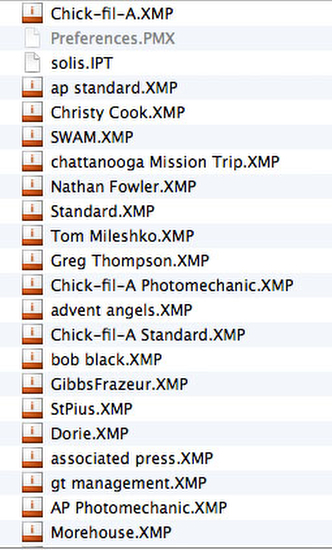
Step 4 The IPTC information I have saved and tend to load one of the templates saved so I do not have to put in the basic information each and every time for a client.  I have templates for clients like Associated Press, and my personal use as well.  I just load the template and make minor changes.
Step 5 I cull the images down
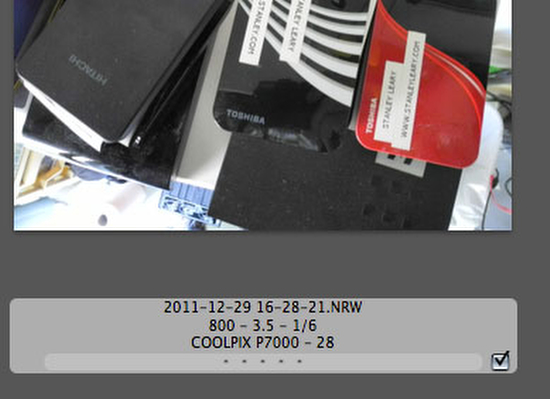
Step 5 - Culling the images so that I am only keeping the best images or usable images.
Step 5 I check the select button for those I want to keep
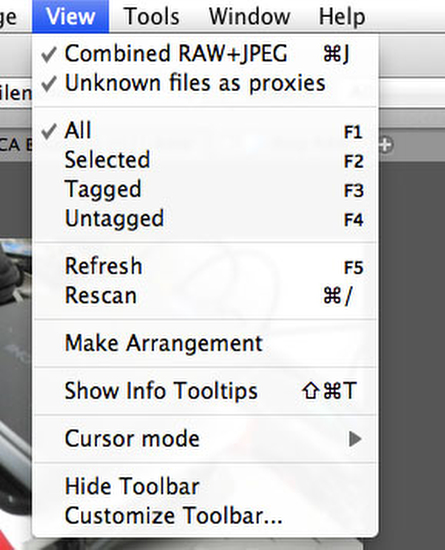
Step 6 - select the Untagged Images
Step 6 I go to View and then select seeing only the untagged images and then delete all of them.  Just keeping the tagged images.
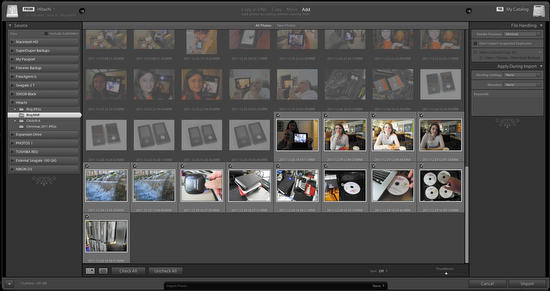
Step 7 Open Lightroom and import from the folder of selected images I created using PhotoMechanic
Step 7 Open Lightroom and import the selected images from Photomechanic.  I am just adding these to Lightroom and not copying them.
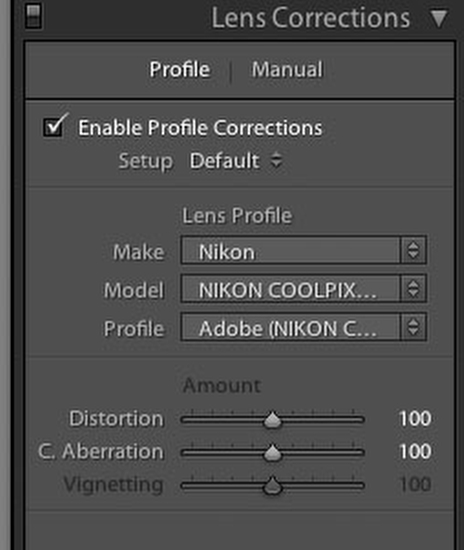
Step 8 - Select all images and in Develop Module I then enable Profile Corrections
Step 8 Enable Profile Corrections for lenses.  This will correct all the aberrations and imperfections known for each lens that I own and therefore giving me the best quality possible.
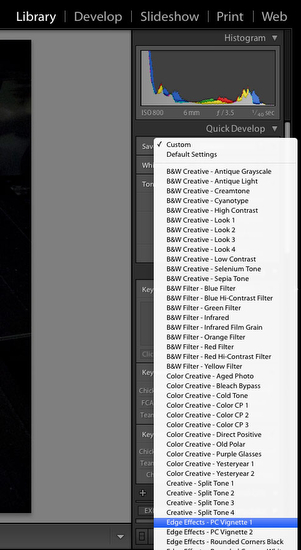
Step 9 - I sometimes will add a vignette to the images. 
Step 9 I like to darken the edges ever so slightly and heavy depending on the situation.  I will select all images and add a PC Vignette 1 for slight or PC Vignette 2 for a heavy use like for a formal portrait.  These are found in the Library Module under Custom.
Step 10 - Adjust image
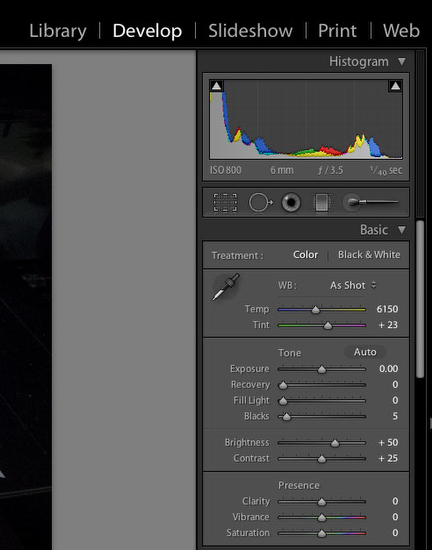
Step 10 - I adjust the image or images.  I will select a group if they are all similar and this way save on time in the editing.  This has a few parts to this:

  1. Hold down "Option Key" while sliding the exposure.  You will see the highlights.  I try and have no white areas on faces for example.  Play with this to get your desired result.
  2. Hold down the "Option Key" and slide the Blacks.  Only if there are black areas do I try and be sure there is a black
  3. Adjust then the Fill Light to open up the shadows.  
  4. I will sometimes use the Recovery to bring in some highlights that might not be recovered when I did the main exposure.  Again play with this for desired result
  5. I then usually add some saturation by using the Vibrance slider. Usually no more than 35. It will affect everything but people.  That to me is really cool, because I don't like to make the people red for example.
  6. I may do other fine tuning beyond, but these 5 steps are pretty much used every time.
Step 11 Exporting
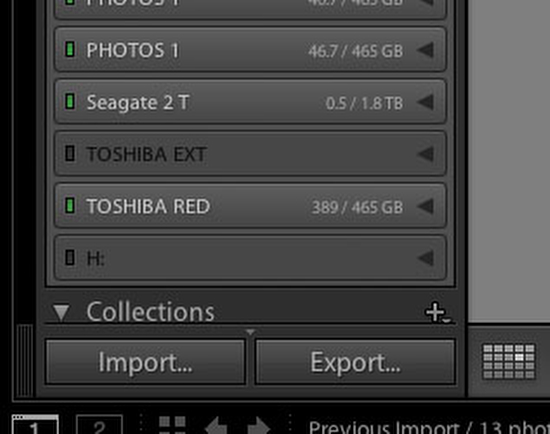
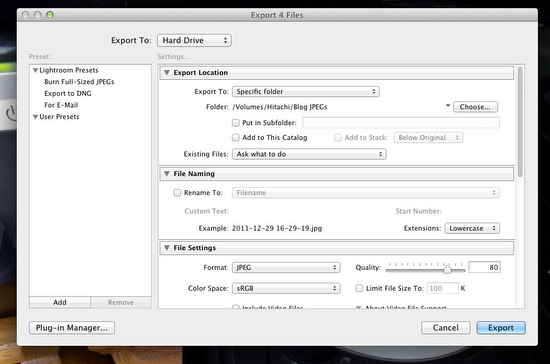
 Step 11 Exporting. Go to the Library module and in the lower left click export.
Step 12 Exporting choices
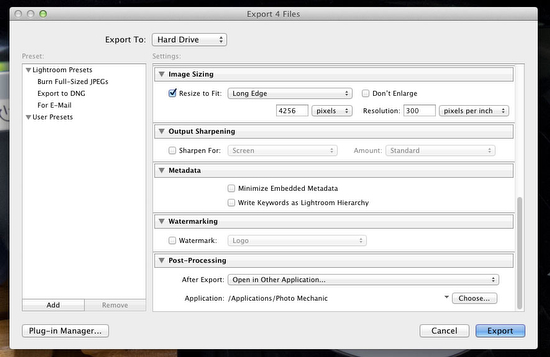
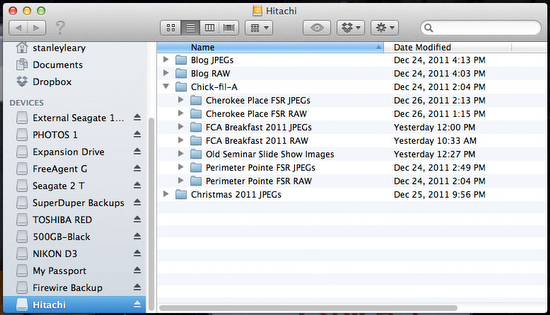
Step 12 Select a folder to export. I use + JPEGs. I select sRGB as a standard since it is more usable for more situations. I set quality to 80.
Step 12 I keep images all the same size
Very important not to check the "minimize Embedded Metadata" because this will remove all the camera data which many database software programs use to help narrow down the search by date and time that a photo was taken.
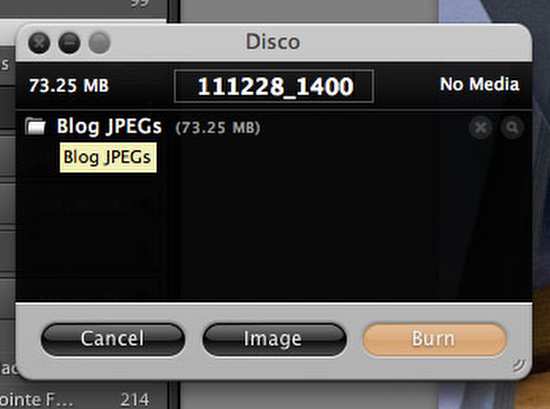
Step 13 Making of DVD/CD.  I will drag the folders from here to the Disco Software.
Step 13 Making of a DVD I use the software Disco for the Mac to burn my DVDs and CDs.  The reason is this will let me take very large shoots that need multiple DVDs and spread the project for me over a number of discs.

I name the Disc by year, month, day and time that I burn the disc
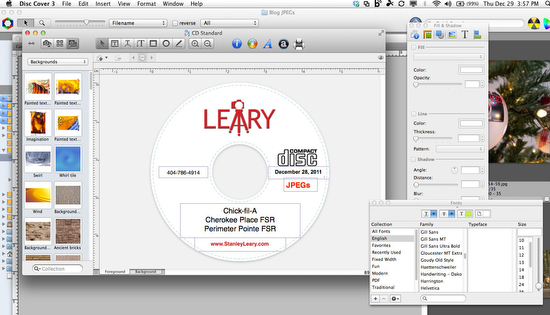
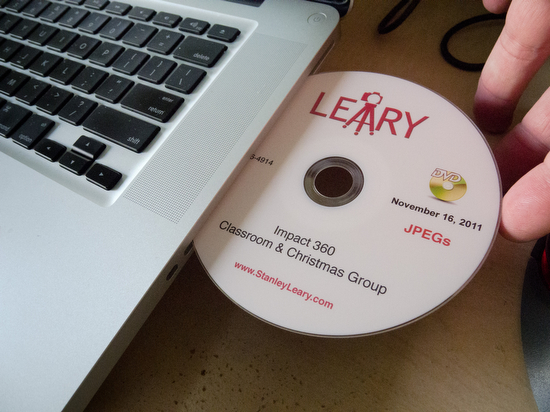
Step 14 Print on the Disc using Disc Cover 3

This helps with branding and looking professional for the client.
Step 15 Print using the Epson Photo Stylus R280 Printer
 
Printing on the DVD with Epson Photo Stylus R280
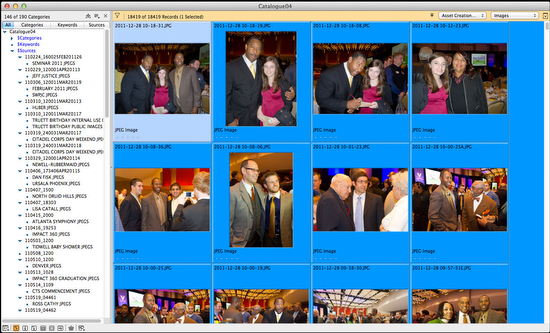
Step 16 Ingesting into Cumulus

Ingesting into Cumulus from DVD

Cumulus lets me search all the images. I am searching all that text I put into the metadata earlier.  I can search and narrow down my search using Boolean searching technique. 
Cumulus helps me later find images using the text search. Once it finds images I can see the thumbnail and it tells me which DVD it is stored.

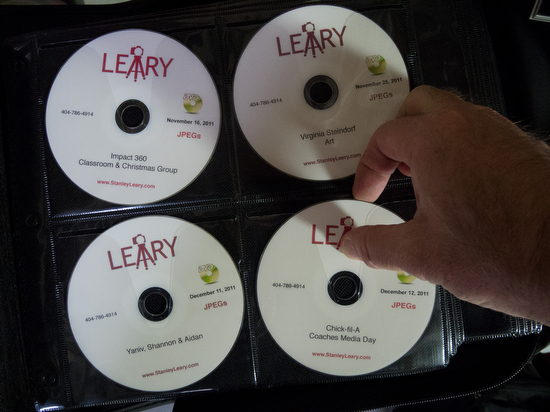
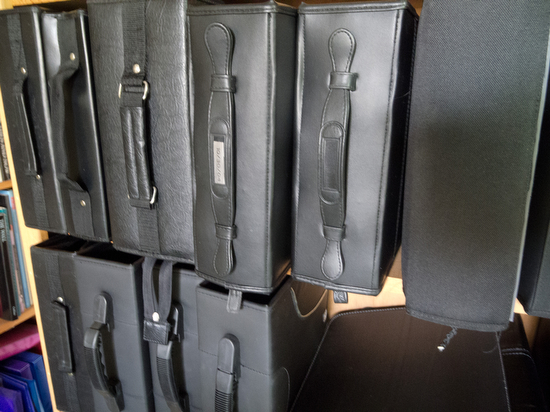
Disc is put into a binder in chronological order.

Binder is put onto the shelf
Summary

I now have a way to find all the images and have it in two places minimally.  On the hard drive and on a DVD.  I normally also upload these and/or give a Disc to the client.  This makes for the third copy.  Later I will copy the files from the hard drive to another hard drive giving me in essence 4 copies.

I hope this helps you see my digital workflow.

Tuesday, December 27, 2011

How to become a humanitarian or missions photographer

New church and well being built in Becanchen, Yucatan, Mexico. Nikon D3, ISO 200, f/8, 1/100, 24-120mm
"I feel God calling me into missions photography ..." or "I want to be a humanitarian photographer and would like to meet you," are two things I am hearing almost weekly now. 

To make this dream a reality is to engage your head and your heart in this journey.

Reasons not to become a humanitarian/missions photographer

  1. The field is overcrowded. If you live in a major city like Atlanta you are very much aware of traffic jams.  Another great comparison is going to Universal Studios or Disney World.  You are going to stand in a very long line because this is a very popular job. This field is not just crowded, every day more and more people are wanting and trying to become photographers.
Fernanda washes clothes and makes hammocks for a living in Akil.  Her son Roberto Carlos has finished school and wants to go to college. They live in the Yucatan in Mexico. Nikon D3, ISO 200, f/5, 1/8, 24-120mm

  2. Most photographers do it for free.  Translation--it is very difficult to make a living. How will you compete against others who will not only do it for free, but pay their way to cover a cause around the world?
Mayan family at their home in the Yucatan, Mexico. Nikon D3, ISO 200, f/5.6, 1/250, 24-120mm
  3. It requires a large financial investment.  You need cameras, lenses, flashes, memory cards, computers, software, and training to use all this.  Did you notice the list was multiples? Everything requires a backup because equipment will fail and you must still deliver.

  4. It is a business. Since the 1970's staff jobs are actually dwindling.  More and more photographers are freelancers who must pay higher taxes and higher healthcare insurance than their staff counterparts.  Don't forget you need camera insurance and liability. You must first be a business person and then a photographer. 
David Woods stopped on our drive to BoBo from Ouagadougou, Burkina Faso for our lunch. You need to be able to eat a variety of food when you travel. Nikon D2X, ISO 100, f/8, 1/320, 24-120mm

 5. You have to be outstanding and not average. If you watched American Idol then you have a good comparison to this industry, but the numbers are greater.  Everyone owns a camera and many think they can make great photos. American Idol auditions hundreds of thousands to get it down to 25. If you go back to past seasons not all of those 25 finalists are making a living at it. The odds are similar in photography. There are many great photographers, but they didn't have the complete package to make it.

  6. Everyone owns a camera and can make a photo. Think about this for a while. Why pay you to photograph something when they can take it themselves?

  7. 95% of your time you are not making pictures. Even the most successful National Geographic Magazine photographers spend only a fraction of their time shooting. Most of the time you are researching a topic or an organization trying to find ways you can help them achieve their goals.
Clenence is holding Azer who is sick and 3 years old.  Her husband is Jacob Tarnagda a leader in the church and is 40 years old.  Jacob converted from Islam to Christianity.  His home is in Soumagou, Burkina Faso. Nikon D2X, ISO 100, f/7.1, 1/60 24-120mm

  8. It's not about you. If you want to take pictures because you have an interest in something, well unless an audience is willing to pay you to see your work there is no career for you.

The most successful photographers today are not focused on telling a story with their camera--they are focused on connecting the subject with the audience to achieve a goal.

There is no AAA roadside assistance in Burkina Faso. My host David Woods repairs the truck that just lost a belt on the side of the road. Nikon D2X, ISO 100, f/2.8, 1/2000, 24-120mm

Here are some questions you need to answer


1) Why do you want to be a photographer?

If your answer is I like to take pictures and meet people, then keep on doing this as a hobby.  If you want to tell the stories of some people you have met, you still need to keep this a hobby.

Humanitarian and missions photographers are goal focused. When I am photographing an orphan I am wanting to help them find a parent. Some who will see my photos may give money to cover their housing and food until they find a parent and this good, but my goal is to move people's hearts to take this child in.

My goal is not to tell the orphan's story. Do you see the difference?

Dr. George Faile, family practitioner is making his rounds at the Baptist Medical Centre in Nalerigu, Ghana. Yes that is two children from two different families sharing a bed in a hospital. Nikon D2X, ISO 800, f/2.8, 1/40, 18-50mm

2) Why should you be the photographer?

If the goal is to do something, why are you the best selection and not a professional photographer who has given their life to not just taking pictures, but to the cause?

If the goal is to get a orphan adopted why would anyone want to have a photographer shoot it that has never helped anyone get adopted verses the photographer that does. Think about it why not hire William Albert Allard who made the famous photos of the little shepherd boy who lost his heard to a reckless driver in Peru? Allard's photos moved the readers of National Geographic Magazine to replace his herd and then some.

A mass of people wait for medical treatment at the Baptist Medical Centre in Nalerigu, Ghana. They are all waiting for Dr. George Faile to see them that day.  Nikon D2X, ISO 400, f/2.8, 1/25, 18-50mm

3) What are you doing to be the very best photographer?

Organizations that want to achieve their goals are not going to let just anyone photograph for them.  Actually they want to keep most photographers away from their projects.  Many photographers will do more harm than good.  Too many photographers are just trying to build a portfolio rather than help.

I am called to be a photographer

Just like a professional musician you will need to study the craft and find a teacher/mentor.  Even in Star Wars Luke had to find Yoda to help teach him the skills to become a Jedi Knight.


My suggestions:

1. Take classes in the following:

    a. Business and marketing - You need to understand how to price your work, how to negotiate with a client and most importantly how to find a client.
    b. Psychology - You need to be able to work with a variety of people from all walks of life. You need to be able to get to know people in the most intimate way possible in the shortest time possible, because you will be telling their story as an expert on their life.
    c. Photography - You need to know how to make your camera do what will work in any situation. You need to be able to not just capture something, but help capture it in a way that sets the mood as well as captures the moments. To do this you will need to master: Aperture; Shutter Speed; Hot Shoe Flashes; Studio Strobes; Available Light; Composition and much more.
We ate in a coffee growers home in El Aguilia, Mexico. Nikon D3S, ISO 12800, f/5.6, 1/60, 14-24mm

2. Study the masters - You will need to become a master.  Remember the organization will hire the person they think is best suited to help them achieve their goal. You need to become the expert they want on their team. The best way to do this is to study all the great photojournalists that have gone before you. You need to know why their work was so successful.  

3. Study with a master - Take a workshop with someone who is known for storytelling that also is known to help organizations meet their goals.  I am teaching such a class in Tibet August 5th - 15th.  I will be teaching you how to photograph in another culture, how to tell the story and reach your audience with the message.

4. Go to seminars and workshops to get inspiration. I recommend going to seminars like the Southwestern Photojournalism Conference in Fort Worth, TX February 23 - 26. Here you will be able to hear successful photographers talk about their work. The room is often filled with past speakers and current masters of humanitarian and missions photography.

5. Get critiqued to learn - Don't show your work to just get pats on the back. Show you work to people who can point out the basic things you are missing early in your career and as you grow can teach you about the nuances. If your purpose is only to show your work and have everyone applaud only - well then you need to keep this as a hobby, because even the masters of the craft look for ways to get even better. If you go to the SWPJC you can enroll in the 2 minute show. You can show everyone at the conference your work in 2 minutes. Hey this is one of the best ways to get critiqued and discovered.

Monday, December 26, 2011

Where do my photos go?


Where do my photos go? You can own the greatest camera and if you haven't established a workflow for your images you can loose all of them before you ever see them.

For the majority of my photo shoots I can capture all the images on 1 - 16GB card per camera. However, there are some photo shoots and especially when I travel overseas where I will not only fill the 2 cards in the camera I will need to download them and continue to shoot.
Nikon D3s with 2 - 16GB CF cards in the slots

I am using SanDisk Ultra 16GB CF cards in my cameras
When I am having to download the images and reuse the cards or use more CF cards I ingest them on site with my ColorSpace Hyperdrive memory card backup system.

For some photo shoots I will use one of the Hyperdrives through a day and then pass this along to someone to handle the post processing one day while I am shooting and putting more images onto another drive. At the end of that day I will trade out the drive with the one I first gave to the person for processing.

This lets me not only continue to shoot, but if there are problems with the images I can get a call from the person and if there is dust on a chip for example I would stop shooting and clean the sensor.

The advantage of the Hyperdrives is that I can turn one on and down load my images very quickly and then continue to shoot.
I have two ColorSpace Hyperdrives.  The older model which isn't UDMA and the newer UDMA model.  I have a 120GB drive in the older model and a 160GB in the newer UDMA model.
For those wanting to travel light, the Hyperdrive with a tablet will let you see your images and have backup of all the images with very minimal computer equipment.

There are two major times where the speed of your cards will become very noticable.

1) When you shoot a lot of images quickly your card will come to a stopping point until the images can be written to the cards. This is when the cheapest, which is usually not the fastest cards, will affect your ability to continue to work.

2) When you are ingesting your cards to either your computer or the ColorSpace Hyperdrives the speed of the cards will determine how long it takes for the transfer.

For the most part unless these are critical to you, you can shoot a slower card that costs much less.

One last suggestion: Always format your cards in your camera and not on you computer. The cameras format in a different way and will give you better performance.

Saturday, December 24, 2011

You Might Be A Photographer if ...

Your friends are giving you Christmas ornaments each year.
Twas the night before Christmas and I was sitting in my recliner by the tree. I looked over to enjoy the season when it hit me I am a photographer because I have so many ornaments to remind me.
Somewhere on your Christmas tree you have Santa with a camera.
I was enjoying my coffee in my Nikon mug and it tastes so much better when I have logos around me. Not just any logos will do for it is always Nikon and can never be a Canon. 
You have a picture of Santa in a slide mount.
There are also ornaments to remind me just how long I have been in this career. I have a slide of Santa from another Christmas eve.
You have a What The Duck Christmas ornament
Today I have a cartoon character that helps me laugh and laugh really loud. What the Duck has given me much glee this year, helping me make light of the moments which use to get me all up tight.
You don't just have Christmas ornaments but coffee mugs with cameras or camera manufacturer logos.
Nikon 24-79mm f/2.8 Coffee Mug.  If you have one of these you have it pretty bad.
Merry Christmas!

Wednesday, December 21, 2011

Who is the master of color photojournalism?

Some of the books by William Albert Allard that I own.
What is right? Simply put, it is any assignment in which the photographer has a significant spiritual stake...spiritually driven work constitutes the core of a photographer's contribution to culture. - William Albert Allard - on the right photo assignment., Photographic Essay (American Photographer Master Series)

If you need some inspiration and want to learn from one of the all time best photojournalists, then you need to discover William Albert Allard.

Be sure and visit his website http://www.williamalbertallard.com/

Very few photojournalists have the ability to gain the access as Allard has done throughout his career. He started in 1964 by talking his way into the Amish community and capturing some of the most intimate photos ever taken of a culture that shuns photography.

I first discovered his work when I would open my families subscription to National Geographic Magazine. His imagery captured my attention and later I would study his work so much that I slowly discovered how his style worked.

First of all the best thing about the books and especially his latest book William Albert Allard: Five Decades is his honesty.  When I first met him he was more distant than when I encountered him later in his career. After you read the books you start to understand that he made some mistakes that he regretted, but learned from.

Allard has published 6 books.  Here is a link to them for you.

What is special about Allard is he is probably the only photographer I know that his entire career was spent working with color and being published in color.

What amazed me through all the years was how Allard would shave an exposure by small amounts to change the colors and therefore affect the mood of the photograph. By just underexposing or overexposing an image you can change the mood.  I learned this from all those years of being so absorbed by his work.

I think the best pictures are often on the edges of any situation, I don’t find photographing the situation nearly as interesting as photographing the edges. ~William Albert Allard

Allard really makes you feel like you are peeking in on some really intimate moments. So intimate are these moments that you start to wonder how did he gain the trust of the people to let him even in the room.

I have heard William Allard speak numerous times and have watched every piece of video with him in it that I can get my hands on. I can tell you he could tell you every secret of his and still no one could do what Allard does.

I think the main reason his photos are so powerful is his access. How he gets that access is all about something so innate that I doubt even he can articulate. He takes for granted how he doesn't work his way into someone's life as much as Allard is invited into their lives.

After you meet him there is something that makes you want to know more about him.

If a subject has a delicate surface to it, you do not want to go charging in there. You need to establish some kind of presence and understanding. I will say, 'Try to forget I'm here. I won't ask you to pose, I won't ask you to do anything.' It's important that I just be allowed to be around, to be present. Photographing people requires a willingness to be rejected. So, I think the best approach is to be honest and direct. Very often, I tell them, "You don't know me. There's no reason why you should trust me...the only thing I can promise is that I'll try to do the most honest work I can. Ultimately, it comes down to somehow being able to instill confidence. I don't think you can bullshit your way into that, because a lot of these people can see through walls. If you want to photograph people, you'd better know something about them. [Allard often credits "Serendipity" for the success of his pictures.] I like to explore, to be sensitive to the rhythms of the moment. Exploration means seeking out what I think is there, and yet often finding something finer, something closer to the center, that no amount of research could have led me to. I tend to react more than direct. You have to be receptive [to your subject]. You have to care. You can't do good work if you don't care. That's not necessarily a strength, but it gives you strength. - William Albert Allard, Photographic Essay (American Photographer Master Series) by William Albert Allard

Allard has made a living studying people and capturing them with his camera. Another way Allard uses these skills is in community theater as an actor. Allard is able to not just observe but take these observations and become a character.

If you don't own William Allard's books and you are wanting to photograph people you are missing the best possible photojournalist of our times.

Tuesday, December 20, 2011

4 Mistakes I Avoid Today

I like to arrive early and scout possible camera angles to use later. Nikon D3, Nikkor 14-24mm, ISO 6400, f/4, 1/200
This is the time of year for Christmas parties and New Year events.  Through the years I have screwed up and here are some things I now avoid.

1) Arrive on time

If a client asks you to arrive at a certain time, it may be right at the time of the event, giving you no time to scout the location. Always arrive early to give yourself some time to look around and know where some good camera angles might exist later in the event.

While I found a good angle, I later tried it and it wasn't as spectacular as I thought it would be. I did however shoot from this angle with a different lens later. Nikon D3, Nikkor 14-24mm, ISO 6400, f/4, 1/100
2) Don't get caught off guard

If I can I always bring more than I will need, because I have been burned more times than I can count.  Over the years I have bought a lens or two that I don't use a lot, but the costs of renting them over and over verses the time I do use them made sense to buy them.  Having a backup flash helped me this year when my SB900 got over heated and later needed repair. I am glad I had the SB800 there to continue to get the photos.

Some things that I recommend in that list of items to have:
  1. Backup camera
  2. Backup lens or two. 
  3. Backup Flash
  4. Extra Fresh batteries
  5. Tripod
While I had to go to bed early so Santa would come when I was young, now I had to be ready at a moments notice to get the photo of Santa coming down the elevator.  I could of been up five floors when this happened or just under the elevator, but no matter where I was that night, until he came down I had to be in position with a lens to get the shot. Nikon D3S, Nikkor 24-120mm, ISO 12,800, f/5.3, 1/80
 3) Relying on available light

I started shooting years ago and prided myself on shooting in almost any situation without a flash.  As it says in the Bible pride comes before the fall.

Proverbs 16:18 "Pride goes before destruction, a haughty spirit before a fall."

Using a flash to be sure you see your subjects face is important at times. I now use the flash to be sure I am not cursing myself as I am trying to fix it in post.

Where the pianist was sitting and how the light was on his face before I added the flash made him more to be a silhouette than anything else. My trusty "Voice Activated Light Stands" (my daughter or wife usually) pointed my Nikon Speedlight SB900 with the Radio Poppers PX radio system helping relay my Nikon Speedlight SU800 signal to the flash for TTL off camera flash. I balanced it to the room light.  Nikon D3S, Nikkor 24-120mm, ISO 2000, f/5.3, 1/60.


4) I'll Fix it later in Post


If you look closely you will notice I used two of my "Voice Activated Light Stands" for this photo. I had no idea if there was going to be one or more folks with Santa getting an award. I had my wife and daughter holding the Nikon Speedlights off to the camera on either side pointed at the subjects. By the way to not look light just a lot of light I had one light turned up a stop more than the other to give some shape to the faces. The cool thing is with the Nikon Speedlight SU800 I was doing this from my camera and never had to go over to the "VALS" and change the power on the flashes themselves. Nikon D3S, Nikkor 24-120mm, ISO 12800, f/5.6, 1/400.
I cannot tell you how many times I have sat at my computer and wish I had done something with the lighting in the camera. You cannot fix everything in post. You have got to do everything possible to get the best possible image in the camera. Your goal should be that you have nothing to do to the RAW image other than convert it to a JPEG for the client. Anything more than this is compensating for a reason that you were unable to get it in the camera.

I used two of my "Voice Activated Light Stands" for this photo. Nikon D3S, Nikkor 24-120mm, ISO 10000, f/4.8, 1/320.