Showing posts with label photojournalism. Show all posts

Monday, March 13, 2017

SWPJC 25 years

Left to Right: Jim Veneman, Bob Carey, Morris Abernathy, Louis Deluca, Ron London, & [Me] Stanley Leary
We just wrapped up our 25th Anniversary for the Southwestern Photojournalism Conference and this is the original crew. When we started I am not sure how long we thought this would go on, but all of us feel like it was just yesterday when we started this adventure.

I apologize for the rambling below. It is a stream of consciousness of some of what I experienced this past weekend at the conference.

Jim & Carol Veneman are having facetime with their grand children
Twenty five years ago we didn't have the ability to FaceTime with each other. We also didn't have the ability back in 1992 to shoot photos and share them instantaneously with each other.

A CBU student with Garrett Hubbard reviewing her environmental portrait.
The student workshop that we added many years ago has turned into a huge success. One of the main reasons is the ability of the students to shoot and show the instructors their work immediately for some feedback and the ability to go and reshoot if necessary.


I want to talk here about my journey through the years. When we started the SWPJC I had not really come to terms with my Autism. When I was in third grade I was tested and fell on the spectrum, but back then they didn't give me the label.

I would slowly understand through many different events that I fit the Aspergers Syndrome perspective on the Autism Spectrum. Through the years I have been taking steps like speech therapy and studying social work which all helped me greatly improve in my deficiencies.

This past weekend when I was teaching I was reminded of my Autism.

I asked everyone in the class I was leading to take a picture. When asked what they took a picture of I had people talk about taking a picture of me with a scowl on my face. Then a couple minutes later someone talked again about my body language as being negative.

This is me with my dad and sister.
I could have just crawled up into a ball and just cried. I realized that while I had done a great deal through the years to pay attention to others I had not done much to work on my face expressions.
Autism is a developmental disorder involving qualitative impairments in social interaction. One source of those impairments are difficulties creating facial expressions of emotion. Difficulties with facial expressions may arise from deficits in a motivation to express positive emotions with others. The difficulties may also stem from physiological problems in physically creating expressions that are due to damage to areas of the brain that control the facial nerve (which produces those expressions). 
I know my family has really given me a hard time through the years when they take photos of me. I just don't look happy. I guess there are moments when a glimpse of my enthusiasm does come through, but I cannot consciously bring the emotions I feel to my face.

I can tell you that I am always thinking and observing others. I do not take lightly those around me. I am always trying to figure out how to be of service. Can I help them or what is their problem they might need help with. I am often trying to connect people with a need with a person I know that could be the solution. So my face expressions are I guess some what accurate. I am thinking which can produce a scowl or tense brow.

I want to be Helpful and Not Hurtful ...
So that you may not be sluggish, but imitators of those who through faith and patience inherit the promises. – Hebrews 6:12
I can tell you that God isn't finished with me yet. I have a lot of work to do with my face expressions. The good news is I kind of know what I need to work on going forward.
... LORD, lift thou up the light of thy countenance upon us. – Psalm 4:6

Morris Abernathy my good friend for more than 30 years
The Southwestern Photojournalism Conference all started because Morris Abernathy called Jim Veneman and mentioned we had an opportunity to take over a photo workshop that Don Rutledge had held at the Seminary for years.

Morris' vision was to expand the conference and make it an event that more people would feel welcomed. Morris has one of the biggest hearts for people that I know. He is also the one person who has had me doubled over in laughter where tears are flowing so many times. My wife and I think of the times we both have enjoyed his humor.

What a joy Morris has been not just to me, but to all who come into contact with him. We were blessed that he invested so much of his life into the conference.
Iron sharpeneth iron; so a man sharpeneth the countenance of his friend. – Proverbs 27:17

Akili Ramsess with Jim Veneman 
Morris is the person who was leading all the rest of us to include everyone. This photo of Jim Veneman putting his arm around Akili Ramsess just after he met her is indicative of the purpose of the conference. We were about welcoming everyone to the table.

While this was the purpose of the original group I can tell you that through the years it hasn't gone well every time. You see I know from personal experience that there are many other people out their like me. Their face expressions and body language doesn't always match their hearts.

I believe those who started the conference want to return to our core values and put into place some changes that will make this conference more like Morris Abernathy had envisioned.

Brad Smith having a great time with Brien Aho during the Southwestern Photojournalism Conference
We are planning on getting our committee together to do a planning retreat for the conference. We have not done this before and believe this is what is needed to go forward for the conference to be successful.

Twenty five years ago Ron London was the first speaker. He was our last speaker on Sunday and revisited his talking points from 1992. 
Ron London reminded us at the conference to never stop being an amateur photographer. He went on to explain what the word amateur came from and means.
An amateur (French amateur "lover of", from Old French and ultimately from Latin amatorem nom. amator, "lover") is generally considered a person attached to a particular pursuit, study, or science in a non-professional or unpaid manner. Amateurs often have little or no formal training in their pursuits, and many are autodidacts (self-taught).
Garrett Hubbard started the conference with asking us to examine our identity
"The most powerful words ever said to you are your own," said Garrett Hubbard. The self talk we do can be the most damaging or up lifting. We are in charge of which that will be.

Garrett also talked about how we often limit our identity to what our job title is and encouraged us to see our whole selves.

Akili Ramsess reviews a students photos
Akili Ramsess, NPPA executive director, spent her presentation and every other opportunity to talk about our success is all about relationships. She also helped us to see that is what NPPA is trying to do for photographers is help them have relationships throughout the industry.

Patrick Murphy-Racey was wanting to help equip photographers with the gear they need to help their work to connect more effectively with audiences.
Patrick Murphy-Racey thinks more like me than most any of my other friends when it comes to photography. The biggest difference between us is Pat's enthusiasm and excitement is written all over his face.

If there is one photographer I am extremely jealous of it would be Pat. I am jealous of how he exudes excitement to others.

While I am thinking and really looking for ways to serve even more than I do now, Pat is buzzing by me like a Energizer Bunny in the commercial. He is beating his drum and pulling as many as he can behind him in his parade. Pat is the pied piper of photojournalism.


Before you know it Pat has a group of students and teaching them all about lighting.
By this everyone will know that you are my disciples, if you love one another." – John 13:35 
The cornerstone of the conference is Jesus Christ. The thing that we try to do each year is very similar to what a mason call the "Holding Bond" – maintaining a plumb-aligned bond or brick pattern. To do this a mason creates the "Hanging the line" – attaching a mason’s line to the leads at opposite ends of a wall.

The committee that produces the conference each year is taking the time to meet soon to retool the conference. We will be "Hanging the Line" so that we can be "Holding Bond" so that when people look at our conference they will see the love we have for one another.

Stay tuned through our website SWPJC.org.

Brad Smith and Brien Aho with the Chick-fil-A Cow.
Brad Smith shared his tips on how to make connections and showing your portfolio. Besides having strong and unique images Brad pointed out how important it is to be a likable person. 
Nikon, Canon and Sony were at the conference showing off their gear, but also let students borrow cameras and lenses for the Student Workshop. This is Brien Aho, the Nikon representative working with student on borrowing a camera. I consider Brien more than a camera rep. He is a friend and someone we all enjoying hanging around.
Brien Aho is helping one of the students with his Nikon 5300. The student was asking me, but I knew Brien was more familiar with the camera as a Nikon representative. Every time I turned around I saw Brien helping people with their cameras.
Brien was a Navy combat photographer, which you wouldn't know right away in his role as a Nikon representative. Once everyone realized his background he quickly had people lining up to show him their portfolio and ask for his critique.
Thought I would end this on a sunrise photo of student taking a photo at the Fort Worth Mounted Police horse stables.

Wednesday, March 01, 2017

Covering a candidates for City Council meeting

L/R Marie Willsey, Lori Henry and Shelley Sears are all running for open spot on the city Council, speaks at Roswell City Council Candidate forum held at the Roswell Community Masjid. [Nikon D5, Sigma 24-105mm f/4 DG OS HSM Art, ISO 2500, ƒ/4, 1/100]
I went to the local Masjid in Roswell to cover three of the candidates running for City Council office.

Why?

I wanted to show that this was pretty historic to show the Masjid hosting the meeting and as well to capture the personalities of those running for office, so that the audience would know about the candidates a little more than before the event. The tiles had Arabic language on them and I included them to show the location of the meeting.

I watched and listened. Each of the candidates running for office was very different from the others.

Shelley Sears was running on her success as a business woman in Real Estate. [Fujifilm X-E2, FUJINON XF 55-200mm, ISO 3200, ƒ/4.8, 1/100]
Shelly Sears was no nonsense business personality. She had a very similar approach of Trump. She wanted everyone to no she was not a politician, but a successful business person. She was running on the platform of we need business people running the city and not politicians.

I noticed she leaned forward more than the other candidates and intentionally chose not to use a microphone. This to me was her visually saying she needs no help at all and can handle it herself. I waited for the moment I thought that show her take control lean forward and tell you how she is going to take control was the best way to capture her.

Marie Willsey has been serving on her homeowners association board. She was seeing this as an opportunity to serve just like she has done for homeowners board, but a bigger stage of the community. She just likes serving. [Fujifilm X-E2, FUJINON XF 55-200mm, ISO 3200, ƒ/4.8, 1/100]
Now Marie Willsey reminded me of the stay at home mom who is involved in community service projects. She was serving on her homeowners board and loved doing this. She saw many of the same things facing the homeowners as those concerns for the larger community.

All the time when she was talking she was smiling. It was important that she came across as friendly and wanting to be seen as someone there to help you. So, I was sure to capture the smile and the warmth she was conveying to the audience.

Lori Henry had served in the past on the City Council. She wanted people to know she understood the issues that are the hotting topics to the community. She wanted to portray herself as scholared candidate on the cities issues. [Fujifilm X-E2, FUJINON XF 55-200mm, ISO 3200, ƒ/4.8, 1/100]
Now the third candidate had been here before. Lori Henry was running at the well educated on the issues candidate. She took issues and explained what needs to change to make a difference.

To capture this I had to look for that expression that showed a lot of thought going into her comments. So I looked for that furrowed brow and intense gaze.

Thought before I shot

As you can see I thought about each person. I felt their presence and looked for ways to capture those things into a visual moment that communicated some of this to the audience through the lens of the camera.

[Nikon D5, Sigma 24-105mm f/4 DG OS HSM Art, ISO 2800, ƒ/4, 1/100]
However First I ...

The very first thing I did was to walk into the room and asses the room technically.

The room had fluorescent as well as tungsten lights. I wrote an earlier blog talking about this here and how to get good white balance.

I basically did a custom white balance using the ExpoDisc and was sure that the shutter speed was no faster than 1/100.

Next I sat on the front row center so I could get a clear shot of the speakers without any distractions. Also I knew I could stand up for a moment and move to the side and get an overall shot at some moment.

I also brought two cameras. The Nikon D5 had a 24-105mm which helped for the over all shot and the three speaking, but then I brought my Fuji X-E2 with the 55-200mm which let me get tight shots of them individually speaking without me leaving my chair.

Once I had all the technical stuff taken care of I then switched my mind over to listening and finding those moments to tell the story.

Workflow

I call all this my shooting workflow. You need to always get the best technical shot as well as getting the moments to tell the story. There is a process that takes place every single time.

Do you have a process? Do you know why you are taking a photo? Do you know who your audience is for your photos? If you don't know these answers then you will not be able to communicate much through your photos.

Monday, September 12, 2016

Mr. Robot conjures the photo style of photojournalist Don Rutledge

Portia Doubleday and Rami Malek in the pilot episode of "Mr. Robot"
I love the depth in the imagery in the cinema-photography. 

by Don Rutledge
I was talking to my long time friend Ken Touchton on the phone. We had both talked about the TV show Mr. Robot.

Watch On-Line Now Here
We were talking about the photography style of the show and quite frankly it is unique. We were thinking that with today's large screen TVs of LCD Sizes 32, 40, 42, 46, 52, 55, 70, 82 it was now bringing the cinema into our homes. The BIG SCREEN has finally arrived so that the director of photography for TV shows is no longer limited.

John Howard Griffin the author of Black Like Me walking down street in New Orleans. photo by Don Rutledge.
The last show that Ken Touchton watched he actually turned the sound down and just watched and studied and this was when he realized it was like watching Don Rutledge's photography once again. You can see in this 1956 photo of John Howard Griffin walking down the street the similarity of using the negative space.

by Don Rutledge
Now to run Don's work in a newspaper was more difficult than in a magazine. In a magazine the designer would take a photo like this one above and run it across two pages. Sitting in your lap it has the same affect as a 55" TV screen would have across the room–Cinematic as we might call it today.

Using negative space like this helped Don to create mood both positive and negative to help tell a story.

by Don Rutledge

Don had a way of finding a wonderful scene and then letting the scene unfold with the people moving in and out of the frame. You will see this over and over in Mr. Robot.

by Don Rutledge
This photo of a Russian pastor is a great example of one of the compositions used over and over in the TV Show.

by Don Rutledge
When two people are in the photos in Mr. Robot you see this quite often.


Here is how Don Rutledge has shot some street scenes in the past.

by Don Rutledge
Don created tension by playing things off of each other in his compositions.


While the director of photography for Mr. Robot is doing what they think is unique it has been around a long time, just harder to see in the media when it started in magazines like LIFE magazine back in the 1950's.

While most of today's video is 50% the closeup Mr. Robot is pulling upon a style of the great photojournalists like Don Rutledge.

Wednesday, July 13, 2016

My calling to be a photojournalist

Nikon D2X, Sigma 18-50mm f/2.8 EX, ISO 800, ƒ/2.8, 1/20
Back in high school I felt a call to be a preacher. For those not familiar with this kind of language I will try to explain this a little more for you.
A vocation (from Latin vocātiō, meaning "a call, summons”) is an occupation to which a person is specially drawn or for which she/he is suited, trained, or qualified. Though now often used in non-religious contexts, the meanings of the term originated in Christianity. 
In my Christian tradition we believe that one is responding to God.
After this, I heard the Lord ask, “Is there anyone I can send? Will someone go for us?”
“I’ll go,” I answered. “Send me!” – Isaiah 6:8
While early in my career I would say that when I decided to not to go to seminary after getting my Social Work undergraduate degree that I took a detour, now I would say I was learning how to tell stories.

While working on my master's thesis on Don Rutledge I started to realize I was a preacher. Here is what I wrote in my thesis:
After talking with Don, this writer felt redirected in his call to be a minister who used the camera as a central part of his ministry.  Many who are Christian photojournalists have struggled with the call.  In many ways, the Christian photojournalist is a preacher.  The photojournalist's illustrations are not done with words in the pulpit but with photographs on the printed page.
Today I would change that last line to say with still/motion images used in many mediums to tell the story.

Nikon D2X, Sigma 18-50mm f/2.8 EX, ISO 800, ƒ/2.8, 1/30
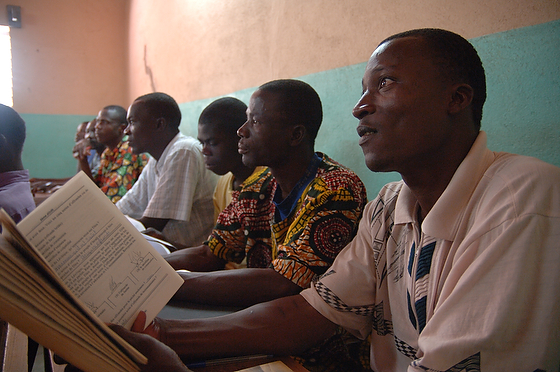
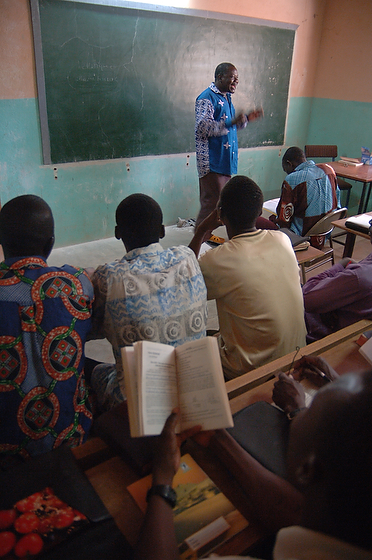
The men in these photos are pastors in Burkina Faso learning how to be effective preachers to lead their congregations.

In 1992 a few of my friends started the Southwestern Photojournalism Seminar in Fort Worth, Texas. To help identify who we were we came up with this sentence:
The Southwestern Photojournalism Conference is the conference for those who believe photojournalism to be a calling and the act of bearing witness to be important.
I believe all photojournalists are responding to a call. Those who agree to the code of ethics of the profession that you can find here are seeking truth and communicating that to their audience.

The hardest part of the code of ethics to me is trying to be sure you are being truthful. This means you must really spend time getting to know the story. You must dig to be sure you are representing the subject accurately and that after seeing your story will feel that you accurately represented them.

While in seminary I was taught how to do an exegesis.
Exegesis includes a wide range of critical disciplines: textual criticism is the investigation into the history and origins of the text, but exegesis may include the study of the historical and cultural backgrounds for the author, the text, and the original audience. Other analysis includes classification of the type of literary genres present in the text, and an analysis of grammatical and syntactical features in the text itself.
Now I went to seminary after working as a photojournalist for more than six years. What I found was that the skill was pretty similar to what a journalist does to be sure they understand a story.

My call story is unique to me, but has a lot of similarities to some of biblical characters like Jacob, Joseph and even Moses.

It is only when you look back through the lives of these biblical characters that you see how God took each thing that often was a struggle that was to help prepare them for their calling.

Moses complained about his voice to God. I was born with Autism. Both of us complained about our struggle to communicate.

What I can tell you is that the camera brought me a great deal of comfort to help navigate this world. I am so thankful that my father who was a Baptist preacher advising me to major in either Social Work or Business in undergraduate and that I would get all of my biblical studies in seminary.

Majoring in Social Work taught me how to listen with my ears and eyes. I learned how to ask questions to get to the bottom of a problem. I also learned about body language and how to read people. This would later help me tremendously with a camera and recognize why certain photos were better at communicating than others.

While my intention of going to seminary to get my masters in communication to return to the church to do photojournalism, it was the required courses in education and theology that I would truly teach me more skills that I use today.

Nikon D2X, Sigma 18-50mm f/2.8 EX, ISO 800, ƒ/2.8, 1/60
Had I not been willing to take a different direction by becoming a photojournalist I might be a pastor today of a congregation. Each week I would prepare a sermon and speak to my congregation. Pastors equip the saints to do the work of the church.

However because I followed the call to use photojournalism as my pulpit the audiences I have reached through different newspapers, magazines, online media and the list goes on is not a few hundred, but literally I am touching the world with the photos I have been privileged by my subjects with their help to capture so that audiences will understand the world in which they live better than they did before they saw these images.

I believe I am equipping the saints through educating them with photos, text/audio and even cinema that helps to deliver stories to them so that they can take actions to make this world even better because they now know more than they knew before.

My favorite thing to do today is to teach others who feel called into this profession of photojournalism/storyteller and equip them to do even more than I was able to do. 

Friday, June 24, 2016

Three Stages of Composition

photo by: Don Rutledge
I learned so much from Don Rutledge, my mentor. He took this photo of an Alaskan family on the tundra welcoming a missionary they called a friend. Don was walking up with the missionary and realized this was the moment.

Why does the photo connect? Learn some of the techniques that Don Rutledge taught me in this video on the three stages of composition.


Sunday, May 29, 2016

Panel Discussion – FOCUS [Fellowship Of Communicators Uniting Socially]


Yesterday I hosted FOCUS [Fellowship Of Communicators Uniting Socially] meeting in Roswell, Georgia.

We had a panel discussion made up of these industry leaders and you can listen to them in the video above. They are discussing the state of the industry and tips they recommend for today's professional communicator.

Dr. Houston Davis serves as the Executive Vice Chancellor and Chief Academic Officer of the University System of Georgia. USG is comprised of Georgia’s 30 public universities and colleges including four research universities, the Institute of Oceanography, State Archives, the Public Library System, and statewide Information Technology Services. USG enrolls approximately 314,000 students and employs approximately 41,000 faculty and staff.

Prior to May 2012, Davis served as the Vice Chancellor for Academic Affairs for the Oklahoma State Regents for Higher Education and served as the state’s liaison on the national Complete College America initiative. Prior to 2007, he served as Associate Vice Chancellor for Academic Affairs for the Tennessee Board of Regents, on faculty and in academic leadership for Austin Peay State University, in fiscal and academic affairs for the Tennessee Higher Education Commission, and as a regional counselor for the University of Memphis. In addition to his past professional duties, he served in the role of Director for the National Educational Needs Index project, a Lumina funded initiative measuring educational, economic, and population pressures in the 50 states that influence policy and planning at local, regional, and national levels.

He is involved in research projects and writing in higher education governance, economic development, and accountability issues and serves on several national advisory groups on higher education policy, degree completion, academic preparation, and accountability. He received his Ph.D. from Vanderbilt University with other degrees from the University of Memphis and Tennessee State University.

In addition to his professional duties, Houston Davis has served as director for the National Educational Needs Index project from 2004-2011, an initiative measuring educational, economic, and population pressures in the 50 states that influence policy and planning at local, regional, and national levels.

Dr. Davis is involved in research projects and writing in the areas of higher education access, governance, economic development, and accountability issues in higher education and serves on several national advisory groups on higher education policy, degree completion, academic preparation, and accountability.

A native of Clarksville, Tennessee, Davis received his Ph.D. from Vanderbilt University, Nashville.

Faith Peppers is the director of public affairs and chief communications officer for the University of Georgia College of Agricultural and Environmental Sciences. She is known across North America for work in agricultural issues management and crisis communication. She manages strategic communications, issues management, brand and executive reputation management, crisis communication and legislative relations for the college, agricultural experiment stations and Cooperative Extension.

She holds an associates degree in journalism from Middle Georgia College and bachelor and master degrees in journalism and communication from Georgia State University. Before joining the University of Georgia in 1993, she spent more than 10 years as an Atlanta newspaper reporter, public information officer and marketing specialist. She has won numerous regional, national and international awards for writing, editing, media relations, marketing and communication training, and is an often-requested speaker on media relations, crisis communication and other public affairs topics across North America.

She has published research and professional development papers on defining agriculture to urban audiences, effective media relations in urban markets, strategic issues management and working and managing in a telecommuter workplace.

Her current work focuses on what promises to be the greatest social justice issue of the next decade – food security around the world.

Michael A. Schwarz is an independent editorial and corporate photographer/videographer based in Atlanta, Georgia. Over a 30-year career Michael has completed more than 6,000 assignments for publications and corporations around the globe. His editorial client list has included USA Today, Fortune, Forbes, Business Week, The New York Times, Newsweek, Time, National Geographic Traveler, The Chronicle of Higher Education and Sports Illustrated. His corporate client list has included The Home Depot, UPS, The Coca-Cola Company, Harvard University, Brown University, GE, Synchrony Financial and Porsche.

Michael has a background as a photojournalist and is a 3-time Pulitzer Prize nominee. He has received numerous awards from the Pictures of the Year competition and was a winner of the Dag Hammarskjold Award for Human Rights Advocacy Journalism. Many, many years ago LIFE Magazine featured Michael as one of the best young photographers in America in a special issue of their magazine. In 1998, Michael collaborated with author Ellen Spears on the book "The Newtown Story: One Community's Fight for Environmental Justice." Michael is a native of Baltimore and a graduate of the Rochester Institute of Technology. Michael has served on the Board of Directors of the Atlanta Photojournalism Seminar and the Atlanta Chapter of ASMP. He maintains membership in the National Press Photographers Association (NPPA), the American Society of Media Photographers (ASMP),and the Atlanta Press Club. In a recent reader’s poll sponsored by the Atlanta Press Club, Michael’s collaboration with writer Steve Sternberg, “When AIDS Comes Home,” was voted the favorite Atlanta story of the last 50 years.

In addition to his photographic work, Michael does digital photography consulting and training. His corporate clients have included: Nikon, and Best Buy. He is a featured trainer with Blue Pixel Inc. and has been a lead instructor of Nikon School since 2001 a workshop leader for the Mentor Series.

Greg Thompson is senior director of corporate communications for Chick-fil-A, Inc., one of America’s largest privately held restaurant chains with 2,000 restaurants and annual sales of almost $7 billion.

Prior to joining Chick-fil-A, Greg spent 25 years in worldwide management and executive positions with IBM in Atlanta, Tucson and Tokyo. In his career at IBM and Chick-fil-A, Greg has edited several magazines and web sites, produced numerous events, product rollouts, videos and multi-media packages and has hired countless photographers, videographers, writers and producers – including a number of Pulitzer Prize winners. He also has worked during that time as a writer, producer, photographer and consultant for a number of well-known organizations.

Greg joined IBM after a career as a photographer and journalist for three newspapers and The Associated Press.

He is a graduate of Vanderbilt University, where he studied history, political science and sociology while also working as a reporter and photographer for the then Gannett-owned Nashville Banner.

Greg also is involved as a volunteer and consultant with several faith-based NGOs around the world. He serves on the boards of HOI, which focuses on Honduras and Nicaragua, and SCORE International, which focuses on the Dominican Republic, Costa Rica, Panama and Cuba. Greg accompanied a SCORE medical relief team into Haiti shortly after the 2010 earthquake and worked with CRASH Japan and Samaritan’s Purse in Tohoku, Japan after the 2011 earthquake and tsunami. He has also done volunteer work in Honduras, the Dominican Republic, Peru, Guatemala, Nicaragua, Mexico, Cuba, Jamaica and Cambodia.

Greg and his wife, Mary Belle, have been married 32 years and live in Marietta, Georgia.

Monday, January 18, 2016

The terrorist attack in Ouagadougou had me remembering my time there


This weekend there was a horrible attack where 32 people lost their lives in Ouagadougou, Burkina Faso. Above is a quick slide show I did back in 2005 of my visit to Burkina Faso & Ghana.

Here some of the news reports:

Story image for burkina faso from Newsweek
Newsweek

Burkina Faso Capital Security Tightens After Jihadi Attack

New York Times-3 hours ago
OUAGADOUGOU, Burkina Faso — In the wake of a weekend attack that killed up to 32 people, security was beefed up across Burkina Faso's ...
US condemns attacks in Burkina Faso
Opinion-Jerusalem Post Israel News-22 hours ago


I thought I would take this blog just to give you some of what I learned while in Burkina Faso.

I was there just ten years ago. I don't think I know any of those killed directly, but I do know many of those I worked with that month in 2005 were most likely affected by this terrorist attack.


One of the oldest Mosques in Burkina Faso which is located in the downtown of Bobo-Dioulasso. Believed to have been built in the early 1880's. Religions in Burkina Faso are Muslim 61.6%, Catholic 23.2%, traditional/animist 7.3%, Protestant 6.7%, other/no answer 0.2%, none 0.9% (2010 est.)


Coffee is almost exclusively instant coffee (Nescafe is the usual brand). One of the region’s finest institutions (found mainly in French-speaking countries) are the coffee stalls where clients sit on small benches around a table and drink glasses of Nescafe mixed with sweetened condensed milk.


Burkina Faso is a poor, landlocked country that depends on adequate rainfall. About 80% of the population is engaged in subsistence farming and cotton is the main cash crop. The country has few natural resources and a weak industrial base. Cotton and gold are Burkina Faso’s key exports and Burkina Faso’s economic growth and revenue depends on global prices for the two commodities.


In 2014 Burkina Faso was ranked 124th in the world economy, right behind Chad and just above Equatorial Guinea.


Ethnic Groups are Mossi 52.5%, Fulani 8.4%, Gurma 6.8%, Bobo 4.8%, Gurunsi 4.5%, Senufo 4.4%, Bissa 3.9%, Lobi 2.5%, Dagara 2.4%, Tuareg/Bella 1.9%, Dioula 0.8%, unspecified/no answer 0.1%, other 7% (2010 est.)


Most of the shepherds herding cattle are Fulani as this young boy is above.


Here I am about a mile or so from the Ivory Coast border and those swimming here are Senara tribe.