Showing posts with label journalism. Show all posts

Sunday, May 29, 2016

Panel Discussion – FOCUS [Fellowship Of Communicators Uniting Socially]


Yesterday I hosted FOCUS [Fellowship Of Communicators Uniting Socially] meeting in Roswell, Georgia.

We had a panel discussion made up of these industry leaders and you can listen to them in the video above. They are discussing the state of the industry and tips they recommend for today's professional communicator.

Dr. Houston Davis serves as the Executive Vice Chancellor and Chief Academic Officer of the University System of Georgia. USG is comprised of Georgia’s 30 public universities and colleges including four research universities, the Institute of Oceanography, State Archives, the Public Library System, and statewide Information Technology Services. USG enrolls approximately 314,000 students and employs approximately 41,000 faculty and staff.

Prior to May 2012, Davis served as the Vice Chancellor for Academic Affairs for the Oklahoma State Regents for Higher Education and served as the state’s liaison on the national Complete College America initiative. Prior to 2007, he served as Associate Vice Chancellor for Academic Affairs for the Tennessee Board of Regents, on faculty and in academic leadership for Austin Peay State University, in fiscal and academic affairs for the Tennessee Higher Education Commission, and as a regional counselor for the University of Memphis. In addition to his past professional duties, he served in the role of Director for the National Educational Needs Index project, a Lumina funded initiative measuring educational, economic, and population pressures in the 50 states that influence policy and planning at local, regional, and national levels.

He is involved in research projects and writing in higher education governance, economic development, and accountability issues and serves on several national advisory groups on higher education policy, degree completion, academic preparation, and accountability. He received his Ph.D. from Vanderbilt University with other degrees from the University of Memphis and Tennessee State University.

In addition to his professional duties, Houston Davis has served as director for the National Educational Needs Index project from 2004-2011, an initiative measuring educational, economic, and population pressures in the 50 states that influence policy and planning at local, regional, and national levels.

Dr. Davis is involved in research projects and writing in the areas of higher education access, governance, economic development, and accountability issues in higher education and serves on several national advisory groups on higher education policy, degree completion, academic preparation, and accountability.

A native of Clarksville, Tennessee, Davis received his Ph.D. from Vanderbilt University, Nashville.

Faith Peppers is the director of public affairs and chief communications officer for the University of Georgia College of Agricultural and Environmental Sciences. She is known across North America for work in agricultural issues management and crisis communication. She manages strategic communications, issues management, brand and executive reputation management, crisis communication and legislative relations for the college, agricultural experiment stations and Cooperative Extension.

She holds an associates degree in journalism from Middle Georgia College and bachelor and master degrees in journalism and communication from Georgia State University. Before joining the University of Georgia in 1993, she spent more than 10 years as an Atlanta newspaper reporter, public information officer and marketing specialist. She has won numerous regional, national and international awards for writing, editing, media relations, marketing and communication training, and is an often-requested speaker on media relations, crisis communication and other public affairs topics across North America.

She has published research and professional development papers on defining agriculture to urban audiences, effective media relations in urban markets, strategic issues management and working and managing in a telecommuter workplace.

Her current work focuses on what promises to be the greatest social justice issue of the next decade – food security around the world.

Michael A. Schwarz is an independent editorial and corporate photographer/videographer based in Atlanta, Georgia. Over a 30-year career Michael has completed more than 6,000 assignments for publications and corporations around the globe. His editorial client list has included USA Today, Fortune, Forbes, Business Week, The New York Times, Newsweek, Time, National Geographic Traveler, The Chronicle of Higher Education and Sports Illustrated. His corporate client list has included The Home Depot, UPS, The Coca-Cola Company, Harvard University, Brown University, GE, Synchrony Financial and Porsche.

Michael has a background as a photojournalist and is a 3-time Pulitzer Prize nominee. He has received numerous awards from the Pictures of the Year competition and was a winner of the Dag Hammarskjold Award for Human Rights Advocacy Journalism. Many, many years ago LIFE Magazine featured Michael as one of the best young photographers in America in a special issue of their magazine. In 1998, Michael collaborated with author Ellen Spears on the book "The Newtown Story: One Community's Fight for Environmental Justice." Michael is a native of Baltimore and a graduate of the Rochester Institute of Technology. Michael has served on the Board of Directors of the Atlanta Photojournalism Seminar and the Atlanta Chapter of ASMP. He maintains membership in the National Press Photographers Association (NPPA), the American Society of Media Photographers (ASMP),and the Atlanta Press Club. In a recent reader’s poll sponsored by the Atlanta Press Club, Michael’s collaboration with writer Steve Sternberg, “When AIDS Comes Home,” was voted the favorite Atlanta story of the last 50 years.

In addition to his photographic work, Michael does digital photography consulting and training. His corporate clients have included: Nikon, and Best Buy. He is a featured trainer with Blue Pixel Inc. and has been a lead instructor of Nikon School since 2001 a workshop leader for the Mentor Series.

Greg Thompson is senior director of corporate communications for Chick-fil-A, Inc., one of America’s largest privately held restaurant chains with 2,000 restaurants and annual sales of almost $7 billion.

Prior to joining Chick-fil-A, Greg spent 25 years in worldwide management and executive positions with IBM in Atlanta, Tucson and Tokyo. In his career at IBM and Chick-fil-A, Greg has edited several magazines and web sites, produced numerous events, product rollouts, videos and multi-media packages and has hired countless photographers, videographers, writers and producers – including a number of Pulitzer Prize winners. He also has worked during that time as a writer, producer, photographer and consultant for a number of well-known organizations.

Greg joined IBM after a career as a photographer and journalist for three newspapers and The Associated Press.

He is a graduate of Vanderbilt University, where he studied history, political science and sociology while also working as a reporter and photographer for the then Gannett-owned Nashville Banner.

Greg also is involved as a volunteer and consultant with several faith-based NGOs around the world. He serves on the boards of HOI, which focuses on Honduras and Nicaragua, and SCORE International, which focuses on the Dominican Republic, Costa Rica, Panama and Cuba. Greg accompanied a SCORE medical relief team into Haiti shortly after the 2010 earthquake and worked with CRASH Japan and Samaritan’s Purse in Tohoku, Japan after the 2011 earthquake and tsunami. He has also done volunteer work in Honduras, the Dominican Republic, Peru, Guatemala, Nicaragua, Mexico, Cuba, Jamaica and Cambodia.

Greg and his wife, Mary Belle, have been married 32 years and live in Marietta, Georgia.

Thursday, September 17, 2015

Community Journalism with Fujifilm X-E2

Fujifilm X-E2, FUJINON XF 18-55mm, ISO 6400, ƒ/3.6, 1/50

Community Journalism


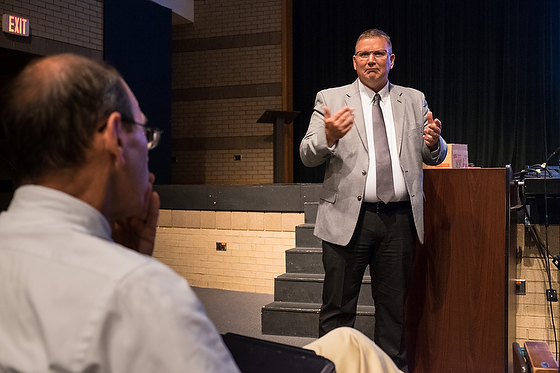
Last night at my daughter's high school the county had an informational meeting about the planning for schools in our county. I took my Fuji X-E2 camera with me just in case I wanted to use it.

There were less than ten people in attendance. No real reason to have a meeting you would think, but this is how a lot of meetings happen every day in our communities that have major long term impact on our communities.

Fujifilm X-E2, FUJINON XF 18-55mm, ISO 6400, ƒ/3.2, 1/30
Those who show up and speak up are the ones they hear from and they must assume this is the will of the community because they asked them for their feedback and this is what they get.

Those in attendance at the Fulton County Schools Educational Space Standards Community Meeting were able to hear how the county has hired outside experts in educational space to help the county set those educational standards that then the designers and architects will use to help in implementing changes to improve our schools.

They will now have the WHY part of the process answered if anyone asks why they were making these changes. Also when the changes recommended come up against budget restraints everyone will know what they are falling short of doing.

Fujifilm X-E2, FUJINON XF 18-55mm, ISO 6400, ƒ/4, 1/18
So imagine you go to one of these meetings in your community. Do you think a photo with some explanation would be a great way to communicate with your friends through social media?

Fujifilm X-E2, FUJINON XF 18-55mm, ISO 6400, ƒ/4, 1/18

Suggestion


Next community event you go to be sure and take some good photos and add some text as a caption. This can help us build stronger communities.

Sunday, October 27, 2013

Storytellers purpose is to be the glue of the community

Alive After 5 is the Third Thursday each month April – October from 5-9pm on Canton Street in downtown Roswell, GA. 
I love living in Roswell, GA. While we are in one of the largest metro communities in the United States, Roswell has the small town feel. We have events like the Alive After 5 during the summer months where the community comes together to just experience each other, music, arts and food.

This is Seth Gamba, orchestra teacher at Elkins Pointe Middle school, playing the drums with the orchestra. The group plays on electric string instruments and even plays some rock tunes during the Alive After 5 event. My daughter plays in the group on the viola. Proud dad as you can see.
The community loves to do positive things together. Today people are seeking out experiences. Walt Disney understood this when he built Disney Land and Disney World.

This is my wife with the Paranoia Haunted House crew that was at Alive After 5 to promote their business.
My wife loves to post photos like this to her Facebook account and from the number of likes and comments I know the rest of her friends love this as well.

Role of the Journalist

According to Webster Dictionary "journalism is the activity or job of collecting, writing, and editing news stories." Wikipedia goes on to say that journalism "serves the purpose of playing the role of a public service machinery in the dissemination and analysis of news and information."

The role of media in the broader sense is helping communities connect to one another. I see journalists as helping people plug into their community network and the connection is being made through the media.

When you look at all the content that a local media outlet should cover of their community the pie has many slices. One of the slices that journalism serves in a democracy is to inform the community to better play a role in their government.

Wikipedia says, "In a democratic society, however, access to free information plays a central role in creating a system of checks and balance, and in distributing power equally between governments, businesses, individuals, and other social entities. Access to verifiable information gathered by independent media sources, which adhere to journalistic standards, can also be of service to ordinary citizens, by empowering them with the tools they need in order to participate in the political process."

I fear too many journalists are only serving a slice of the pie to their audience. They want more than just the things in their community that are going wrong.  If you were to graph out the story coverage of many media outlets I think you would find that there is a lopsided coverage on the squeaky wheel.

Could you take a media coverage of their community and would it reflect the same percentages of categories of stories taking place daily, or would it be slanted.

What about work communities?

Most communication offices within corporations are serving like the media for their community. I find my role within a nonprofit was very similar to my role at the newspaper. My role working for a large corporation is also very similar.

The breaking news story in the nonprofit and business world are the stories that management needs told. While we do not have investigative journalists looking into management and reporting this to the community, we do have companies realizing that transparency is the best way to build affinity with customers. You are finding more PR professionals communicating where their company has made a mistake and how they are taking actions to correct it.

Audience
|
Medium
|
Storyteller
|
Subject

The common theme for communications professionals is serving as the conduit between the Subject and the Audience.  The most powerful way to make this connection is the story. We use some medium to deliver that story to the audience.

Mistakes Storytellers Make

All you need to do is look at those four words above: 1) Audience; 2) Medium; 3) Storyteller and 4) Subject. If anyone of these is diminished in importance then the connections are not made. The result of this over time is a community that lacks cohesiveness.

I believe way too many professional communicators are wrapped up in either the medium or the subject.  They buy the latest gear and try cool shots and forget the story. Sometimes they get so attached emotionally to the subject that they loose their objectivity to know the story.

I believe the audience more often than the medium or subject the most overlooked part of the puzzle.

I believe Steve Jobs is one of the best business people who understood the audience. When he rolled out new products they were not what people wanted or even needed. No one talked about a computer with a graphical interface before he helped to introduce the Mac. No one new what a tablet device was before he introduced the iPad.

What Steve Jobs did know was how to help improve the lives of his audience. He saw how they lived and how he could improve their lives.  Great storytellers need to know their audience just as well.  This way when we tell them stories of subjects in their community they will line up just like people do when Apple releases a new product. They know that it will be a great story, because yesterday they gave me a great experience.

Secret about your audience

When you immerse yourself into the community that you are covering this is when you find your subjects for the story.

Even businesses like Starbucks and Chick-fi-A train their employees to learn about their customers and to connect with them. Watch this video done by Chick-fil-A.


I encourage storytellers to discover their communities. Find where they congregate and then find those who want and need to communicate to those groups. Then become an expert on the subjects that they cover for those audiences.

Deb Pang Davis, Assistant Professor, Syracuse University
In Deb Pang Davis' comments to the National Press Photographers Association Business Blitz at the Grady School of Journalism she was encouraging photographers to be involved in social media. This is one of the best ways to be a part of a community. People get to know you and you get to know them and share content.

Marketing is connecting you to your audience.