Showing posts with label sigma 1.4 converter. Show all posts

Wednesday, December 03, 2014

Following UGA Head Coach Mark Richt for a game assignment

Click here for online version
Decision Magazine hired me to follow UGA head coach Mark Richt. I was asked to also get photos of his wife Katharyn Richt.

If it worked out I was to try and get photos of them together. That never happened, but I stuck with the coach and his wife the day.

Nikon D4,  Sigma 120-300mm f/2.8 DG OS HSM, Sigma 2x EX DG APO Autofocus Teleconverter, ISO 1250, ƒ/5.6, 1/2000
I arrived really early and met Katharyn early sitting in the stands.

Nikon D4, 28-300mm, ISO 900, ƒ/5, 1/2000
While this will win no awards it is starting with the safe shots to be sure I had some good expressions.

Nikon D4, 14-24mm, ISO 400, ƒ/16, 1/500–Nikon SB900 fill flash -1EV
I liked this photo much better even tho I cannot see her face as well she is doing what she does every game to help support the team and Mark.


The magazine picked that photo and one more of Mark interacting with one of the players.

Nikon D4,  Sigma 120-300mm f/2.8 DG OS HSM, Sigma 2x EX DG APO Autofocus Teleconverter, ISO 1600, ƒ/5.6, 1/2000
Now at this point in the season the top running back in the country is UGA #3 Todd Gurley. I really tried to get a photo of him with the coach. The best I did that day was this shot, but the ƒ/5.6 was too shallow to show Mark clearly in the photo in the background.

Nikon D4,  Sigma 120-300mm f/2.8 DG OS HSM, Sigma 2x EX DG APO Autofocus Teleconverter, ISO 450, ƒ/5.6, 1/2000
Mark Richt is on the far right with headset. Well I just missed it. Just a few days later the suspension by the NCAA came out so he was definitely out of the magazine piece. It would have pulled the attention away from the storyline.

Here are the selects that I gave the editor.

Friday, August 08, 2014

Photography Tips for Covering Football

Nikon D2X, Sigma 120-300mm ƒ/2.8, ISO 400, ƒ/2.8, 1/1250
Action Shots

For this blog I am just focusing on what happens on the field and not the reactions to it by fans and the sidelines.

Three things I think you should strive to have in all your action shots on the field:
  1. The Ball
  2. Expression
  3. The competition
While not every great sports photo will have all three, the overwhelming majority of them will have all three elements.
Definition of Sport—an activity involving physical exertion and skill in which an individual or team competes against another or others for entertainment.
Nikon D4, Sigma 120-300mm ƒ/2.8, ISO 12800, ƒ/5.6, 1/1000
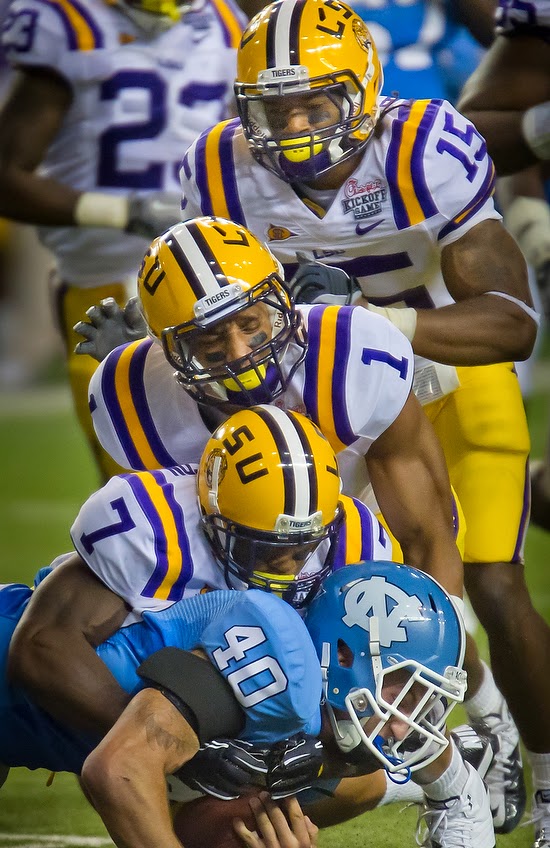
I like capturing the expressions of football players. This shows the "physical exertion" being put forth to play the game. The key for me is to put myself in the place where I will see their faces more often.

Nikon D4, Sigma 120-300mm ƒ/2.8, ISO 12800, ƒ/5.6, 1/1000
I recommend when possible to cover one team. this way you can show their team's faces on offense and defense without running up and down the field over and over to get in front of them.

I generally try to shoot way down the field in front of the teams and prefer standing in the endzones. If they are far away I just use longer glass like  600mm lens and when they are on the goal line I may switch to my 70-200mm lens.

Why the endzone? Well they are generally running in that direction and trying to cross the goal line. When you are on the sideline they may run slightly in your direction, but they could be running to the other sideline as well.

Nikon D4, Sigma 120-300mm ƒ/2.8, ISO 12800, ƒ/5.6, 1/1250
While my knees get sore from kneeling most of the time I think you get better "athletic" moments. When you are low you make the football players look like they are much higher off the ground when they jump than when you stand. We like our star running backs to look like Roman Gods that fly when necessary. Remember the purpose of the sport is entertainment. Them flying because I am down low is a lot more exciting than from above where they look like they are closer to the ground.

Nikon D3S, Sigma 120-300mm ƒ/2.8 with 1.4 converter, ISO 6400, ƒ/4, 1/2000
Some of the best defense shots of the game are behind the line of scrimmage. This is where the quarterback is sacked or the running back is caught in the backfield for a loss. You see the defense moves the ball forward for their team when they create a loss for the offense of the other team.

You can always rent long glass lenses rather than buying them. I recommend having between 300mm to 500mm lens coverage. This can be done with 1.4 & 2X converters.


Here is the list of gear I use in Football
  • (2) Nikon D4 Cameras
  • 14-24mm ƒ/2.8 Nikkor
  • 28-300mm ƒ/3.5-5.6 Nikkor
  • Sigma 70-200mm ƒ/2.8
  • 120-300mm ƒ/2.8 DG OS HSM | S carried in the Thinktank Glass Taxi™ [not in photo]
  • Sigma 1.4 converter
  • Nikon SB-900
  • Manfrotto 294 Aluminum 4 Section Monopod
  • Manfrotto by Bogen Imaging 323 RC2 System Quick Release Adapter w/200PL-14
  • ExpoDisc
  • Shure FP15/83 Lavalier Wireless System
  • RØDE VideoMic Pro
  • Zacuto Z-Finder
  • AWP Knee Pads - Important to save your knees
  • ThinkTank System for lenses using belt and harness
  • ThinkTank Memory Card Holder
  • ThinkTank Airport Security™ V 2.0 Rolling Camera Bag
  • ThinkTank Credential Holder Tall V2.0

Nikon D3S, Sigma 120-300mm ƒ/2.8 with 1.4 converter, ISO 6400, ƒ/4, 1/2000
One last advantage of shooting from the end zones—BACKGROUNDS. Your background is easier to keep clean and improve impact.

Have fun shooting this fall.

Monday, July 21, 2014

Photographers need repetition to grow

Fuji X-E2, 55-200mm, ISO 6400, ƒ/7.1, 1/125, EV -1.7
My bird feeders are teaching me a great deal these days. The feeder doesn't change day to day but the light and the birds do.

This past weekend I observed we had a lot of fledglings. Fledge is the stage in a young bird's life when the feathers and wing muscles are sufficiently developed for flight. It also describes the act of a chick's parents raising it to a fully grown state.

Fuji X-E2, 55-200mm, ISO 6400, ƒ/4.8, 1/420, EV -1.3
Here I watched the House Finch feeding the Fledgling. It was just fun watching this take place and so I decided I would pull out the cameras and photograph them. The combining of one interest with another really enhances the experience.

When I started the photos were horribly over exposing. I was shooting in aperture mode. I had Auto ISO chosen with a minimum shutter speed setting of 1/500.  I compensated the exposure by turning the EV to -1.7 and would fine tune it here and there based on the histogram.

The Fujinon XF 55-200mm was pretty slow with a ƒ/3.5-4.8 aperture. I was getting pretty good results, but we had rain coming down most of the weekend and I thought this was a great time to test the new Sigma 120-300mm ƒ/2.8.

Nikon D4, Sigma 120-300mm f/2.8 DG OS HSM Lens, ISO 4000, ƒ/6.3, 1/320 EV 0
With the Red Bellied Woodpecker I was not having to use the exposure value compensation and got wonderful detail in the feathers.

Nikon D4, Sigma 120-300mm f/2.8 DG OS HSM Lens + Sigma 1.4 converter, ISO 4500, ƒ/6.3, 1/500 EV -1.3
However when the darker Downy Woodpecker visited the feeder I had to compensate the EV -1.3.

I was having fun and the thing is while I was having fun I was also learning how to check the exposure from bird to bird because that will affect the exposure. I could have tried the manual exposure, but the light was changing as the sun would peek through a little and then disappear.

I also enjoyed shooting with the faster ƒ/2.8. I was able to add the Sigma 1.4 converter when I photographed the Downy Woodpecker and get just a little closer to 420mm.

I was also learning about the birds. I downloaded the Peterson's guide to my iPad and enjoyed finding out the names of the birds. At first I thought I had a Hairy Woodpecker, but that is a bigger bird with a longer bill.

Taking photographs allowed me to have the time to zoom in and really examine the bird in detail. Too often they come and go on the bird feeder too quickly for me to study.

Now you know why so many birders are also photographers.

Do you have something you can photograph this regularly and see how your camera reacts in different light and also help you grow? If not I really recommend you look. I found mine in my backyard.


Wednesday, March 12, 2014

Comparing "Bokeh" on Nikon, Sigma and Fuji lenses


Which camera and lens took this first photo?  Here are the choices

  1. Nikon D4, Nikon 85mm f/1.4 AF-D [Lens $969]
  2. Nikon D4, Sigma 70-200mm f/2.8 EX DG APO OS HSM [Lens $1249]
  3. Nikon D4, Sigma 120-300 mm f/2.8 DG EX APO IF HSM [Lens $2500]
  4. Nikon D4, Sigma 120-300 mm f/2.8 DG EX APO IF HSM, with Sigma 1.4 converter [converter $249]
  5. Nikon D4, AF-S NIKKOR 28-300mm f/3.5-5.6G ED VR [Lens $897]
  6. Fujifilm X-E2, FUJINON XF 55-200mm f/3.5-4.8 R LM OIS [Lens $699]
  7. Fujifilm X-E2, FUJINON XF 18-55mm f/2.8-4 OIS Zoom [Lens $694]
It might surprise you. For this exercise I shot each lens wide open and at the longest focal length and the closest distance that the lens would focus. Now there is a slight focus issue due to my skills of placing the tripod and subject, but you can see for yourself and pick the photo that matches the above photo.

Nikon D4, Nikon 85mm f/1.4 AF-D

Nikon D4, AF-S NIKKOR 28-300mm f/3.5-5.6G ED VR

Nikon D4, Sigma 120-300 mm f/2.8 DG EX APO IF HSM

Nikon D4, Sigma 120-300 mm f/2.8 DG EX APO IF HSM, with Sigma 1.4 converter

Nikon D4, Sigma 70-200mm f/2.8 EX DG APO OS HSM

Fujifilm X-E2, FUJINON XF 18-55mm f/2.8-4 OIS Zoom Lens

Fujifilm X-E2, FUJINON XF 55-200mm f/3.5-4.8 R LM OIS Lens
If you had a hard time figuring out the top photo it is the Fujifilm X-E2 with the FUJINON XF 55-200mm f/3.5-4.8 R LM OIS Lens.

When I photograph people for portraits I love the Nikkor 85mm f/1.4 AF-D.  While I can get closer with many other lenses as you can see above, any closer with the 85mm you are too close.

I hope this exercise also points out that using a longer lens can give great "BOKEH" if you back up a little and zoom in all the way.

The one lens that really wasn't all that great was the FUJINON XF 18-55mm f/2.8-4 OIS Zoom because zoomed all the way in at 55mm the ƒ/4 is just too much depth of field.  I think if I had the Fujinon XF 55mm ƒ/1.2 then I would see something similar to the 85mm ƒ/1.4.

The lesson I hope is that you might try some longer lenses for portraits to get some smooth silky "Bokeh".