Showing posts with label visual storyteller. Show all posts

Monday, September 19, 2016

Mr. Robot appeals to the cerebral audience–Especially visually

Fujifilm X-E2, Fuji XF 18-55mm, ISO 400, ƒ/2.8, 1/125
Rami Malek picked up the Emmy Award for Outstanding Lead Actor for his role in "Mr. Robot.” Malek had the perfect Elliot line to deliver: "Please tell me you're seeing this too."

"I play a young man who is, like so many of us, profoundly alienated," Malek said, which lives with social anxiety disorder and clinical depression in the show. "And the unfortunate thing is I'm not sure how many of us would want to hang out with a guy like Elliot.

"But I want to honor the Elliots, cause there's a little bit of Elliot in all of us." Tod Campbell, the director of photography for Mr. Robot, helps make the show visually cerebral. This helps to connect the show to the nerds. For a writer's concept to truly connect with cinema a director of photography helps to bring out the writer's moods and tone through the visual. The cinema-photography is writing with light to compliment the words to bring the audience along on the storylines.

Fujifilm X-E2, Fuji XF 18-55mm, ISO 500, ƒ/3.2, 1/60

Campbell's use of the negative space helps to make the audience's eyes wonder through the scene. Also by not using a lot of movement within a shot the audience does have time to ponder the surroundings of the actors.

Fujifilm X-E2, Fuji XF 18-55mm, ISO 800, ƒ/3.6, 1/60

Most movies today have more than 50% of the scenes being closeup shots. This technique makes you wonder what is outside the frame to engage the audience.

Fujifilm X-E2, Fuji XF 18-55mm, ISO 400, ƒ/2.8, 1/60
Notice here when you go close how you wonder what is beyond the frame.

Fujifilm X-E2, Fuji XF 18-55mm, ISO 400, ƒ/2.8, 1/60
Now going much wider you see what is going on, but your eye wonders much more. In this process you start to write you own visual narrative even more. For me this is a much more cerebral exercise for the audience and if you pause long enough on your visuals the audience will start to take it in. Here is the trailer for Mr. Robot.


I think to appeal to the nerds and deep thinkers you have to give them the content that allows their brains to engage and process the content. Mr. Robot does this not just with the storyline, but the visuals help truly engage the audience in a way that is rarely done within cinema today.

Maybe the biggest reason Mr. Robot is such a big hit is because it is being unconventional. By being different the show's creators appear to be revolutionary. For me it is a style I grew up on in magazine photojournalism.

Mr. Robot to me proves that the audience is not just ready for much deeper storylines, but craving them. They are tired of the quick sound bite and the simplistic closeup visuals. People are ready to think and enjoy having their brains do some exercise to keep up with the storyline.

Thursday, April 17, 2014

Is your life as a photographer a good story? Here is how to make it better.


To be the subject of a story that is compelling requires the subject to be called to a task that is outside their comfort zone. It is necessary for the subject's survival and to the benefit of others.

Donald Miller is a best-selling American author and public speaker based in Portland, Oregon. He writes a great deal about storyline on his blog here http://storylineblog.com/.  Miller says that a story is a sense-making device. A good story brings about clarity whereas our normal lives seem disjointed.

Miller uses the parallel of music and how it parallels story. Sounds are just noise until they are put into a form. That form transforms the noise into music. A storyline is no different to Miller. The author has put together a series of events so as to be told through a set form.

This is the basic formula that not only Miller uses to tell many stories but movies like the Hunger Games and Star Wars used.


The very first thing that takes place for a character in a story is a conflict must happen or you will lose the audience.


When you are just enjoying your life and you are doing everything to keep some normalcy into your life this is a sure sign of a boring story.


Here in this sports photo of a quarterback being pursued by what looks like most of the defense and no one between them you have all the makings of the story, minus the ending. The character has a problem of getting tackled. He has trained up to now in practices and with a coaching staff to prepare for this moment. All this is implied with the school team uniform. The task is simple move the ball forward to keep the ball for your team or make a touchdown. The outcome is either a comedy or tragedy.


This is John Howard Griffin transformed as a black man while he was doing the research for his book Black Like Me. Sitting beside Griffin is the photographer Don Rutledge who followed him documenting his trials as a black man in the south. This was done in 1959 at the height of the Civil Rights Movement.

John Howard Griffin walking down street in New Orleans.
The two of them traveling together through the deep south for the book was extremely dangerous. Paul Guihard was a French journalist covering the Civil Rights Movement in the United States in the 1960s. He was murdered in rioting at the campus of the University of Mississippi in Oxford after James Meredith attempted to enroll at the all-white school. He was shot in the back at almost point-blank range by an unknown assailant near the Lyceum building. Guihard's case was closed without success and never re-investigated. In his last dispatch made the very same day, he had written "The Civil War has never ended."

Just taking on this project was a story in itself. Not only was Griffin a character in the story, Don Rutledge was also being transformed through the coverage.

I remember Don trying out new camera systems that would stretch him to learn the new system and in doing so it stretched his photography. He was always putting himself in new situations to capture new stories. By the end of his career he had traveled into more than 150+ countries of the world.

Clarity

Some of the best stories are not the ones that are the big hit on New York Times best books or the blockbusters in Hollywood. The best stories are the ones that are most clearly told.

You see our lives are like run on sentences. What we do throughout our days are often not a great sequence for a story. It is quite disjointed.

A great story starts by establishing the hero of the story and the problem they face going forward.

The best way for you to grow is to get out of your comfort zone.

I am not qualified

Too often you will turn down great opportunities because you feel ill equipped. Hey that is the problem facing Luke Skywalker. He will go off and meet Yoda to train and have him help him with a game plan.
I bought this Dodge Viper model for $12 and then spent time lighting an all black car to make it interesting. This was my way of challenging myself for a day in the studio.
Find a problem

Step One—The first thing to grow as a photographer is to find a problem. maybe it is a story that is difficult or maybe it is getting a photo of something from an angle no one has done before. Whatever it is you need to have a problem you need to tackle.

Step Two—Find a guide to help you. This means you either find resources through reading, videos or maybe find someone who can teach you. Most likely the guide you look to will be someone who has been there and done that.

Step Three—Make an action plan on how you will go forward to deal with your problem.

Step Four—Take action. Don't procrastinate. Go and get your feet wet.

Step Five—Evaluate yourself. Was this a comedy or tragedy? It is a good story either way and you will learn something from it that will equip you to go forward. 

Thursday, April 03, 2014

Storytelling is about capturing moments

Nikon D2X, 24-70mm ƒ/2.8, ISO 800, ƒ/2.8, 1/40
Storytelling is about moments

You may think that sitting around a room where people are just talking things move at a much slower pace than say a baseball game.

You would be wrong. I think the action moves just as fast as in any sporting event.

Nikon D2X, 120-300mm ƒ/2.8, ISO 400, ƒ/8, 1/1500
Sports photographers are not pushing their shutter on motor drive and then picking a great moment in sports any more than they do with people sitting around in a room. The motor drive is to take the photos after the moment the photographer is capturing. This is because you don't know if the ball will pop out of the catcher's mitt and the player sliding home then is safe.

Nikon D2X, 70-200mm ƒ/2.8, ISO 400, ƒ/5, 1/160
The ever so slight head tilt or body posture can communicate so much. It doesn't have to be a big gesture like the one of the man with the hand gestures. It can be ever so subtle as the lady in the photo above.

Nikon D2Xs, 18-25mm ƒ/2.8, ISO 400, ƒ/6.3, 1/100
Can you see the moment?

One thing that can kill a great moment is not being able to see it.


As you can see in these two photos of the young girl the off-camera flash really adds life to the face giving more dynamic range and therefore more color and life into the photo. Capturing the moment is more than just squeezing the shutter at the right moment.


Can you see how much more "POP" this photo has with the off camera flash?


Photographers are doing all they can when they are telling a story. They must get the best light to help communicate the story on the subject and the best moment as well.


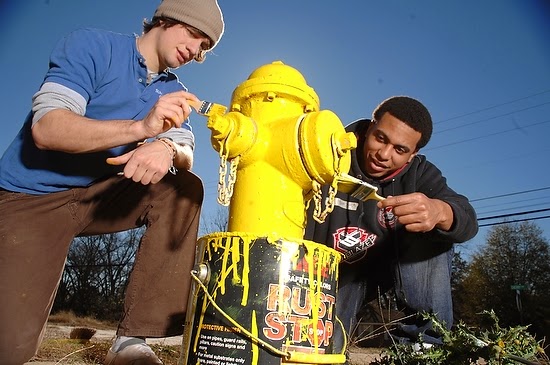
Sometimes I am crawling on the ground to get into a position so you can see the subjects faces and then since sometime the best location the subject has the sun right behind their heads as in the photo of the guys painting the fire hydrant [fire plug for those out west] I again use an off-camera flash to fill the subjects faces with light so they are not just silhouettes.


Other times I am getting as high as I can to look down on the subject to capture the expanse surroundings and their faces.


I rarely and having people pose and hold it for me as in this photo of the two ladies. This was just a moment and I shot it. It worked really well and I like the moment, but had I said hold it just a second, OK now 1 ..., 2 ..., 3 ... this would have killed the expressions. So even when people pose for you if they hold their expression it isn't as good as just before they hit their peak smile. I love to shoot just before they reach it.

This way they are smiling and not just posing.

Monday, December 30, 2013

Best moments of 2013 for me

Tourists enjoying Hawaii Volcanoes National Park. [Nikon D4, 28-300mm, ISO 160, ƒ/5.6, 1/1000]
What a year it has been. I have really had a great year of moments and feel extremely blessed.

Lili'uokalani Park, Hilo, Hawaii. [Nikon D4, 28-300mm, ISO 250, ƒ/7.1, 1/60]
Each year starts with me in the Georgia Dome covering the Chick-fil-A Bowl. This year will be no different. Dorie, my wife, will be celebrating her 20th year working the press box.

Tom Butler, Kona Coffee Grower [Nikon D4, 28-300mm, ISO 2000, ƒ/10, 1/200]
I am returning to Kona, Hawaii to teach lighting and business practices to Youth With A Mission Photography School 1.  I love meeting these students every year that are from all over the world. I learn from them if not more than I probably teach to them.

Anacleto Rapping on the far left and Joanna Pinneo on the far right review a student's portfolio at the Southwestern Photojournalism Conference. [Nikon Coolpix P7000, ISO 1600, ƒ2.8, 1/30]
This year I am also working with the Southwestern Photojournalism Conference in Fort Worth, TX. This takes place the first weekend in March.  

Bill Bangham, Eugene Richards and Stanley Leary at the SWPJC. [Nikon Coolpix P7000, ISO 1600, ƒ2.8, 1/60]

Dave Black looks at a person's portfolio at the SWPJC.  [Nikon Coolpix P7000, ISO 1600, ƒ2.8, 1/50]
During Spring break we took our daughter Chelle to Los Angeles for her first visit. We visited all of her uncle's friends.

Pam Goldsmith is a world renowned violist who was Richard Zvonar's partner for more than 20 years. This is our daughter's uncle. Pam took some time out to help Chelle who has also taken up the viola. [Nikon D4, 14-24mm, ISO 1600, ƒ/9, 1/60]

Chelle visits with Richard Bugg who works with Meyer Sound. Their sound system is what was used in the Beijing Olympics and other major productions throughout the world. Richard Bug is another one of Richard Zvonar business associates. Together they built this sound design system.  [Nikon Coolpix P7000, ISO 400, ƒ2.8, 1/6]

Dorie and Chelle in front of the Chick-fil-A in Hollywood, CA. We stopped here for lunch while seeing the sights of Hollywood one day. [Nikon D4, 28-300mm, ISO 100, ƒ/3.5, 1/800]

Dorie, Stanley and Chelle Paradise Cove in Malibu, California. [Nikon D4, 28-300mm, ISO 100, ƒ/8, 1/200]

Another friend of Richard Zvonar is Ronan Chris Murphy who has a recording studio in Santa Monica where we visited him. [Nikon D4, 14-24mm, ISO 12800, ƒ/6.3, 1/25]

Chelle and Dorie in front of the Hollywood sign. [Nikon D4, 28-300mm, ISO 280, ƒ/29, 1/60]
Now you really don't have to go to Hollywood to meet the stars. Many live near us in Roswell, GA. 

Chelle met Pip, is an American singer who participated in season 2 of The Voice as part of Team Adam Levine while she was a model in show with Pure Fashion.  [Nikon D4, 28-300mm, ISO 1600, ƒ/5.6, 1/125]
I get to live out much of my life through my kids. Her school had Mark Wood come and do a workshop with the orchestra. Wood was one of the violinists and an original member of the symphonic rock group Trans-Siberian Orchestra, which he left in 2009. He has also played with Celine Dion, Billy Joel, Steve Vai, Westworld, and Lenny Kravitz. As a solo performer he has released seven CDs featuring his own versions of popular rock songs. On these CDs he is accompanied by "The Mark Wood Band" consisting of one member of the Trans-Siberian Orchestra, several other musicians, as well as his wife Laura Kaye.  

Chelle got to even sing with him on stage.

Mark Wood leading the workshop. [Nikon D4, 28-300mm, ISO 10000, ƒ/5.6, 1/100]

Chelle is performing on her Viola with Mark Wood. [Nikon D4, 120-300mm ƒ/2.8 Sigma, ISO 12800, ƒ/4, 1/320]

Chelle is singing with Mark Wood. [Nikon D4, 120-300mm ƒ/2.8 Sigma, ISO 12800, ƒ/4, 1/320]
As you can see photography is helping me remember and share my moments with you and the world. 

1st Lt. Nelson Lalli came home this past summer after serving our country in Afghanistan for 9 months. We were so thankful he returned home. [Nikon D4, 14-24mm, ISO 10000, ƒ/8, 1/60]
While there are many other moments that were special I will close out this past year with my coverage in Mexico. I was so thrilled to cover a coffee cooperative that is turning not just the farmer's lives around, but their communities as well.

David Cifuentes Velazquez, coffee grower and member of the Just Coffee Cooperative, enjoys sharing with a visiting group how coffee is grown. The joy on his face and family captured how their family has been restored to the community because of the coffee cooperative. [Nikon D4, 14-24mm, ISO 12800, ƒ/5, 1/80]
Remember everyone has a story and I would love to help tell your story as well. Give me a call if you need any help.

Be sure and check out my latest package I had translated into English from my coverage of coffee cooperative in Mexico below.


Monday, December 16, 2013

Taking photos mindlessly will result in an image that is worthless


Dr Linda Henkel, conducted a study at Fairfield University in Connecticut where they led a group of students around a museum and asked them to either photograph or try to remember certain works of art and historical exhibits.  She said: "People so often whip out their cameras almost mindlessly."

What many writers are taking away from this is "photographs STOPS our brains remembering what happened." Just Google "photography doesn't help you remember" and you will see the articles all quoting research.

I think the research got it right and even Dr. Henkel clarified her comments, but what do writers want you to hear? I think they are tired of hearing "a photograph is worth 1,000 words."

Photos that are worth the category of a 1,000 word story are not where the photographer just pulls out their camera and snaps a quick photo.  I think if we look at how Norman Rockwell used photography to come up with a great illustrations. Rockwell would have many different photos for him to pull from to create his masterpiece.


When a photo is going to not just help you remember, but tell a story to those who were not there with the photographers then the perspective the photographer chooses and the moment can help capture a story.

Too many people just pull out their phones today and because it is with them they are even more careless than when they had to think to remember to bring a camera. Since it is with them all the time and they are not having to buy film and pay for each shot--they cheapen the moment by mindlessly just clicking the photo.

“Research has suggested that the sheer volume and lack of organization of digital photos for personal memories discourages many people from accessing and reminiscing about them,” said Dr. Henkel.


Photographs that tell stories require the photographer to think before pressing the shutter release. What should they be thinking about to have photos that will later tell the story?
  1. Why am I taking this photo?
  2. What is the story?
  3. What do I want those who see the photo to do after they see it?
  4. How do I feel about this story?
  5. What can I do to help convey my emotions about the story in the photograph?
  6. What must be "Within The Frame" of the photograph?
  7. What will be left out of the frame of the photograph?
  8. Where do I want everyone to look first?
  9. How can I compose this photo so that the secondary is secondary, but still relevant.
In the photo above of the gift of a viola to a young man you can see the lady, who is his mother, looking on and conveying pleasure. The son is thrilled not just for himself, but for his mother.

The story is that this single mother works several jobs to put food on the table and roof over her family. They do not really have the money for her son to be playing a viola, but the viola may just be his ticket to college and a career.

I wanted to capture this moment of telling the story of why this gift was such a big deal. I don't think you will think I just pulled out my phone and took this photo. You can tell it is more than a memory jogger. Because I thought about it not only will I remember the moment--my photo will help others who were not there to know the story.

Sunday, December 08, 2013

Are you filling holes in an organization or using holes to fill the organization?

Pastor Emanuel Yameogo is in front of the church he pastors in Koudougou, Burkina Faso, Africa.

Many photographers are enjoying giving of their time to travel the world for a NGO in exchange for access to subjects. You can get hooked on doing this for the wrong reasons. Getting one more country stamped on your passport can feel good to even those who are doing it for all the right reasons, but be sure this is not the motivation for you to see the world.

I just had someone post this on a forum that I contribute to and enjoy.  I posted this as a response and believe too many photographers with big hearts and giving to organizations are often doing more harm than good in the big picture for those organizations.

San Antonio Catholic Church in Tikul, Yucatan, Mexico
"NGO/NPO's have a budget for marketing. Do not let them tell you they have no budget."

Sadly this is not true in all cases. While there are many reasons they have no or inadequate budget for marketing there is one that many of us contribute.

Altruism is one of the biggest problems with these organizations. Many media professionals out of wanting to help actually have hurt many of these organizations over time.

A giving photographer isn't able to give to their charity $20,000, but chooses to give of their time of what would amount to a $20,000 gift. This is how many organizations are able to do more with less.

Let's say that for the next 20 years this photographer gives annually a week of their time doing projects from multimedia, still photography and maybe some writing to help with marketing materials for this organization.

Jacob Tarnagda [left] and Jay Shafto walk through the Jacob's courtyard. Jacob is a leader in the church in Soumagou, Burkina Faso, West Africa.
Sadly the photographer dies one year for whatever reason. Slowly this organization is loosing traction. Their marketing is not as good as it was. They cannot find a veteran photographer like the one they had before. Now they rely on college students and amateurs who give of their time.

Sometimes they just stop doing any photography. That was something someone gave to them but not something they needed in the minds of the NGO.

While the photographer was alive and giving the organization flourished, but once he/she was gone they started to wither. 

Street scene in Tikul, Yucatan, Mexico.
Please don't be that photographer.

Be altruistic and give of your time just like the photographer did all those years. However, this is how you can be different and help the organization.

Take the time to have conversations with the leadership. Sit them down and get them to understand the real costs and encourage them to start creating a marketing budget. Get them to put it into the budget that they vote on each year.

Your gifting of time can cover the costs while you are able, but by this being on the visible budget you will be helping the organization slowly create a budget. 

I would help them over time realistically put together a budget just like each of us who are independent have to do for our budgets. Maybe get them to slowly hire a few independent media specialists to help your projects be better. 

Night street scene in  Tikul, Yucatan, Mexico.
Once more thing besides creating a physical budget for the organization, help them to know how to use entry level communications people. Help them to understand the importance of strategic creatives and how they can mentor the newbies. 

Maybe you help them by training students and having them work with you on these projects for internship credit. Be sure if you do this, that you are communicating the importance of the seasoned pro. Let them know how this is saving them money in the long run. Show how new fresh perspectives of the students can also help them grow. Just be sure they understand the importance of strategic communications rather than just photos and videos being created to have something "visual."

This is the hanger used for the ministry story point in the bush village of Sabtenga, Burkina Faso, West Africa.
You need to help the organizations understand the difference between filling holes and using holes to fill the organization.