Showing posts with label Event photography. Show all posts

Tuesday, June 25, 2013

Flash or not to flash

Nikon D4, 70-200mm,  ISO 10000, ƒ/2.8, 1/800 with Nikon SB900 on camera flash fired at slow sync
While at first glance this photo is quite acceptable the main light is now my flash and not the stage lighting.

Nikon D4, 70-200mm, ISO 2500, ƒ/2.8, 1/100
The second shot is available light and shot only 1 minute prior to the flash shot. This is around 9 pm and on one of the longest days of the year, so there is still some sunlight as the sun sets.

There is not as much "Stage Light" as there will be after the sun sets.

Nikon D4, 70-200mm, ISO 2200, ƒ/2.8, 1/320 with fill flash from SB900.
Here I went to the other side of the stage and shot a similar comparison of the flash and no flash.

Nikon D4, 70-200mm ISO 12,800, ƒ/2.8, 1/400
The one reason I was using the flash to begin with is the singer Marc Broussard's hat is casting a nasty shadow and most of the time his eyes are hard to see.  You can see the shadow in the second available light shot.

While the flash fixed this issue as long as it was on my camera it just ruined the mood of the stage lighting.

Nikon D4, 70-200mm, ISO 12800, ƒ/2.8,  1/100
While I now decided to shoot the rest of the performance with available light I now had another problem the light on the lead singer's face only looked good occasionally   Most all the time the light looked like this when he sang.  You see a bright spot on his chin and his eyes are in a shadow.

Nikon D4, 70-200mm, ISO 12800, ƒ/2.8,  1/80
Now to get the best photos of the lead singer Marc Broussard I had to pick the best moments where the light and the emotion came together. I think I have this here when Marc looked up into the light and also the emotion in his face worked really well.

Now you know why so often a spot light is used to follow the main character on a stage with stage lighting. You also can see why many theaters have foot lights. These are lights on the floor of the stage at the front aimed up at the actors to get rid of the shadows under hats and those with deep set eyes.

When there is still not enough light at ISO 12800

I have been in the darkest places like Swayze's Venue in Marietta.  Here the punk band moved around so much that I needed flash.

Nikon D4, 14-24mm, ISO 4000, ƒ/5.6, 1/60
Here is an earlier post in case you want to see when I do use flash and how I used it off camera: http://blog.stanleyleary.com/2012/08/nikon-d4-iso-12800-still-not-enough.html.

Monday, June 24, 2013

High ISO is King for Night Events

Nikon D4, 14-24mm,  ISO 12,800, ƒ/2.8 & 1/125
Available Light

I try my best to always look at the light that is present and go with it before I use a flash.

When Nikon introduced the Nikon D3 the ISO on that camera went to 6400 with no trouble. Then Nikon bumped it up again with the Nikon D3S to ISO 12,800.

My newest Nikon D4 ISO goes to 12,800 comfortably and if you really need it you can bump it all the way to Hi-4 (ISO 204,800).  The Nikon D4 has other improvements as well with focusing and especially in video.

Nikon D4, 14-24mm,  ISO 12,800, ƒ/2.8 & 1/125
In the photo here of singer Marc Brousard singing at the People's Fest at Atlantic Station the lighting for the stage was very minimal as compared to other music events. For most other major music events at Chastain Park Amphitheater or Verizon Wireless Amphitheater you could easily shoot people on the stage with ISO 400 or 800.

This is important because for the bigger venues you can actually own a much cheaper camera than you need to capture the event when the light is low.

This is true in sports as well. When you are photographing an NFL game at night the light on the field is much better than when you are shooting in a small town at their high school Friday night football game.

Nikon D4, 70-200mm,  ISO 12,800, ƒ/2.8 & 1/100
Do you need to go and buy a Nikon D4 for $6,000 without a lens to take photos?  If you want the very best ISO 12,800, but Nikon even makes point and shoot cameras that will go to ISO 12,800.

If you want to shoot events like the People's Fest at Atlantic Station as I did this past Saturday night then you need a high ISO camera.  Minimum of ISO 6400 in my opinion will just barely work before you need to add a flash.

Nikon D4, 70-200mm,  ISO 12,800, ƒ/2.8 & 1/125
For the photo of the couple I am hand holding a 70-200mm lens at 1/25 and vibration reduction technology is helping, but if they move they would not be in focus.  The light from the stage and surrounding shops is helping light them, but barely.  ISO 6400 would have me shooting at 1/10 of second.  I doubt seriously that I would have gotten this shot without the ISO 12,800.

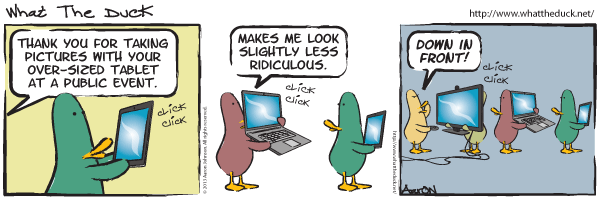
http://www.whattheduck.net
With the recent dismissal of the entire photo department at the Chicago Sun-Times we can see the times are changing. But there is no way an iPhone given to a reporter will capture the photos I was getting. Also, just to own the Nikon D4 will not get the same results.

You have to know how the camera works and how to make it work for you to get the best photos.

To remain competitive you need to have the best gear to capture the type of photos of the subjects you want to get paid to shoot. If you don't have the best possible the guy that is able to show a better image because of their gear will get the job.

Remember, it is the photographer with the best images of the subjects that will get the job and not the most expensive gear.

All this is to say, your images decide if you get hired not the gear, but your gear can hold you back to get good images. If you have great gear and not good images then you still want get the jobs.


Friday, February 22, 2013

Center stage isn't always the best photograph

Heartbridge performs at the Ohana Gathering on Thursday night in Kona, Hawaii.
When you are assigned to cover an event be careful not to focus all your attention on the center stage.

Loren Cunningham is the keynote speaker for the Ohana Gathering.
You have to get the center stage of course, but just look around and maybe even go outside and you might be surprised as to what you find.

Here I found that if I color balanced for the tungsten lighting on the stage the sky went even to a darker blue at dusk.


Monday, February 11, 2013

Tip for covering events


This is a tip I learned today from my fellow photographer friend Nathan Fowler.

If you are covering a meeting then take photo of the schedule as the very first photo on the camera. This way you can easy reference it.


Your camera will by default show you the last photo you made and there for to start at the beginning is just a click to next photo which takes you back to your first. This way you can pull up the schedule and review it easily. 

Why do this? How often are in in a dark room in the back covering a meeting and cannot see the schedule. On the LCD on the camera it is lit up easy to see. You can zoom in and read the details.

I will be doing this for now on, how about you?

Tuesday, November 20, 2012

Covering a typical community meeting tips


Rabbi Greene of Temple Beth Tikvah speaks to the HomeStretch volunteers at their appreciation dinner. (Nikon D4, 70-200mm,  ISO 12,800, ƒ/2.8 and 1/160, Custom White Balance with ExpoDisc)
One of the staples of many professional photographers is covering meetings. Very seldom do these photos end up in your portfolio. Unless you are covering a meeting where they hired a lighting crew you have to work just to get acceptable photos.

This event was in the meeting room of the local synagogue.  They had wonderful stage lighting, but like many groups they choose not to put their speaker on the platform where the stage lighting would have helped. No they put the speaker on the floor where the lighting was the worst in the entire room.

Lucky for me in the first photo that the podium was draped with an off white cloth. It helped to kick light back into the face of the speaker.  I prefer not to use a flash because it can be distracting to everyone. So I did use it sometimes, but tried to use it sparingly as more of a backup.


I wanted to show you this overall photo of the meeting I covered. Now notice how the white tables are kicking light back up into the faces of those people seated. You can see their eyes.  Now look at those people standing around.  The canned lights above are creating raccoon eyes for them.

From this photo I can tell I can easily shoot the people around the tables, but I may need some fill flash on those with the raccoon eyes.

As a photojournalist I was trained to see those things to be sure the photos were useable.

(Nikon D4, 28-300mm,  ISO 12,800, ƒ/5.6 and 1/50, Custom White Balance with ExpoDisc)
I decided I didn't need the flash for the ladies at the table.  I just cranked the ISO up and shot it.

Here I put a CTO (Color Temperature Orange) filter over my Nikon SB-900 flash. It comes with the flash. I still shot at ISO 12,800 ƒ/5.6 and 1/100 so that the background wouldn't go dark and look natural. I also did a custom white balance using the ExpoDisc.
I wanted to be sure I was getting good skin tones, so I would get a few shots of speakers and people in the room using a fill flash.

In all of these photos I was what I call running and gunning. As a photojournalist I don't stop people and ask them to do it again. Now when I shoot for a company where we need certain things to look a certain way it is OK to make changes--it isn't photojournalism it is advertising or corporate communications.

It is due to all my training as a photojournalist that companies need me. They need a photographer that can deliver in any situation with photos that communicate.

The professional photographer needs to get the best possible photo and sometimes that means without taking away from the atmosphere of what you are covering. They need the fly on the wall and not the Hollywood film crew making the meeting a set for their movie or TV show. Sure the photos would look 100% better doing just that, but the reason they are having the meeting isn't primarily for the photos.

Can you get photos like these of your meetings?  Maybe this is why you should hire a pro sometimes.

Friday, October 26, 2012

Key to good photos: Point your camera in a different direction


You go to an event and if you are like everyone in the photo above you are all pointing your cameras in the same direction and at the same time.

By all means still get the "obvious shot." What I want to encourage you to do is look beyond the main stage of an event.


Before this middle school orchestra concert all the students arrive early to get their instruments tuned.  Here I went to the area they were tuning and got really close.


Seth Gamba is the music teacher and the last time I saw someone tuning something like he is doing was early in my career. I watched the NASCAR pit crew use a screwdriver touching the block of a running engine to tune it by adjusting the timing.

Doesn't this photo make you want to know what he is doing.  This is quite different than the obvious conducting shot.

Warming Up

While the students are getting their instruments tuned and warmed up, I roamed around and got in close for some photos that you have to look really close to see if this is the performance or practice.


All the photos above are taken before the performance. Occasionally you can see in the background things that wouldn't be going on in the performance.  But look at how many look like a performance shot.

The hardest part during the performance is getting a good photo due to the angles you are limited to. Hey before hand I am walking all through the orchestra and taking photos.  Can't do that during the performance.

During the Performance


One of the things that I notice in the performance shots is the musicians are looking for the conductor as compared to before he wasn't around.


What will the 8x10 look like?

I get a kick out of seeing the iPad being used as a camera. I keep seeing and and thinking they are already seeing the finished 8x10 print.

But how did it sound?


Dorie Griggs, my wife, operated the video camera from the bleachers while I was down front shooting. If you have read this far you might as well enjoy hearing them play. By the way my daughter does the first "scream" in the performance.

Color correction

I used the ExpoDisc to get a custom white balance for the best skin tones.  Here is another blog post on how I use it. 

Thursday, September 06, 2012

Dissecting Party Event Photo Coverage

Let me start with the client's email to me the morning after the event. Yes I deliver quickly.
The pictures are great.  I really love the clarity; especially those that are up close.  Please send me an invoice so I can submit payment.

thanks again!!

When I cover a party I have a shot list in my head. As I work through the list I notice that I become more and more relaxed as I tick things off the list.

I have learned over time to cover an event in phases that allows me to be sure I have the "safe" shots and then slowly I can add the photos that add to the package.

Nikon D4, 28-300mm, ISO 2800, ƒ/4, 1/100
Phase One

Arrive early and start taking photos of the location. Most likely the hosts have spent a little money on the food and the caterer has done their best within the budget to show their best.

Nikon D4, 28-300mm, ISO 5600, ƒ/4.8, 1/100

Nikon D4, 28-300mm, ISO 5600, ƒ/5, 1/100

Nikon D4, 28-300mm, ISO 4500, ƒ/5.3, 1/100

Nikon D4, 28-300mm, ISO 6400, ƒ/5, 1/100
By arriving early you can have more space to work as well. No one is really there and this gives you the ability to backup, move close, and change your angle to get what you like for representing the food.

All the food shots I did with available light. I am not trying to do the cover of Southern Living Cookbook so I am not shooting the photos at the lowest ISO and lighting the food to make it look it's very best. My purpose is to show the food as it looked for the event.

I try to use available light as much as feasible. All the food shots were done with available light.

Phase Two

I work the room trying to get photos of the people interacting. During this time I might use some flash to fill in the shadows. I want to be sure the photos are solid and not me pushing the limits of the situation, which might not work.

Nikon D4, 28-300mm, ISO 3200, ƒ/5.6, 1/80 and Nikon SB-900 bouncing on the ceiling with no diffusion dome.

Nikon D4, 28-300mm, ISO 3200, ƒ/5.6, 1/80 and Nikon SB-900 bouncing on the ceiling with no diffusion dome.
As you can see this is where I might have the guest pose for a photo. I am encouraging them to get closer to one another. Now if they do not want to get too close I just capture them with a little space or when they want to show a true friendship you might see them holding on to each other.

I try and shoot these just a little loose for two reasons. First if you shoot too tight and they want an 8x10 print then they may not have enough excess to crop the photo from long side. The same can be true for a 5x7 except this is where they don't have enough from the short side to crop. Keeping it loose allows for different dimension prints.

Second, I like to show the environment. I think this is one of the largest mistakes made by amateurs. They come in so close the pictures no longer have any context. Whose party are they attending anyway?

Why Flash?

Nikon D4, 28-300mm, ISO 900, ƒ/5.6, 1/100 and no flash

Nikon D4, 28-300mm, ISO 500, ƒ/5.6, 1/80 and Nikon SB-900 bouncing on the ceiling with no diffusion dome. They are outside on a porch with an overhang that has a white ceiling.
During the second phase I am occasionally shooting available and then quickly adding a flash. The reason is the flash will help fill in the shadows. With darker skins their is a tendency to loose the face details if you are not careful. Notice the difference in the skin tones of the face of this lady and you will see how the lower photograph is technically nicer. I prefer the expression of the first photo and wish I had the flash on for that photo and then it would be perfect for my taste.

As one who is always advocating getting the flash off the camera, unless the budget would have allowed for a photo assistant to walk around with my flash the guests would most likely bump into a light stand and maybe get hurt and/or damage my gear. So I stayed with on camera flash for this event. However, I did bounce it and never shot with it directly pointed at the subjects.

Nikon D4, 28-300mm, ISO 12800, ƒ/5.6, 1/60 and no flash

Nikon D4, 28-300mm, ISO 4000, ƒ/3.5, 1/500 and Nikon SB-900 bouncing on the ceiling with no diffusion dome.

Nikon D4, 28-300mm, ISO 400, ƒ/4.8, 1/80 and Nikon SB-900 bouncing on the ceiling with no diffusion dome.

Nikon D4, 28-300mm, ISO 2500, ƒ/4, 1/250 and Nikon SB-900 bouncing on the ceiling with no diffusion dome.

Nikon D4, 28-300mm, ISO 800, ƒ/5.6, 1/125 and Nikon SB-900 bouncing on the ceiling with no diffusion dome.

Nikon D4, 28-300mm, ISO 1000, ƒ/5.6, 1/100 and no flash.

Nikon D4, 28-300mm, ISO 2500, ƒ/5.6, 1/100 and no flash.

Nikon D4, 28-300mm, ISO 3600, ƒ/5.6, 1/100 and no flash.

Nikon D4, 28-300mm, ISO 2000, ƒ/5.6, 1/200 and no flash

Nikon D4, 28-300mm, ISO 2000, ƒ/5.6, 1/125 and no flash

Nikon D4, 28-300mm, ISO 3200, ƒ/5.6, 1/100 and no flash
 Notice in these two photos I have switched to an ultra wide-angle lens the Nikon 14-24mm ƒ/2.8.  I love shooting with these lens to help give context and put the viewer as if they are standing right their on the porch and part of the conversation.

Nikon D4, 14-24mm, ISO 1000, ƒ/5.6, 1/200 and no flash
Notice in this photo below I went just a little wider than the photo above.  The one above is shot at 24mm and the one below at 19mm.  I love seeing the three women in the back in three different conversations. You can just tell everyone is enjoying themselves and having moments of their own.

Nikon D4, 14-24mm, ISO 2000, ƒ/5.6, 1/200 and no flash
Using the 28-300mm lens I can zoom in as I have done below with the photo of the guy listening to another person. This was zoomed to 300mm and let me look across the room just like you would if you are there to catch glimpses of others enjoy conversations.

Nikon D4, 28-300mm, ISO 2000, ƒ/5.6, 1/250 and no flash
You need some overall shots to capture how many people came to an event. This is everyone gathering for a few comments at the cocktail party. I shot it with the Nikon 14-24mm @ 14mm to capture as much of the room as possible.  I am holding the camera as high as I can above my head and angling it down to show the room almost like a security camera would do in the corner of a room.

Nikon D4, 14-24mm, ISO 2200, ƒ/5.6, 1/100 and Nikon SB-900 bounced with no diffuser.

Nikon D4, 14-24mm, ISO 2500, ƒ/5.6, 1/200 and Nikon SB-900 bounced without the diffuser

Nikon D4, 28-300mm, ISO 2000, ƒ/5.6, 1/125 and no flash
Phase Three

Usually there is a point that I have photographed most everyone in the room a few times. I have the event covered if I were to stop working. This is where I am now freed up to start looking around for more interesting photos.

Now in Phase Two I did some of these photos, but this is where now I just look for moments and may push the limits of the situation.  A good example is shooting with the Nikon 28-300mm zoomed to 300mm shooting available light. Even at ISO 12800 inside you might be hand holding at really slow shutter speeds.

I did this and had to toss a lot of the photos because of camera movement or the subject moved. It would be common for the subject to start laughing and toss their head back in the process and I get a blur and nothing is sharp.  This is why I often wait to do these shots in Phase Three, but I might mix a few in Phase Two.

Nikon D4, 14-24mm, ISO 11400, ƒ/5.6, 1/100 and no flash

Nikon D4, 14-24mm, ISO 10000, ƒ/5.6, 1/100 and no flash
Nikon D4, 28-300mm, ISO 2000, ƒ/5.6, 1/160 and Nikon SB-900 bounced with no diffusion
Since I have pretty much everything the client needs, when the chef asked for a photo for himself it was easier to meet this request towards the end. I could have done this in Phase One, but he was very busy then.

Nikon D4, 28-300mm, ISO 5000, ƒ/5.6, 1/100 and no flash

Nikon D4, 14-24mm, ISO 4500, ƒ/5.6, 1/100 and no flash
With the photo of the man in the center and the people around the table I moved a little back and forth until I used him to block the light behind him. This is the president of Georgia Tech talking to the new tenured professors.

Nikon D4, 14-24mm, ISO 11400, ƒ/5.6, 1/100 and no flash
In this photo below you can see the dining room from above. Hopefully this gives you the reason why you arrive early to take photos of the food. Where do you stand to get those photos now?

Nikon D4,14-24mm, ISO 10000, ƒ/5.6, 1/100 and no flash
In the following two photos notice the slow shutter speeds and high ISO settings.  The top photo was shot at 250mm and the lower one at 210mm.  Either of these would normally be shot at a minimum of 1/250 shutter speeds to be sure there is no camera movement. In the lower photo I am shooting at 1/40 shutter speed. While I can do everything as perfect to capture this moment all it takes is for the lady to move slightly and it is a blur. This is why I shoot this type of photo without a flash and ISO 12800 in Phase Three. I am taking larger risks. If I did this in Phase Two the number of photos I would be giving the customer would shrink drastically.

Nikon D4, 28-300mm, ISO 8000, ƒ/5.6, 1/100 and no flash

Nikon D4, 28-300mm, ISO 12800, ƒ/5.6, 1/40 and no flash
The Seasoned Pro

It takes years to really know how to shoot in this way. Besides dividing up types of photos I am also pushing the limits of the flash and available light.

Notice I am shooting inside at really high ISOs and using flash. Why would I do that?  Read this early blog post of mine to answer that question here.

Shooting the way I did for this event is very complex, but the results I think speak for themselves. I think I captured real moments with very little intrusion. This is why clients hire me, not because they just need a photographer. They need a photographer who will come in and not come to them complaining about not enough light and basically creating problems.

Before my client even saw these photos they were excited to invite me back. They liked how I work was their comment to me as I left. If it is that evident they see a difference in how I work as compared to other photographers and they haven't even seen the results, then I know it is my years of experience showing in how I carry myself.