Showing posts with label history. Show all posts

Friday, April 15, 2016

Are you preserving your stories and the stories of your family?

Nikon D5, Sigma 120-300mm ƒ/2.8 DG OS HSM | S, Sigma TC-2001 2x, ISO 9000, ƒ/5.6, 1/400
Last night I enjoyed watching my daughter playing the witch in the musical Into the Woods at her high school.

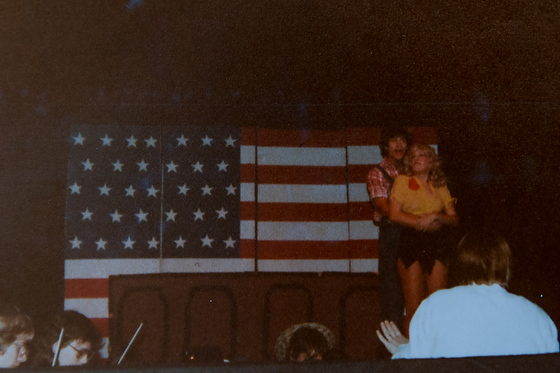
It made me think of thirty-four years earlier my high school musical Lil' Abner. 


This is one of two photos I have of me from that performance. I gave my camera to a friend and asked them to take some photos. They took maybe three photos total. When shooting film people were careful because each time you pushed the button it was like spending a dollar.

This is just a copy of the print from that show that I could find.

Nikon D5, Sigma 120-300mm ƒ/2.8 DG OS HSM | S, Sigma TC-2001 2x, ISO 5000, ƒ/5.6, 1/125
The main characters in the musical Into the Woods are taken from Little Red Riding Hood, Jack and the Beanstalk, Rapunzel, and Cinderella, as well as several others. The musical is tied together by an original story involving a childless baker and his wife and their quest to begin a family, their interaction with a witch who has placed a curse on them, and their interaction with other storybook characters during their journey.

It makes you think about the next generation. As I am watching this I am realizing I am now watching the next generation as actors on the stage as my friends and I did years ago. Some of my friends went on to Broadway from that cast and there maybe some from the cast today that will become Broadway stars.

Nikon D5, Sigma 24-105mm f/4 DG OS HSM Art Lens, ISO 7200, ƒ/4, 1/80
My daughter has all of our family flying in from all over the country to see her as the Witch. I hope that in thirty-four years that all these photos and videos I have been making of my daughter will help her tell her story to her children.

What I hope to do with my photos of our family is to help preserve the story of our family so that in the generations to come will be able to look back and see the legacy from which they come from.

Nikon D5, Sigma 120-300mm ƒ/2.8 DG OS HSM | S, Sigma TC-1401 2x, ISO 7200, ƒ/4, 1/400
What are you doing to help preserve your families story? Are you capturing some of the moments that can be shared in the future?


Thank goodness that today's cameras let us capture situations that when I was in high school were so difficult to capture on film.

Nikon D5, Sigma 120-300mm ƒ/2.8 DG OS HSM | S, Sigma TC-1401 2x, ISO 7200, ƒ/4, 1/400
Tips

  • Take the photos of live performances and events of your family
  • Share the photos now through social media
  • Store images – have the images in at least three places. With today's Cloud solutions I recommend putting the photos here as one way to preserve them.
  • Create hard copies
    • Prints
    • Photo Books
  • Include Text!!!!! Take the time to write down things like who is in the picture and what is going on. Think of writing a caption like you would see in a newspaper or magazine. Attach it to the photo. [metadata]
  • Have a plan on how you will pass down to future generations your photos for them to have and cherish.

Tuesday, December 01, 2009

Learning from the Masters

Imitation is the most sincere form of flattery…

Last week someone said to me, “I love the Rembrandt lighting you used in the portrait of our CEO.” A day or so after that a photographer friend of mine mentioned that she could see Eugene Smith’s influence in my photography.

Well, I don’t mind telling you I felt really good. Those familiar with the work of Eugene Smith know how flattered I felt.

As my interest in photography developed (pardon the pun) I became fascinated with the work of great photographers. I studied their work until I felt I knew why they were considered Greats.

Several years into the profession I was privileged to work with Don Rutledge; an extraordinary photographer. Don had an encyclopedic knowledge of photographers both legendary and contemporary. 


 “Writers,” Don would say, “can talk at length about famous writers, but most photographers don’t know anything about the greats in our field. How can they expect to learn if they don’t study”?

An interest in learning from the masters can turn a trip to an art museum or a stroll through local art galleries into an exhilarating adventure.

What kind lighting did the painter use: Was it midday sun, window light or was it a single candle creating the mood?

Why did the artist choose this moment, that expression, those surroundings? This is a fascinating study and it all comes back to you as you are composing a photo a few days or even years later.

Just studying what was done alone doesn’t help much. It is necessary to learn how to replicate what you’ve learned. This knowledge along with your own way of “seeing” will one day result in your own style.


The best advice I ever received about developing a style of my own was, “Don’t worry about it.” That’s easy for some well-established pro to say to a fledging photographer.

However, he was right. Sure enough, someday someone will say how much they like your style. Don’t say, “Oh wow! I didn’t even know I had a style.” Be cool.

The style we see in other’s work is usually apparent in the way they handle (1) Lighting, (2) Composition and (3) the Moment.

Lighting creates mood. The warm light of an evening campfire sets the mood. What do we include in the photo we are about to make? What do we exclude? Is the girl facing the fire lost in thought when we shoot or is she looking into the shadows the texture of her skin catching the light? Do we wait to see her eyes or capture that tilt of her head that seems to say so much?

I cut my teeth in photography using the available light. It was a good five years before I started experimenting with studio lights. This was a good because I learned to see what is natural and then I learned to duplicate it with artificial lights.


Making a photograph that grabs the attention of the viewer is a good thing, but learning how to hold that attention can take time. Something that holds attention is called “the decisive moment.”

It’s easy to know the decisive moment in sports photography. A basket is made or the pass is caught. Knowing the decisive moment and capturing it with the camera is not exactly the same thing, but the capturing part can be learned.

At first glance a committee sitting around a conference table brings to mind all the excitement and action of a chess match. However, there is action there to capture just as in a sports event albeit more like golf than rugby. Still, there are pivotal moments that tell the story of what is transpiring in the meeting.

Some of the photographers I’ve studied and continue to study are: James Nachtwey, William Albert Allard, Sebastião Salgado, Dave Black, Eugene Smith, Carolyn Cole, Joanna Pinneo and Don Rutledge.

Google these names and check them out yourself. If you know of others whose work you appreciate please send me an email and let me know who they are. I am always looking to improve and grow.