Showing posts with label Sigma 120-300mm ƒ/2.8 DG OS HSM | S. Show all posts

Wednesday, March 22, 2017

Storytelling Photo vs Point Photo

Fujifilm X-E2, Fuji XF 55-200mm, ISO 6400, ƒ/4.5, 1/100
"When I take you out in the surrey with the fringe on top!", sings Curly in the musical Oklahoma!

This photo above is the only time on the stage during the entire production of the musical at Roswell High School where the surrey is on stage. This is the one scene that captures the build up of the whole show to where we see what Curly was singing from the beginning of the show promising Laurey how he would treat her on a date.

Nikon D5, Sigma 120-300mm ƒ/2.8 DG OS HSM | S, Sigma TC-2001 2x, ISO 5000, ƒ/5.6, 1/250
This is Ado Annie Cames singing, but because I am isolating her alone only the corn in the background helps to place this with the musical Oklahoma!.

This is what I call a point shot verses the top photo which has much more information and is getting closer to helping to tell more of the story. You still need words with either photo to make it storytelling, but hopefully you are seeing the difference between the scene establishing shot and the closeup.

Fujifilm X-E2, Fuji XF 55-200mm, ISO 1250, ƒ/5, 1/100
Now the reason this photo of Curly and Laurey often works as well as the shot of the surrey is that this particular pose is used often in posters to promote the show. Just Google "Oklahoma! Musical" and look at all the photos and you will see this style shot pop up.

Nikon D5, 28-300mm ƒ/3.5-5.6G ED VR, ISO 500, ƒ/4.5, 1/8000
Here is how I shot a promo shot verses the photo above it is from the show. Now while this doesn't tell the story say as well as having the surrey in the photo, Curly is gesturing about how the future he promises to Laurey is better than where she is now.


Fujifilm X-E2, Fuji XF 55-200mm, ISO 6400, ƒ/4, 1/180
Google "Oklahoma Barn Scene" and you can see variations of other productions that show similar scene. Again this is more of a point photo, but because I included more of the set most theatre folks will know this is the Musical Oklahoma!.

Nikon D5, Nikon 85mm ƒ/1.8G, ISO 100, ƒ/1.8, 1/200
People Need The Lord Photo

"I don't need a lot of 'People Need The Lord' photos," commented Jeff Raymond to a photographer shooting photos with him in the Dominican Republic. "What do you mean?," commented the photographer.

Jeff went on to explain the photo style like the Afghan girl on the front of National Geographic by Steve McCurry. This photo has had such an impact that many people think this is the "BEST" way to shoot.

Give me more context is what Jeff coached the photographer to do in addition to a few portraits.

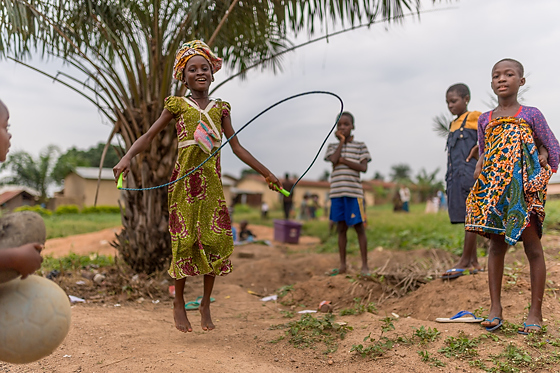
You see the photo of the boy here could have been shot anywhere in the world.


This is a frame from short movie clip. Notice how the kids in the foreground are close enough to give you a portrait, but including the background gives you more context. Here is the movie and you can see what conditions I was shooting.

Kids playing in Togo, West Africa from Stanley Leary on Vimeo.

Please understand this blog post is not saying Storytelling Photo is better than a Point Photo. What I am saying is you need both.

Nikon D5, Sigma 35mm ƒ/1.4 DG Art, ISO 100, ƒ/1.4, 1/2000
The problem I see with many new photographers is falling in love with the closeup shot at ƒ/1.4 and centered. Then they have only slight variations of this photo in their portfolio.

If you are going to be hired over and over you must be the photographer who gives the client more than they expected. This is why learning how to use a variety of lenses, different apertures and shutter speeds on an assignment will have clients raving about you.

Sure you can do OK shooting the "People Need The Lord" photo, but you are a one trick pony show.

Monday, March 20, 2017

What high school theatre can teach us about Volunteers

Fujifilm X-E2, Fuji XF 55-200mm, ISO 6400, ƒ/4.5, 1/100
Roswell High School had their last show of the musical Oklahoma! yesterday. What a production it was for everyone involved.

Fujifilm X-E2, Fuji XF 55-200mm, ISO 6400, ƒ/4.8, 1/180
Our daughter Chelle was in the musical as Aunt Eller and this is the main reason my wife and I were involved as volunteers.

While there are many other ways I could talk about being a volunteer I thought this was a great way to talk about the roles of the volunteer.

If your organization is using volunteers it is imperative on you to define roles of volunteers so everyone knows what they are doing. Most organizations that regularly use volunteers usually have a volunteer coordinator.

Fujifilm X-E2, Fuji XF 55-200mm, ISO 1250, ƒ/5, 1/100
Now in theater the term role came from literally an actor being given a part. No one had the entire play in the time of Shakespeare. They just had their part. This is why often their role would setup the next actor.

For the play to be successful each person needed to know their part/role.

Think of your organization like a musical to give you an idea how important it is for each person to know their part and for someone to be responsible for coordinating like the director of the show.

Nikon D5, Sigma 120-300mm ƒ/2.8 DG OS HSM | S,  ISO 32000, ƒ/5, 1/500
If you want to see excitement on your volunteers faces like here in the scene from Oklahoma! then you need to make everyone feel like they are part of the team.

Now everyone in this musical except for the two teachers were all volunteers. The student actors could have quit at any time.

By the way very seldom does this not cross someone's mind as a volunteer. The main reason for the thought of quitting coming up is due to communication problems, which are often rooted in poor understanding of volunteers.

Fujifilm X-E2, Fuji XF 55-200mm, ISO 6400, ƒ/4.2, 1/140
Here is a list of some suggestions for you:
  • Developing ways to recognize and reward volunteer efforts
  • Helping volunteers feel welcome and supported
  • Developing and managing policies, procedures and standards for volunteers
  • Looking after the volunteer database and records
  • Planning and goal setting
  • Rostering and organizing volunteers
  • Delegating projects and tasks
  • Managing any associated budgets and expenditure
  • Communicating with people from diverse backgrounds
  • Resolving conflict or managing the grievance process.
Some No-Nos
  • Complaining about a volunteers work
  • Ask people to volunteer and then when they show up not use them
  • Make volunteers wait on you
  • Don't thank your volunteers
Nikon D5, Sigma 120-300mm ƒ/2.8 DG OS HSM | S,  ISO 18000, ƒ/5, 1/500
TIME

The one thing that is the most valuable given by any and every volunteer is their TIME. No matter the person no one's time is more valuable than any other person.

The only time it seems that we are really aware of how valuable our time is seems to be when our time is running out on this earth. Don't be one of those people who doesn't think about how valuable your time and others is until your last days here. Each person's hour of time they donate is the same value as another person.

Now some who read this will disagree with me, but just like this play if one person didn't do their assigned part then it is noticed. An actor doesn't appear on stage at the right moment the other actors have to improv and the plot can be affected in the storyline. 

Just think of the time you had a splinter and how annoying that is and affects the whole body. That is how big of a deal each person's time is to the organization. Something so small will be felt by the body.

Feelings Get Hurt

When people get upset working as a volunteer it can almost always be traced back to miscommunication. Often it is when the role wasn't well defined or just as often is when volunteer shows up and those who are coordinating their time dropped the ball.

Fujifilm X-E2, Fuji XF 55-200mm, ISO 2000, ƒ/5, 1/100
When you take the time to plan and organize your thoughts about using volunteers you can get everyone in step together.

When a plan comes together

I can tell you healthy organizations are the ones that treat everyone's time as precious as gold. When they do the word gets out. People see what is going on and want to join. You see way too many people are aware of volunteering and wasting their time or at least not being treated with the respect due when you are giving away your time.

When a theatre company consistently is putting on great performances it is due to someone coordinating all those volunteers and treating everyone's time a precious.

When respecting people's time you will benefit from more friends and deeper friendships. You see a good relationship is respecting one another's time.

Wednesday, February 01, 2017

Be an Anticipator and not a Procrastinator

Nikon D750, Nikon 85mm ƒ/1.8G, ISO 100, ƒ/4, 1/200
Meet recording artist Sydney Rhame. She was a contestant on The Voice a couple years ago. Here she is singing "Photograph". By the time Sydney had gotten on the voice she had already been performing for many years. She actually started singing at age six and then started performing at age eight.


Recording artist are practicing all the time. They work hard for years for their "break."


I spent some time setting up for Sydney. I had not only setup the studio like this for her to make some headshots, I had also scouted around to get colors to match her clothing.

Nikon D4, Sigma 120-300mm ƒ/2.8 DG OS HSM | S, ISO 320, ƒ/2.8, 1/640
I found some fall foliage that I could use in the background to compliment her hair.

Nikon D4, Sigma 120-300mm ƒ/2.8 DG OS HSM | S, Sigma TC-2001 2x, ISO 12800, ƒ/5.6, 1/1250
To get to the big games like the Chick-fil-A Kickoff these players put in many practice days and games spanning years of preparation.

Most Folks

I am finding that more people are procrastinators in their work than are anticipators. People wait until they are near a deadline to actually start working on a project.

In school teachers have projects that they tell us about long before they are due, but most of us wait until the night before. Now after we have done a few of these and found out that doesn't leave us enough time we may actually start it a little sooner–like a day or two earlier.

Word vs Photograph

Throughout my career there has been a healthy tension between writers and photographers. One thing you will hear photographers saying to writers is I can't call the subject and change the ƒ-stop.

A writer can more easily make changes in their part of a project at the last second whereas a photographer has to reshoot to make a change.

When I started out I would just pick up a small camera bag and run out the door for the newspaper. Today I realize that the more I plan and prepare for a photo shoot the better the results.

Today I ask a lot more questions when I get a project. Why are you needing these photos or video? What are you looking for from the project? What is it that the audience to do once they have seen the project?

The questions go on more than just these few questions. Once I am comfortable with the direction and style they are wanting I can then plan for what gear I need for the shoot. Sometimes this requires me renting gear.

For most of my projects today travel is involved. I must book flights, hotels, rental cars, assistants and more.

Nikon D5, Nikon 85mm ƒ/1.8G, ISO 100, ƒ/1.8, 1/160
Advantage of Anticipating

When you anticipate as I must do for assignments there is a lot of dialogue with a client. Much of this is in written form between me and the client. The great thing about this process for me is I have a paper trail showing how I was proactive and getting their approval before executing anything.

When you talk through a treatment with a client in as much detail as possible when the assignment is given then you give yourself and the client the advantage of keeping the costs down and pushing the quality up.

Since I am working in an artistic field for a career then the one thing that keeps you receiving a paycheck is being in demand. Believe it or not but the busiest photographers I know are the ones who are Anticipators and not the Procrastinators.

Some things you can do that are disciplines of an Anticipator:

  • Going to clients with project ideas
  • Responding quickly to phone calls, emails and texts
  • Asking questions when client gives you a project–Immediately and not closer to the deadline
  • Delivering the photos quickly–Photos processed for client without quality suffering
  • Creating estimates and invoices quickly
  • Raising concerns and issues before the client realizes a concern–While there are somethings you cannot anticipate you are always trying to take ownership as if the success or failure of this project can make the client be super successful or put them out of business
They say if you want something done, ask a busy person, even though this idea is somewhat paradoxical. 

The reason is that people with hectic schedules have, by necessity, gotten really good at realistically estimating how long things take. The thing that is interesting is once you know someone like this you are prone to go to them to help you. The one thing you hope never happens is that they say no. The reason they will say no is that they know if they can deliver your request or not.

If you find yourself busy and having to occasionally turn down people it is a good sign that you are most likely an Anticipator. However, if you are desperately trying to find work you might just be a Procrastinator.

How to turn yourself from a Procrastinator to an Anticipator

One of the best things I learned in my time at Georgia Tech working on the communications staff was from our art directors. They had reversed engineered the timeline for producing print projects like view books and magazines. 

I would be part of the meetings with the clients going over new projects. The art director then took a couple of minutes and walked through the deadlines, starting backwards. 

When do you need this project? Then they would start with that date and then say well the printer needs two weeks from the time they have it to turn it around without any rush fees. Before this the graphic artist will need two weeks to layout the piece and then have you sign off on it. This includes two reviews. By the way your review time puts on hold the project. So if you take 24 hours to approve or make changes then that is how much the project is delayed. If you take a week to get it approved then that means we need to move up the date for you to get materials to us.

Now before the graphic artist can start work the writer and photographers have to create their content. The good news is often the photography and writing can be done simultaneously.  They both need two to three weeks. For them to stay on schedule the subjects they need to work with need to be available as well or that also impacts the schedule. 

Based on this we need six to eight weeks to produce your project. When working with most new clients we were often only three to four weeks from their deadlines. Most of the time we had to move their deadlines out due to make things go faster often meant rush fees from printers and or hiring more writers, photographers and or graphic designers to tag team.

The question you must know the answer to for any project is how long do you need to produce your very best portfolio quality of work?

Anticipators are really those people who are gifted at time management and know how to get the very best quality of work and understand the time they need to make it happen. They are also good at executing their plans and producing quality work which creates a demand that creates an even higher demand because they are know for being busy.

Monday, January 30, 2017

Monday Devotional for Photographers – Full-time Ministry

Nikon D5, Sigma 35mm ƒ/1.4 DG Art, ISO 100, ƒ/1.4, 1/2500
Capturing moments like this one in Togo, West Africa is what I thought many years ago would be my full-time career today.

In high school during a youth retreat I responded to what I believed was a call to full-time christian ministry. My church licensed me into the ministry. This was the first step down a process which I thought would have me doing ministry/missions full-time. Full-time meaning I would pay all my bills from being on staff of a missions agency.

I received this call while a senior in high school. My father, a pastor/missionary, gave me counsel. My father mentored me and guided me to avoid some of the mistakes that he made. Together we determined that I needed an education path.

You will open more doors with a master of divinity degree. This is required for most pastor and missionary positions. Before you can get masters you need a bachelor’s degree. This is where my father gave me some of the wisdom from his experience. He said there is basically two areas that he worked in a great deal that a master of divinity don’t prepare you very well.

Nikon D5, Sigma 120-300mm ƒ/2.8 DG OS HSM | S, Sigma TC-2001 2x, ISO 64000, ƒ/5.6, 1/2500

Most ministers and missionaries are the leaders of an organization and having a business degree would really help you with the administrative responsibilities. The second area was that as a counselor.

I decided to major in social work and then the plan was to go to seminary.

Well while in college I discovered photography and more specifically photojournalism. My senior year while on spring break I was offered a job as a photojournalist for a newspaper. I really didn’t see this as a departure from ministry but rather a call to a specialist role in ministry.

I met Don Rutledge my senior year in college and he would become my mentor. Rather than telling that entire story here you can read more here. Basically Don was a photojournalist who worked for the Southern Baptist Foreign Mission Board as the main photographer for The Commission Magazine.

Just a year and half later I would get a phone call from Don Rutledge telling me about a photographer position on their staff.

I would spend five years working on the staff before they went through financial crisis and cut my position.

This was a great time it seemed to go ahead and attend seminary. This was one of the best things I have ever done in my life. I thought I was going to study and learn all this theology that was going to help me and I did, but what I didn’t know was how much I would learn about education. I learned a lot about lesson planning and how people learned.

Upon graduating I thought I was now better equipped to help tell those missionary stories and I was a better communicator. However no positions opened up for me in the church. I did find a job at Georgia Tech.

The assignments here stretched me in other ways. I worked with Gary Meek and the two of us were helping to tell the stories that were shared through all kinds of media. We were published in many national magazines and newspapers as well as all the public relations materials for the school.

I thought my time at the school was God’s way of further preparing me for something in missions. Well it did help me in so many ways and I learned many new skills, which I use today.

For the past fifteen years I have been a full-time freelancer taking any job coming my way in photography and in communications to help pay the bills. I was helping NGO with web design. I had learned how to create my own webpage to help me with freelancing and then others heard and asked me to help them.

Every few years I would do a missions trip, but never did this turn into a full-time career. Last year I did four separate trips for missions and each one was for a week. The rest of my freelancing helped to pay the bills allowing me the ability to do those mission projects.

I am still longing for the opportunity to do full-time ministry work.

Nikon D3S, NIKKOR 14-24mm ƒ/2.8G, ISO 220, ƒ/2.8, 1/8000
Today I am asking myself did God really call me? If he did why am I not working full-time for an organization doing missions/ministry?

Most likely I am limiting God with all my questions. Maybe I am doing missions and ministry and my understanding of what defines ministry is more limiting than the way God sees it.

The one character in the bible I can relate to the most is Joseph, the youngest son of Jacob. He was given a dream that wouldn’t come true for most of his life. In telling of the story it wouldn’t be fulfilled until the very end of the story, which took most of his lifetime.

His older brothers knew Joseph as their father’s favorite. For this reason his 10 older brothers conspired against the boy and sold him to slave traders, while telling their father the boy had been mauled by an animal. Joseph had been given dreams of God’s plan for his life; so with confidence and strength, he endured in this amazing story in Genesis.

He would be falsely accused and thrown into jail. It would be his gift to interpret dreams that would have him later become a leader for the Pharaoh of Egypt and lead them through a time a famine and for the dream he had as a young boy to come true.

Are you too feeling depressed and beat down? Do you wonder if you were ever really called by God to pursue your profession?

Did you know that scripture most commonly associates those who minister for a paycheck as false ministers?

Matthew 6:24 – “No man can be the bondservant of two masters; for either he will dislike one and like the other, or he will attach himself to one and think slightingly of the other. You cannot be the bondservants both of God and of gold.”

The first missionary was Paul and he earned his living as a tentmaker. He said:
1 Corinthians 9:12 – If you support others who preach to you, shouldn’t we have an even greater right to be supported? Yet we have never used this right. We would rather put up with anything than put an obstacle in the way of the Good News about Christ.
Paul also instructed people to work and earn a living:
2 Thessalonians 3:11 – Yet we hear that some of you are living idle lives, refusing to work and wasting time meddling in other people’s business. In the name of the Lord Jesus Christ, we appeal to such people-no, we command them: Settle down and get to work. Earn your own living.
The biblical word “pastor” is the same word for “shepherd” (which is simply a caring servant of God’s people) and, as a matter of fact, Jesus Himself made this point clear when he said the following about such “ministers”:
John 10:12-13 (MSG) – “A hired man is not a real shepherd. The sheep mean nothing to him. He sees a wolf come and runs for it, leaving the sheep to be ravaged and scattered by the wolf. He’s only in it for the money. The sheep don’t matter to him.”
Christians did support Paul’s travels financially and Paul encouraged the Saints to consider those that spend their lives ministering the Gospel, but the gifts were given freely, from love and in response to need (ACTUAL NEED – i.e. FOOD AND CLOTHING).
1 Timothy 6:6-11 (NKJV) – Now godliness with contentment is great gain. For we brought nothing into this world, and it is certain we can carry nothing out. And having food and clothing, with these we shall be content. But those who desire to be rich fall into temptation and a snare, and into many foolish and harmful lusts which drown men in destruction and perdition. For the love of money is a root of all kinds of evil, for which some have strayed from the faith in their greediness, and pierced themselves through with many sorrows. But you, O man of God, flee these things and pursue righteousness, godliness, faith, love, patience, gentleness.
I fully believe that IF God has ordained their service than He will also fully provide every legitimate need they have. But the minister should not have a high and mighty opinion that he is above the need to earn his own living and provide for his family and ministry.

That provision may be having another job to pay the bills.
Ephesians 2:8-9 
8 For it is by grace you have been saved, through faith—and this is not from yourselves, it is the gift of God— 9 not by works, so that no one can boast.
If you have the money and time to do missions full-time then God wouldn't get any credit, but if you lack money and time then when you get to do missions you know it is because of God and not your abilities that made it happen.

Friday, January 20, 2017

Still Photographers – Showstoppers

Nikon D750, Sigma 24-105mm f/4 DG OS HSM Art, ISO 2200, ƒ/4, 1/80
When you go and experience the Theatre you are seeing the sequencing of a story into moments. Within each scene there is build to a crescendo and then all of these different scenes build to a showstopper most of the time.

A showstopper is a performance or segment of a theatrical production that induces a positive audience reaction strong enough to pause the production.

Nikon D4, NIKKOR 14-24mm ƒ/2.8G, ISO 12800, ƒ/2.8, 1/125
Now when you compare the two photos above the main difference is one is a theatre production and the other is real life happening in real time.

For a scene to be a real showstopper the actors must portray through their body language, expressions and tone of voice what would be in a real life situation.

Now what the theatre has in common with still photography is real life is more like video and moving constantly and with theatre and the still image the pause of the action allows time for the audience to absorb the moment.

Nikon D3, NIKKOR 85mm ƒ/1.4D, ISO 200, ƒ/1.4, 1/100
In life we have moments where we ponder and think. If a writer is describing this brief moment they may take four or five pages to describe all that weighs on the character as well as their thoughts and/or dreams. In real life you cannot hear or read those thoughts of people. However in real life the expressions of the person communicates often some of this which a writer only has text to convey.

Nikon D750, Sigma 120-300mm ƒ/2.8 DG OS HSM | S, Sigma TC-2001 2x, ISO 12800, ƒ/5.6, 1/250
Actors must convey those four to five pages of text from a book into the play version of that book. The playwright may have notes to the side of the script to help the actor know what they are trying to communicate, but still what it boils down to is capturing in a moment the expression, body language and tone to communicate to the audience the character's thoughts.

Photojournalists/photographers are not actors in a play. If they are a photographer and they are shooting a scene that will be used in advertising to sell something or doing public relations for a corporation they often will assume the roll of the director. They will place the actors and create the scene to communicate all that they need to capture to move the audience to action.

If they are photojournalists they cannot take on the roll of director. They take on a different roll. The best way to describe that roll has been to be the fly on the wall. The photojournalists can fly around the room looking for a better perspective to see what is going on and then they capture moments as they happen to the later communicate to their audience what happened.

Nikon D5, Nikon 28-300mm ƒ/3.5-5.6G ED VR, ISO 9000, ƒ/5.3, 1/400
What does the novelist, playwright, director, actor, and photographer all have in common no matter their roll? Each is aware of what they are communicating and why. To move the audience you must know what you are trying to capture as a photographer.

Nikon D750, Nikon 28-300mm ƒ/3.5-5.6G ED VR, ISO 7200, ƒ/5.6, 1/500
If you are a photographer you are capturing moments for which you hope they make others pause. As a photojournalist I have learned to do my research before I show up. Listen a great deal with my ears and eyes. I clarify through questions to understand the situation so that I am doing all I can to be true to the moment and not to my preconceived thoughts. I look for those moments that will capture and hopefully be the showstopper that makes you pause and absorb the moment.

I want my pictures to worth the price of admission that my clients pay to see them. 

Sunday, January 01, 2017

My favorite images from the Chick-fil-A Peach Bowl 2016

Alabama Crimson Tide running back Bo Scarbrough (9) is knocked out of bounds by Washington Huskies defensive back Taylor Rapp (21) during the first quarter in the 2016 CFP semifinal at the Peach Bowl at the Georgia Dome. [Nikon D5, Sigma 120-300mm ƒ/2.8 DG OS HSM | S, Sigma TC-2001 2x, ISO 36000, ƒ/5.6, 1/4000]
This is a sampling of some of my favorite images from the Chick-fil-A Peach Bowl.

Alabama Crimson Tide running back Bo Scarbrough (9) is knocked out of bounds by Washington Huskies defensive back Taylor Rapp (21) during the first quarter in the 2016 CFP semifinal at the Peach Bowl at the Georgia Dome. [Nikon D5, Sigma 120-300mm ƒ/2.8 DG OS HSM | S, Sigma TC-2001 2x, ISO 36000, ƒ/5.6, 1/4000]

Nikon D5, Sigma 120-300mm ƒ/2.8 DG OS HSM | S, Sigma TC-2001 2x, ISO 36000, ƒ/5.6, 1/4000

Alabama head coach Nick Saban and the Crimson Tide. [Nikon D5, AF-S NIKKOR 28-300mm f/3.5-5.6G ED VR, ISO 64000, ƒ/8, 1/1600]
Nikon D5, Sigma 120-300mm ƒ/2.8 DG OS HSM | S, Sigma TC-2001 2x, ISO 32000, ƒ/5.6, 1/4000
Washington Huskies (20) defensive back Kevin King pursues Alabama's (9) Bo Scarbrough. [Nikon D5, Sigma 120-300mm ƒ/2.8 DG OS HSM | S, Sigma TC-2001 2x, ISO 40000, ƒ/5.6, 1/4000]
Alabama Crimson Tide running back Bo Scarbrough (9) scores their first touchdown. [Nikon D5, Sigma 120-300mm ƒ/2.8 DG OS HSM | S, Sigma TC-2001 2x, ISO 66535, ƒ/5.6, 1/4000]
Alabama Crimson Tide quarterback Jalen Hurts looks for running room. [Nikon D5, Sigma 120-300mm ƒ/2.8 DG OS HSM | S, Sigma TC-2001 2x, ISO 45600, ƒ/5.6, 1/4000]
Alabama Crimson Tide quarterback Jalen Hurts looks for running back Bo Scarbrough for hand off. [Nikon D5, Sigma 120-300mm ƒ/2.8 DG OS HSM | S, Sigma TC-2001 2x, ISO 40000, ƒ/5.6, 1/4000]
Alabama Crimson Tide running back Bo Scarbrough (9) runs the ball for a touchdown against the Washington Huskies during the fourth quarter in the 2016 CFP semifinal at the Peach Bowl at the Georgia Dome. [Nikon D5, Sigma 120-300mm ƒ/2.8 DG OS HSM | S, Sigma TC-2001 2x, ISO 51200, ƒ/5.6, 1/4000]
Alabama Crimson Tide running back Bo Scarbrough (9) runs the ball for a touchdown against the Washington Huskies during the fourth quarter in the 2016 CFP semifinal at the Peach Bowl at the Georgia Dome. [Nikon D5, Sigma 120-300mm ƒ/2.8 DG OS HSM | S, Sigma TC-2001 2x, ISO 65535, ƒ/5.6, 1/4000]
Alabama Crimson Tide celebrates Bo Scarbrough (9) 68 yard run for a touchdown against the Washington Huskies during the fourth quarter in the 2016 CFP semifinal at the Peach Bowl at the Georgia Dome. [Nikon D5, AF-S NIKKOR 28-300mm f/3.5-5.6G ED VR, ISO 32000, ƒ/4.2, 1/1600]
Alabama head coach Nick Saban addresses the crowd as the Tide celebrates after the Alabama vs. Washington Peach Bowl College Football Playoff semifinal football game, Saturday, Dec. 31, 2016, at the Georgia Dome in Atlanta, Ga. [Nikon D5, AF-S NIKKOR 28-300mm f/3.5-5.6G ED VR, ISO 1000, ƒ/5.6, 1/100]
Alabama head coach Nick Saban receives the Peach Bowl trophy after the Alabama vs. Washington Peach Bowl College Football Playoff semifinal football game, Saturday, Dec. 31, 2016, at the Georgia Dome in Atlanta, Ga. [Nikon D5, AF-S NIKKOR 28-300mm f/3.5-5.6G ED VR, ISO 1400, ƒ/5.6, 1/100]

Friday, December 30, 2016

My coverage of the Chick-fil-A Peach Bowl FCA Breakfast

Nikon D5, Sigma 120-300mm ƒ/2.8 DG OS HSM | S, Sigma TC-2001 2x, ISO 2800, ƒ/5.6, 1/100
My morning started off early with the annual Chick-fil-A Peach Bowl Fellowship of Christian Athlete's breakfast.

They had surprise guest of Heisman Trophy Winner Hershel Walker being interviewed by Ernie Johnson Jr. at the end of the event.

This year the event was moved to the College Football Hall of Fame and Chick-fil-A Fan Experience.

Nikon D5, AF-S NIKKOR 14-24mm f/2.8G ED, ISO 5000, ƒ/5.6, 1/100
For many this is a fun place to come in Atlanta. Seeing all the memorabilia was just an added bonus that the football fans loved in addition to hearing from the football legends.

Nikon D5, Sigma 120-300mm ƒ/2.8 DG OS HSM | S, Sigma TC-2001 2x, ISO 2800, ƒ/5.6, 1/100

The emcee for the event was Ernest Thorwald "Ernie" Johnson Jr. is a sportscaster for Turner Sports and CBS Sports. He also interviewed Dan Reeves.

Dan Reeves spent  23 years coaching for the Denver Broncos, New York Giants and Atlanta Falcons. He played or coached in a record nine Super Bowls – five with the Dallas Cowboys, three with Denver and one with Atlanta. Prior to coaching, he also spent 16 years in the Cowboys organization – five as a player, three as a player/coach and eight as an assistant coach.

Nikon D5, Sigma 120-300mm ƒ/2.8 DG OS HSM | S, Sigma TC-2001 2x, ISO 4000, ƒ/5.6, 1/100
The keynote speaker was Benjamin Watson. In the 2005 AFC Divisional Game against the Denver Broncos, he made perhaps one of the most notable plays in NFL history, when he tackled Denver cornerback Champ Bailey one yard short of what would be a 101-yard interception off Tom Brady. Bailey intercepted the pass one yard inside of the Patriot end zone and proceeded 100 yards before Watson, the only Patriot within ten yards of Bailey, hit Bailey violently, knocking both the ball and Bailey out at the Denver 1-yard line. This play is of note due to the fact that Watson was on the other side of the field when Bailey made the play. He had to sprint an estimated 120-yards, run through a referee and never gave up in the chase.

My job this morning was to document the event. I got some overall shots to establish the location of the event and then also had tight shots of the speakers and everything in between.

I shot the event with what I use on the sidelines of the football field, because the distance to the speakers without standing right down in front of the lectern is a good distance away.

Nikon D5, AF-S NIKKOR 14-24mm f/2.8G ED, ISO 5600, ƒ/5.6, 1/100
My tip for covering an event as this is to plan ahead. Which lenses will you need? Will you need a tripod or monopod? I used the monopod.

Take the time and think all through the event. If you can go early and scout the location.

Sunday, December 04, 2016

Storytelling is the biggest form of entertainment

Nikon D5, AF-S NIKKOR 28-300mm f/3.5-5.6G ED VR, ISO 6400, ƒ/5.6, 1/200
Entertainment is a form of activity that holds the attention and interest of an audience, or gives pleasure and delight. It can be an idea or a task, but is more likely to be one of the activities or events that have developed over thousands of years specifically for the purpose of keeping an audience's attention. Although people's attention is held by different things, because individuals have different preferences in entertainment, most forms are recognizable and familiar. Storytelling, music, drama, dance, and different kinds of performance exist in all cultures, were supported in royal courts, developed into sophisticated forms and over time became available to all citizens. The process has been accelerated in modern times by an entertainment industry which records and sells entertainment products. –– Wikipedia
Fujifilm X-E2, FUJINON XF 18-55mm, ISO 6400, ƒ/5.6, 1/45
During my time in London we stopped by The Globe. The Globe Theatre was a theatre in London associated with William Shakespeare. It was built in 1599 by Shakespeare's playing company. A modern reconstruction of the Globe, named "Shakespeare's Globe", opened in 1997 approximately 750 feet from the site of the original theatre.

I believe photography is one way for us to preserve these storytelling moments and be enjoyed in a new medium and able to be shared to many more than live theater can do. While theater is quite entertaining it is just one way for us to capture the imagination of people. Storytelling is a great way to take the brain hostage and substitute ones own imagination for another person's.

Nikon D5, Sigma 120-300mm ƒ/2.8 DG OS HSM | S, Sigma TC-2001 2x, ISO 3200, ƒ/5.6, 1/100
I love the theater for the same reason I love the movies and TV dramas, they all help me think beyond my imagination. After watching these stories I often find my mind dreaming new dreams made possible by these art forms.

Nikon D5, Sigma 24-105mm f/4 DG OS HSM Art Lens, ISO 160, ƒ/5.6, 1/100
To me the one thing that is just as impactful if caught in such a way that it is a slice of a story is real life. I believe photojournalism is that medium of telling real life stories.

Here is a slice of a wedding which is the first chapter of the couples new life together.

If you want your photography to get better the more your work embodies those real moments that are captured in the best light with a perspective that helps move you along the storyline I think you are going to have a very good chance of hijacking a person's brain from their own dreaming stories to your storytelling.

Nikon D5, Sigma 120-300mm ƒ/2.8 DG OS HSM | S, Sigma TC-2001 2x, ISO 4000, ƒ/5.6, 1/100
Great lighting, great stage direction and acting can really capture an audience's attention. But if you want them to really remember then a sound track can make your story even more memorable.

We all have had a earworm. An earworm, sometimes known as a brainworm, sticky music, or stuck song syndrome, is a catchy piece of music that continually repeats through a person's mind after it is no longer playing. Phrases used to describe an earworm include "musical imagery repetition", "involuntary musical imagery", and "stuck song syndrome".

Also music can just help create mood as much as light does. Music helps us remember storylines and just about anything.

This leads me to what I love doing today the most. Multimedia packages where I combine still images, motion and audio to tell a story.

I do this for companies. Here is just one example:


Storytelling is an art form. The artist is always looking for ways to capture the audiences attention, because you are competing not just with other things demanding their attention, you are competing with their own day dreaming.