Showing posts with label photography workshops. Show all posts

Sunday, February 16, 2014

Photographers: The Best Of Times Are Often The Worst Of Times

Nikon D3S, 14-24mm, ISO 320, ƒ/13, 1/180
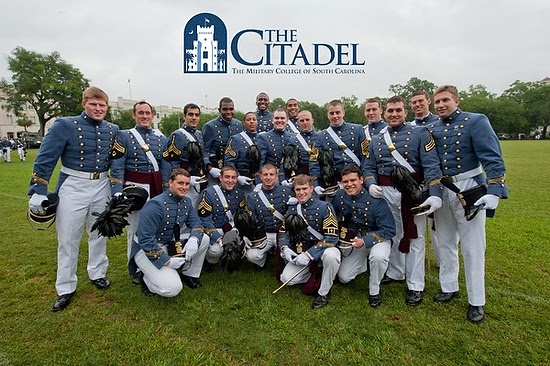
My oldest step-son Nelson Lalli [he is in the center front row] chose to go to The Citadel, a military college. He chose to go to a school where for the most part students are paying to be yelled at and pretty much humiliated as I saw it for most of their entire freshman year. At The Citadel this year they are called Knobs.

We all know that the reason they teach this to the military is that they learn to follow orders and this is critical to the success of the military.

Later Nelson decided his Junior year to try out for the Summerall Guards.  Now if you think being a Knob was hard, the comparison is like thinking of your Knob year as a cake walk.

Nikon D3S, 28-300mm, ISO 1600, ƒ/6.3, 1/320
The Summerall Guards must do all that the rest of the Corp of Cadets is doing plus all the extra physical and psychological torture [well to an outsider] they do. He had to listen to orders while their was someone yelling into his ear just inches from his ear.

You know what they talk about as Seniors? They tell all the stories from Knob year and if they were a Summerall Guard they tell those stories as well.

Great storytelling requires tension. You must have something to move the story along. What is great about a good story is it is rememberable.

Fuji X-E2, 18-55mm, ISO 6400, ƒ/5.6, 1/45
 The students I have been teaching in Hawaii have instructors sit with them and pour their wisdom out to them every day.

Fuji X-E2, 18-55mm, ISO 5000, ƒ/3.6, 1/110
However years later many of these students will remember more about their kitchen duty than from a devotional that someone led, because of the stress that comes from dealing with difficult situations and overcoming them.

Fuji X-E2, 18-55mm, ISO 6400, ƒ/3.6, 1/8
Late into the evening you see students all over this Youth With A Nation campus studying and trying to get everything done for their assignments.

Fuji X-E2, 18-55mm, ISO 6400, ƒ/2.8, 1/110
Here you can see three students in my class working together trying to grasp how to set up three different lights: The Main; The Fill and Background. Each light had to be set for a different power and the Main and the Fill light needed to be one stop different.

Not only did they have to get the lights set they had to get a custom white balance. Now when they had all this technical stuff they still had to work with a model and get a good expression as well as have a good composition.

They were stressed. They continued to come to me. Rather than me just giving them a quick answer, I often asked them questions. The stress you could see going up on their face. Then as Keziah Khoo experienced there was a eureka moment where they got it. The joy on her face made all those struggles worth it.

The difficulty of the class and then mastering the subject made her feel good about what she now knew how to do that she could not do before.

The reason I wrote this today is to let those of you who are experiencing a lot of stress to know that these times will be remembered and as you make it through these tough times the fact that you survived alone makes for a great story.

When your life is boring it is because you are most likely not challenging yourself and growing in knowledge.

Fuji X-E2, 18-55mm, ISO 1600, ƒ/5.6, 1/500, Exp Comp -1
While many people love a great sunset, I love a great sunrise. I love the fresh air and a fresh start to each day.

Funny how sleeping on something that was insurmountable yesterday is not so bad the next day.

Look at your challenges as opportunities that are making your life one exciting story to read.

Monday, August 19, 2013

Mountain Top Experience is good, but you will need more

Grandfather Mountain Camera Clinic 2013 faculty from left to right Stanley Leary, Chuck Burton, Lauren Carroll, and Roger May.
Grandfather Mountain is North Carolina's top scenic attraction

The camera clinic, originally organized in 1952 by Hugh Morton, invites photojournalists to Grandfather Mountain each August to discuss the nuts and bolts of good photography and relevant topics and trends in the field of photojournalism.

This year there were four presenters, Chuck Burton, Lauren Carroll, Roger May and myself, on a variety of topics.

Chuck Burton talks to the group about "Seeking The Different."
Seeking the Different

Chuck Burton started his talk with a couple of photos showing how difficult it is to find something unique. His first photo was a photo in Washington DC a few hours before Hillary Clinton was to address a congressional panel on the Benghazi Attack. In the middle of the photo was the large desk with Secretary of State Hillary Clinton name. In front of the desk were about 20 cameras on the floor, each one holding the place for a photographer.

Chuck then said in this situation you are asked to come up with something unique.

Then he followed it up showing a photo of all the remote cameras on the basketball game and he didn't have a place to put his. Chuck then taped two AA batteries together and on the bottom of his camera to get a photo from the floor. Next photo is the cool shot he got. Then he showed us the next game how there were now 5 camera on the floor doing the same thing.

The point is that shooting every day as an Associated Press photographer he is always "Seeking the Different" in order to keep the readers engaged. Photography isn't about THE mountain top experience, rather it is about a lot more than that. You do shoot a great photo and then just kick back and collect the lottery winnings.

Roger May gives his presentation “The Importance of the Personal Project and Managing a Kickstarter Campaign”
Testify

Roger May's North Carolina license plate is "DOCUMENT." How appropriate for Roger. His kickstarter project "Testify: A Visual Love Letter to Appalachia" is his journey to document his heritage in the mountains of West Virginia.

Roger helped all of us realize that the personal project is quite therapeutic and after pouring your heart and soul into such a project you would like to share it with the world. Many of these personal projects don't really have an appeal of companies to publish because they don't help promote their company directly.  So, one of the best ways today to publish a book on your work is through crowdsourcing.

Crowdsourcing is, according to the Merriam-Webster Dictionary, the practice of obtaining needed services, ideas, or content by soliciting contributions from a large group of people, and especially from an online community, rather than from traditional employees or suppliers.

Kickstarter is the website that helps artists with crowd sourcing.

Community Newspapers

Lauren Carroll presented on “Shine a Light Where There is None: The Importance of Community Newspapers.”

Lauren talked about how much she just enjoyed meeting people from the community and this allowed her to shoot sports, features, and even news. While she doesn't like putting a camera in people's faces during tragedy Lauren explains to her subjects how she wants to tell their story to the community.

On top of Grandfather Mountain looking towards Charlotte, NC from the mountain.
Business practices

I spoke on “Making Money as an Independent Photographer.” The reason I called it "Independent" and not "Freelance" is due to my friend Kenny Irby pointing out how maybe the word FREElancer communicates the wrong thing.

After the presentation many folks came up and said you know your talk would apply to every business.  Since many in the audience were not full-time photographers and had other careers they even commented how some of my points were helping them with some business decisions they needed to make.

The reality is that reading business books on starting a small business would apply to photography.

Coin operated binoculars at Grandfather Mountain with the "Swinging Bridge" in the background.
Coin operated vision

Everyone invested to go to the top of Grandfather Mountain and hoping this will help their vision for the future. It helped to see the bigger picture and from a different perspective.

Now that we have all been too the top of the mountain we now need to move forward and take what we learned and let it help shape our direction.

Mile high above sea level on top of Grandfather Mountain and on the Swinging Bridge.
Do you lack sense of direction?

Maybe you need to put some quarters in a workshop for you to help see your future more clearly.  Go and find a workshop on something you would like to learn more about.

Couple of ways to create your own workshop. If you like someone's work and they don't offer workshops, approach them and ask if you could pay them for a day of their time to teach you something that they do.  You never know they just may take you up on it.

I teach on a variety of topics around photography. If you are interested in a personal workshop or getting a few friends together to split the costs then give me a call. Here are some of the topics I teach on and if you think of something not listed here, give me a call.

  • Business practices for the photographer
  • Hot shoe flash lighting
  • Studio lighting
  • Location Lighting
  • Portraits
  • Poising
  • Product Lighting
  • Missions Photography
  • Humanitarian Photography
I loved playing King of the Mountain as a kid, so this is just me being a kid again on top of Grandfather Mountain.
The More

Famous National Geographic Photographer William Allard gave a presentation at a conference I was attending. Afterwards a young kid came up to Allard and said he needed this for inspiration. 

William Allard turned to some friends and said you know we need one of these about every three months to keep all of us inspired.  Remember the workshops and seminars are there to inspire, but we must take this inspiration and do something with it.

When you come away from a workshop you need to have an action plan of what you are going to do differently than before the workshop.

Maybe after hearing Chuck Burton speak you decide to try one new angle on a sporting event each time you shoot that you haven't done before. You might take a few minutes and go into the stands to shoot or maybe spend more time shooting the bench rather than the action on the field.

After hearing Roger May you decide to take on a personal project. You might even want to photograph your heritage like Roger.

Some people may have listened to Lauren Carroll and decided to look for stories in their community rather than trying to plan a trip around the world.

Did the Mountain Top Experience do more than just bring a tear and touch your heart? If so, then we will see some activity in your life that shows the changes.

Sunday, December 23, 2012

Workshops can be better than new equipment


If you are still looking for a present for the photographer friend then consider a gift certificate to a workshop. If they don't have one then give a VISA or AMEX gift card with a print out of the website to tell them you are giving them the funds to go to the workshop.

Difference between Photography Workshops/Seminars and College Programs

First of all for the most part all your Photography Workshops and Seminars are put on by working pros. Most of the college programs have people teaching who have academic credentials.

Some college programs do have working pros teaching, but this is the major advantage of a workshop and seminar. You get to talk to the pros shooting for National Geographic Magazine or Sports Illustrated.

They will teach you tips that will help you use what equipment you already have better and the recommendation for new gear will help you navigate that next purchase.

I continue to go to workshops and help put them on as well. I just attended earlier this month the Atlanta Photojournalism Seminar.  That was a great refresher for me and a chance to talk to other pros doing what I am doing.

Advice to Students

If you are in a college program you need to go to a workshop/seminar to help you meet people in the industry. You may find a great place for an internship.

I have learned more in a week workshop doing nothing but photography than I did in college classes. One of the best reasons for this is that is all you are doing when you are there.

You don't stop after an hour and then go take an English class and then later to a history class. You are not working on other papers and projects at night that are not related to photography.


One of my favorite programs is the Youth With A Mission's School of Photography. This is a 12 week photography program where guest speakers are brought in to get the students hands on training.

Many of the students have gone on to create their own businesses in photography and many have incorporated photography into other careers.

Tips to make the most of a workshop/seminar
  • Always have business cards. Gives you opportunity to share with not just the speakers, but those in class with you.
  • Always have a portfolio with you. With iPads, Laptops and photo books you should never not have your most recent portfolio to show for feedback and to help you grow.
  • Eat with the instructors if you can. Ask them if they have meal plans and take them to lunch.  This will be your best investment ever. Ask questions and listen. Don't take them to lunch to tell them all about you. 
  • Take notes.
    • Write down notes from speakers
    • Audio record them if they will let you.  Always ask first.
    • Take notes with your camera. (again ask)
  • Get to know as many of those in your class as you can. Sometimes the people sitting next to you are just as valuable of a resource as the teachers.
Cost saving tips
  • Register earlier to take advantage of discounts
  • Find the social media pages for the workshops. This is a great way to share rides or even rooms. I find many college students will fit a few people into a hotel room and save.
  • Find out if Nikon or Canon and sometimes a camera store will provide free cleaning for your cameras. They may limit how many items, but if they will clean two cameras that can save you $30 to $50 for each camera.
  • Try and eat at the meeting space rather than driving all around for lunches and dinners. You will find many of the speakers eat right on site to save on time. You can pack a sandwich and get something small just to sit at their table with other attendees.
  • Always let people know you are going that are potential jobs in the area. If you go to a college be sure and check to see if any of the sports teams are playing nearby. going early or staying later you may tag on a paying assignment which will help lower your costs.
Southwestern Photojournalism Seminar's
2-Minute Shows 


This is March 1 - 3, 2013 in Fort Worth, Texas. They still have some slots left for the student practicum that takes place February 28 - March 1.

2-Minute Shows: The conference has a great opportunity that I don't know any other seminar or conference offers. The first 45 to signup can show their work to everyone in 2 minutes or less.  This is such a great tradition that everyone loves to see everyone's work.

If you come to SWPJC and do not sign up for the 2-Minute Show you will have missed a great opportunity--especially if you are trying to get jobs or do this professionally in the long run.

My suggestion to any photographer who wants to be sure their loved ones know what they want for Christmas is to forward this email to them and suggest a workshop you might want to attend.