Shooting under fluorescent lights can give you very unpredictable results if you do not slow down.
Fluorescent lamps using a magnetic mains frequency ballast do not give out a steady light; instead, they flicker at twice the supply frequency. This results in fluctuations not only with light output but color temperature as well, which may pose problems for photography and people who are sensitive to the flicker.
When the fluorescent light is at the end of its life it can flicker more and for those with photosensitive epilepsy it can trigger a seizure.
Today there are a range of types of fluorescent lights. You may have gone into a HomeDepot or Lowe's and noticed displays showing you different color temperature fluorescent lights.
Color Temperature
Typical incandescent lighting is 2700 K, which is yellowish-white.
Halogen lighting is 3000 K.
Fluorescent lamps are manufactured to a
chosen color by altering the mixture of phosphors inside the tube.
Warm-white fluorescents have color spectrum of 2700 K and are popular for
residential lighting. Neutral-white fluorescents have a color spectrum of 3000 K or
3500 K. Cool-white fluorescents have a color spectrum of 4100 K and are popular
for office lighting. Daylight fluorescents have a color spectrum of 5000 K to 6500
K, which is bluish-white.
On my Nikon D4 in the menu for White Balance you can choose up to seven different presets for fluorescent. There is a major problem I have found trying this method, it isn't easy to pick the right color, because the monitor on the back of the camera isn't that easy to see color in all situations.
Flicker problem
Incandescent lights burn constantly and therefore your color temperature is pretty consistent no matter your shutter speed. However, since fluorescent tubes are actually acting light a flash and flickering you will get an affect different than with flash where above your sync speed part of the frame is dark.
Look at these two different photos and see the color difference.
Everything is set the same (Nikon D4, ISO 12,800, f/5.6, 1/500) in each photo, but you can see the difference in color is due to the flickering of the fluorescent.
Now besides a color shift on the whole picture you may end up with a band across the photo. Personally this is more annoying since it isn't as easy to fix in post production. Have this happen a few times and you are screaming at that computer and camera.
Slow Down
You can get very consistent color under fluorescent if you shoot at 1/100 or slower shutter speed.
Anytime you are under Fluorescent, Sodium-Vapor, or High Temp Mercury-Vapor be sure you shoot slower than 1/100. You may need to shoot at 1/60 with some of the older model lights.
Why Strobes Are Used
There are times when shooting at 1/100th of a second isn't going to cut it. A great example of this is shooting sports inside under those Sodium-Vapor lights in most arenas. This is why many pro photographers are using strobes for shooting sports. They need a consistent color without streaks or bands of color shift in the photograph.
If it were not for this problem of flickering with these types of lights it would be a lot more practical with today's high ISO cameras to not use strobes.
Custom White Balance
The best solution I have found shooting under these lights that flicker like fluorescent is to do a custom white balance.
My favorite way for getting a custom white balance is using my
ExpoDisc.
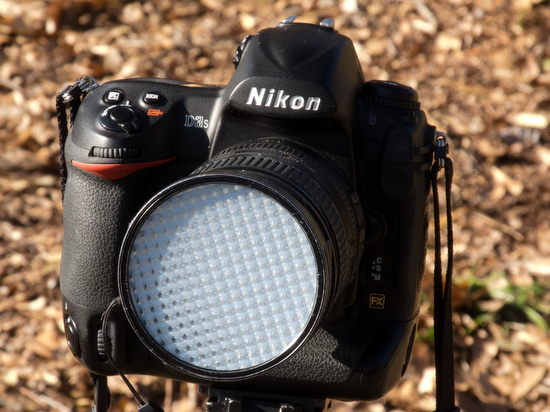 |
| ExposDisc goes in front of the
lens and then you use it to get an incident reading rather than a
reflective reading of the light. |
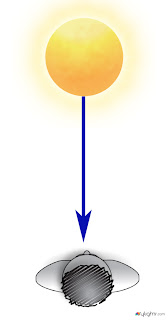 |
| Notice the direction of the light hitting the subject. You move to the same position to get the light reading below. |
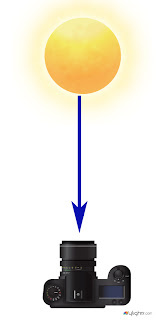 |
| Point the camera toward the direction of the light that is falling on the subject. |
I have found if the subject is facing me and the light is from the side,
I face the camera with the ExpoDisc on it so it is pointing towards the
camera position. The chart above is to help you understand the
concept, but you can modify it.
Now if you are shooting in an arena with Sodium-Vapor lights. Do a custom white balance. However, be sure you do the custom setting at a shutter speed lower than 1/100. You can then raise your shutter speed to higher than that for shooting, but this will give you more consistent color over your images. Even doing this will still cause you problems on about 5 - 10% of the images.
Now you know to slow down your shutter speed when shooting under this light source.


