Showing posts with label Dynamic Range. Show all posts

Monday, December 10, 2012

Flash helps dynamic range

Nikon D4, 28-300mm, ISO 3200, ƒ/8, 1/160 with off camera flashes

My final image for this photo shoot was to be used as a Black and White in a book. To be sure the quality was as high as I could get I did a few things for this photo.

First, I communicated to the subject that please do not wear white and wear a solid color. While I could do everything technically right, the offset printing can be hit and miss. Not all black and white photos print the same on certain type of papers and one of the first places this will show up is either in the whites or the blacks.


Here you can see the photo as I shot it in color. One of the first things I was aware of in this photo was the hand gun. It is solid black. If I am not careful this would be turn out to be just a solid black object with no details.

I decided to use two hot shoe flashes to help give me 5500º Kelvin temperature light, which would give me the greatest dynamic range.

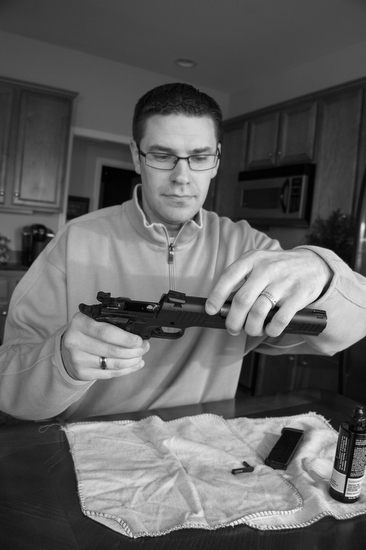
Photo by: Ken Touchton
My friend Ken Touchton was with me and took a couple shots of me working. Ken knows I do this blog and while I wasn't using one of my cameras took some photos of me working.

I am using a Nikon SB-900 and a Nikon SB-800 on PocketWizard Flex TT5, which are held on to the Manfrotto 5001B Nano Black Light Stands with a Manfrotto 175F Justin Spring Clamps with a Flash Shoe.  To trigger the flash from the camera I am using the PocketWizard Mini TT1 with the AC3 to control the flash output in the TTL mode.

When I first started shooting the black ground went totally black, because I had the ISO set at 100.  I cranked the ISO up to 3200 so that the background isn't going black.

While the window light would normally work well, it was an overcast day. So this wasn't 5000º Kelvin temperature light. More like deep shade light in terms of color temperature.

I am shooting at ƒ/8 to keep the depth-of-field somewhat in focus from the subject to the gun.

In many ways this is similar reason to use a flash as when I shoot indoor sports under Sodium Vapor lights. I just want to clean up the light and take the quality to the next level.


Thursday, August 25, 2011

Some subjects are difficult to photograph

When two subjects of different lightness and darkness are in the same photo (Bride and Groom) you will notice the details don't show up equally.  You can see the texture of the white duck and not in the black duck. [ISO 200, f/8, & 1/40 sec]

Which do you expose for in a wedding photo?  Do you show the detail of the bride's white dress or the detail in the groom's black tuxedo? This was the old joke wedding photographers used and the punch line long ago was the bride, because the parents were paying for the photos.

In available light this is still a very difficult shot to pull off. 
7
Setup for the first photo

Now the simplist way to correct for this situation is to add some light.
5
By adding flash on the right side of the photo to light primarily the black duck I was able to add some detail to the photo. [ISO 200, f/8, & 1/40 sec]
While you might think you only need this to help out in those situations to be sure both subjects look good--it makes a difference even in individual photos.
6
You can see that I just added a flash up high at a 45 degree angle to the subject. 


2
Black Subject with no flash to fill in the shadows
What the camera sees is the duck without a flash. When the human eye looks at the duck it scans the subject and adjusts to show the different tones so you can see detail like you do with the flash assistance in the next photo. 

1
Black subject with the flash to fill in the shadows giving an apparent increased tonal value.

4
White Subject available light


3
White Subject with flash at 45 degree to the right and 45 degrees above the eyes.
Summary

When you add flash to a subject that has a dynamic range greater than the camera can record you are in essence bringing the values closer to the range the camera can record and therefore mimicking what the eye actually is seeing.

If you want people to talk about how great your photos are, then you need to capture the scene as close as possible to the human eye and to do that you may have to add some light.

BONUS TIDBIT

When you use flash you are putting the subject into the color space that renders the highest dynamic range.