I had a lot of fun capturing the brand new Chick-fil-A food truck that is being tested in Athens, Georgia. It was parked in the restaurant parking lot to show to their customers and hoping they will book the truck for an event.
This shot was taken at sunset with the sunsetting behind the truck. To show the truck I put one flash on the side laying on top of some bushes to light up the side of the truck.
My assistant was pointing the second flash on the front of the truck just off to the camera's left.
I love using the Neewer T850 with the radio remote. I can control the power output from the radio remote. I just set each flash to a different channel and then I can vary the power from the camera. No need to walk over to the flash to make a change.
Now I have the more expensive Nikon SB-900 but have found it difficult to use in manual mode and change the power from the camera of several flashes. Also shooting in TTL if you just barely move the camera it can change the flash and how it puts out light. Having the lights set to a power gives you more consistent exposures than TTL.
This morning I was shooting volunteers that were pulling nails out of 2'x4's. We started early because is was actually sprinkling and a down pour was on it's way. This was a nasty overcast day.
Now when people bend over and have on ball caps well this is the worst possible situation I can think of shooting where the natural light is actually working against you.
This morning I avoided getting this type of photo that I had at a football game. See how you cannot see their faces. The light is from above and when they are facing down you have total black under those helmets just like you have under the visor of a baseball cap.
My assistant took one of the Neewer TT850 flashes and I had the transmitter which controls the power on my camera. Sometimes I was at 1/8 power and other times only needed about 1/64 power to fill in those shadows of the people working.
My camera is pretty much on the ground so I can see their faces and so is the flash. I asked the assistant to try and stay 45º to 90º from me to create a triangle. I am one corner the subject is another and the flash is the 3rd corner of the triangle.
I am also slightly under exposing from 1/3 to 2/3 and even up to -1 stop under. The flash is kicking in and becomes the main light on the faces.
Had I used on camera flash I would have gotten much better results than without a flash, but by getting the flash off the camera I create more modeling of the skin and creating depth.
Just remember to always have a flash in case you need to do something similar to help the audience connect with the subject.
Nikon D750, Sigma 24-105mm f/4 DG OS HSM Art Lens, ISO 200, ƒ/6.3, 1/160–Neewer T850, Neewer 433MHz Wireless 16 Channel Radio system
This past weekend our family flew down to Jupiter, Florida to surprise my wife's oldest sister for her 80th birthday.
Some of the family my wife had never met and some of the family she hadn't seen for more than 39 years.
After taking this photo I didn't wait till I got home to work on it in the computer. I wanted to be sure to make this photo the most valuable asset it can be to our family going forward.
Here is a video to help you know how to do this in Adobe Lightroom:
After I had the photo in Adobe Lightroom editing software I used the Face Recognition technology to help identify each and every person in all the photos I took this weekend. Now the software while not perfect did a great job. I did have to force it to tag some of the faces.
The good thing is now inside the metadata of the image is everyone's name that is in this photograph.
Metadata is "data that provides information about other data". Two types of metadata exist: structural metadata and descriptive metadata. Structural metadata is data about the containers of data. Descriptive metadata uses individual instances of application data or the data content.
Metadata was traditionally in the card catalogs of libraries. As information has become increasingly digital, metadata is also used to describe digital data using metadata standards specific to a particular discipline. Describing the contents and context of data or data files increases their usefulness. For example, a web page may include metadata specifying what language the page is written in, what tools were used to create it, and where to find more information about the subject; this metadata can automatically improve the reader's experience.
The main purpose of metadata is to facilitate in the discovery of relevant information, more often classified as resource discovery. Metadata also helps organize electronic resources, provide digital identification, and helps support archiving and preservation of the resource. Metadata assists in resource discovery by "allowing resources to be found by relevant criteria, identifying resources, bringing similar resources together, distinguishing dissimilar resources, and giving location information."
This is one of my family photos from my dad's side of the family. I know the man on the far left (even this is sketchy to me) is my great grandfather who owned the blacksmith. He is H. P. Sewell.
Who are the rest of the people? We don't know.
Make your photos from your family more valuable. Take the time to identify who is in the photo.
Nikon D750, Sigma 24-105mm f/4 DG OS HSM Art Lens, ISO 100, ƒ/4, 1/200
This is the three sisters from the weekend and my wife's great niece. Just imagine a few generations later where they are telling the stories to their children about who their ancestors were.
Now putting the names of the people on the back of the print as was done by many people in the past is the same as today embedding that information using metadata.
In PhotoShop just go to the menu item File>File Info...
Under the basic table in the description box put the people's names in the photo. You can even put them in left to right and row 1, 2 and so on to help people in the future who will not know who anyone is in the photograph.
Now this is the Spotlight search on a Mac, but you can do a text search on a PC and get the same results. Because the names are embedded in a photo you can now search and find those people. Here I put the last name in for Teubner. I didn't even have to finish spelling it before the photos started listing for me in the search box.
I setup two umbrellas with hotshoe flashes to make the group photos this past weekend. Once I had them setup we had one our family members to take a photo of our family, which rarely happens. Like the cobbler we have few photos of us as a family.
Nikon D750, Sigma 24-105mm f/4 DG OS HSM Art Lens, ISO 180, ƒ/4, 1/250–fill flash
While we did setup and take some posed photos, we enjoy just as much those moments capturing the family having fun.
Nikon D4, Sigma 70-200mm f/2.8 EX DG APO OS HSM, ISO 1250, ƒ/2.8, 1/2000
Nikon D750, Sigma 24-105mm f/4 DG OS HSM Art Lens, ISO 12800, ƒ/5.6, 1/60
I feel great about this past weekend. I not only got to meet family members I didn't know we had, but I can now look back at the photos and tell my family who is who and help them know what a wonderful family heritage we have.
Nikon D750, AF-S NIKKOR 28-300mm f/3.5-5.6G ED VR, ISO 5000, ƒ/5.6, 1/100–Off camera flash Neewer TT850 triggered by the Neewer 433MHz Wireless 16 Channel radio remote set to 1/128th power and with gels and grid
I love it when you are able to get super close because the people forget about you. Here this boy is deep into his computer software and the teacher is helping him.
This takes time.
Nikon D750, AF-S NIKKOR 28-300mm f/3.5-5.6G ED VR, ISO 6400, ƒ/5.6, 1/100–Off camera flash Neewer TT850 triggered by the Neewer 433MHz Wireless 16 Channel radio remote set to 1/128th power and with gels and grid
Now if I did this just once you might think it is luck, but trust me once you let people feel comfortable with you and you are non threatening you can get really close and get better photos.
This photo is shot with a 14-24mm and I am shooting zoomed as wide as it will go at 14mm. All of the photos in this blog I can just take my hand and reach and touch the main subject's face.
This is the key to your photos looking better–Get closer with your feet. You should be able to touch your subject because you are too close most of the time.
Nikon D750, AF-S NIKKOR 28-300mm f/3.5-5.6G ED VR, ISO 1600, ƒ/5.6, 1/100
Notice the difference when you work this close from the 14mm to this photo at 28mm. Starts to look like a telephoto lens.
By getting close and using ultra wide-angle lenses you get a sense of place. You can see the other students and how they are working. I try to put the audience in the room with me.
Nikon D750, AF-S NIKKOR 28-300mm f/3.5-5.6G ED VR, ISO 1600, ƒ/5.6, 1/100
Here I stepped just a little back and zoomed in to 42mm. Notice how distant you are in comparison?
You want you photos to look better then use your feet and get close enough you can touch your subject.
There are a few exceptions and wildlife is one of those exceptions. I like to use really long lenses like 500mm or 600mm so I live to have another day.
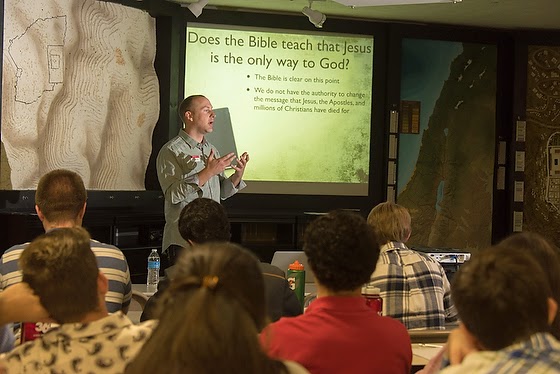
This is one of the ways I learn best–Experiential Learning. Experiential learning is the process of learning through experience, and is more specifically defined as "learning through reflection on doing". Experiential learning is distinct from rote or didactic learning, in which the learner plays a comparatively passive role.
The first photo here is a replica tomb of what Jesus Christ was placed into after his crucifixion.
Nikon D750, AF-S NIKKOR 28-300mm f/3.5-5.6G ED VR, ISO 100, ƒ/5.6, 1/125–off-camera flash using the Neewer TT850 flash & Neewer 433MHz Wireless 16 Channel Flash Remote Trigger
The docent, tour guide, helped us to see the cross that Christ most likely was crucified on rather than the Roman designed cross many wear today or that is in churches. They went into a great amount of detail to help you understand why this was such a horrible way to die.
They have authentic goat hair tent like the nomadic shepherds have lived in for thousands of years. Here you sit and listen as the docent helps explain what you are seeing and experiencing.
Nikon D750, AF-S NIKKOR 28-300mm f/3.5-5.6G ED VR, ISO 100, ƒ/5.6, 1/160
This is a replica of the main gate to the city. Here you learn about the gate that Jesus would have come through on the donkey. What happened around this gate gives you perspective.
They have the press that they first use when working with olives. It was good to see and have an expert in Biblical History speaking and helping us to see the significance of the Mount of Olives and the celebration of Holy Week.
You can experience a Jerusalem Biblical Meal, which would have been similar to the last supper. I recommend going to the center for a experiential learning experience. For photographers it makes for a fun location to shoot.
The Explorations in Antiquity Center is not related to any particular denominational tradition, so the conferences should be both meaningful and sensitive to people from many different backgrounds.
Nikon D750, AF-S NIKKOR 28-300mm f/3.5-5.6G ED VR, ISO 2000, ƒ/4.8, 1/100–off-camera flash using the Neewer TT850 flash & Neewer 433MHz Wireless 16 Channel Flash Remote Trigger. The MagMod with grid is used to keep light off the screen.
Here is a explanation of the MagMod I used to keep the flash off the screen in the photo above.
Nikon D750, AF-S NIKKOR 28-300mm f/3.5-5.6G ED VR, ISO 12800, ƒ/5.6, 1/100
I had a lot of fun the past few days at the Southwestern Photojournalism Conference and student practicum in Fort Worth, Texas. The time started off right with me helping a student at Leddy's. M.L. Leddy's is truly a legend in the handmade boot and saddle industry. Since 1922 they have provided “made by hand” products for discriminating customers all over the world.
The student's assignment on Thursday night was to capture an environmental portrait.
Nikon D750, AF-S NIKKOR 28-300mm f/3.5-5.6G ED VR, ISO 12800, ƒ/5.6, 1/200
Nikon D750, AF-S NIKKOR 28-300mm f/3.5-5.6G ED VR, ISO 1600, ƒ/5.6, 1/250
Kaylee Kaybay Walding found this street photographer in downtown Fort Worth, Texas for her environmental portrait.
Nikon D750, AF-S NIKKOR 28-300mm f/3.5-5.6G ED VR, ISO 1600, ƒ/5.6, 1/250
The one thing all the students were initially struggling with is their fear of people. Getting them to talk to people to find a subject was difficult, but as the deadline to stop approached they were overcoming that fear.
Nikon D750, AF-S NIKKOR 28-300mm f/3.5-5.6G ED VR, ISO 10000, ƒ/8, 1/250
On the far right and left front of the photo is Justin and Ashley Veneman. They are photographers in Memphis, Tennessee and were helping the students learn how to set their camera here as others looked on.
Nikon D750, AF-S NIKKOR 28-300mm f/3.5-5.6G ED VR, ISO 12800, ƒ/8, 1/50
I have blogged a few times about Dave Black. After we introduced all the instructors Dave asked to speak to everyone for just a minute. "I want to see everyone's portfolio that is here this weekend. No matter how long it takes. So come and see me," Dave said to the group.
Dave lived up to that promise and stayed up to 2:00 am the first day and 3:00 am the second day sitting right here on this couch reviewing portfolios. He encouraged people to gather around so they could hear his comments so they could learn from each other.
Nikon D750, AF-S NIKKOR 28-300mm f/3.5-5.6G ED VR, ISO 12800, ƒ/4.8, 1/250
Here is Dave Black reviewing Susanne Childer's work. Everyone around them is Susanne's class from Kailua-Kona, Hawaii.
Nikon D750, AF-S NIKKOR 28-300mm f/3.5-5.6G ED VR, ISO 12800, ƒ/4.5, 1/25–off camera flash with the Neewer T850 triggered with the Neewer radio remote
One speaker we love to have back over and over again at Southwestern Photojournalism Conference is Dave Black. He is always prepared with great content and always delivered in an entertaining way.
Here are some of the many expressions that Dave had in just a few minutes. We were laughing and crying with Dave.
Nikon D750, AF-S NIKKOR 28-300mm f/3.5-5.6G ED VR, ISO 12800, ƒ/5.6, 1/200
Nikon D750, AF-S NIKKOR 28-300mm f/3.5-5.6G ED VR, ISO 12800, ƒ/5.6, 1/125
Nikon D750, AF-S NIKKOR 28-300mm f/3.5-5.6G ED VR, ISO 12800, ƒ/5.6, 1/100
Put on your calendar February 26 – 28, 2016 for the conference and if you are a student be sure and attend the student practicum that precedes the event on February 25 – 26.
I just drove up tonight to Mauna Kea and took a few photos. Here is one where I used my cell phone's LED light to light paint the branch in front of me.
Here it is without light painting.
There were four of us driving around the Island and I wanted a memento photo of the group. So I decided to pull out my Neewer TT850, and the Neewer 433MHz Wireless 16 Channel to light the group.
I used the MagMod system to hold a CTO +1 gel in front of the flash.
I don't think portraits tell stories, but are part of the story. For the most part most portraits are the nouns of a sentence. For a complete sentence you need a verb.
Nikon D4, 28-300mm, ISO 280, ƒ/5.6, 1/250
Storytelling?
Yes this photo has a subject and a verb that makes it storytelling. However the one photo often lacks all the elements in a complete story. This is where caption can help make up the missing parts.
Most storytellers agree you need five elements for a story. The five main elements of a story: setting, plot, characters, conflict and theme.
Subject vs Author
Great storytelling is when you never notice the author/photographer. However today I would say too many people who think they are doing storytelling it is all about the author/photographer.
I love this photo of my wife and I with the founder of Chick-fil-A, Truett Cathy. I love telling the story of how Truett's son Bubba asked me to give him my camera to take the photo.
This is what I think our generation is over emphasizing as storytellers. The story becomes more about look at who I am with and what I am doing. Don't you wish you were here?
Sure take these photos and even share them on your social media, but don't let these replace storytelling where you tell the story of the subject.
Nikon D4, 14-24mm, ISO 10000, ƒ/5, 1/100
This young lady is peaking in and seeing does she want to be a part of this brand new Young Life club at the Rancho el Paraíso located in the Agalta Valley of Honduras. Inside the room Daniela Tereza Perez is talking to the other youth. HOI helped bring Young Life to their campus to help reach the youth in the area.
If I do my job just right I had you clicking on HOI to learn more. I am pulling you into the story.
Nikon D4, 14-24mm, ISO 450, ƒ/8, 1/250–off-camera flash using the Neewer TT850 flash & Neewer 433MHz Wireless 16 Channel Flash Remote Trigger
In my opinion–Don't confuse a nice portrait with storytelling. It is a noun that needs help to make it a story.
Think of it this way–if you are telling a good story then everyone who sees it will take away the same story. They may be impacted differently, but they will be able to tell the story. Looking at a portrait of a person allows each person to make up what they think the story is all about.