Showing posts with label documentary photography. Show all posts

Wednesday, March 27, 2013

Which photo is best? Another Example


Click on photo for a larger view.

This is a series I shot of a little Senara boy in the town of Konadouga, Burkina Faso, which is located in West Africa.

Which of the photos would you pick and why?  Here are larger versions of the composite above:

Photo 1

Photo 2

Photo 3

Photo 4

Photo 5

Photo 6

Photo 7

Photo 8
I think anyone of the photos will work. Yes I do believe they are all good and which one to use depends on what I am wanting to say to people. Now I might crop the photo a little depending on the photo I select and how it will be used.

I could easily see this photo running over two pages of a magazine with the headline and story on the left over the photograph.

I think the furrow of his eyebrows and his hands on the post change so much from photo to photo. The only photo I really feel like makes the child look content and happy is Photo 2. You could argue Photo 3 also he is playful and enjoying himself.

All the other photos he is looking at the photographer inquisitively which can be interpreted many different ways.

For the most part all the ones with the furrow of his eyebrows and tight grip on the pole communicate some type of desperation to me. These look more like the NGO photos trying to raise money for their programs that help children. The expression communicates uneasy feeling which can help the viewer feel responsibility for the child.

I am shooting slightly from above the child a few feet away from him. What I find interesting is in the last photo he raises his chin which makes his eyes look more level to the camera perspective. This in turn puts him more on eye level with the audience.

That last photo could be used where you may have the child making his on plea for help in the copy.

Which photo is best? The first question should be what are you trying to say.

Photographer Tip

When shooting situations like this in the field you have to feel the situation. Then you must know what you are trying to communicate about this person to people who are not hear but will be the audience.

There are two of the journalists questions I think you need to really understand and know what the answers are before you push the shutter release.

What and Why are the two question of the five I would stress.

Here are the five questions a journalist should ask:
  • Who is it about?
  • What happened?
  • When did it take place?
  • Where did it take place?
  • Why did it happen?
Some authors add a sixth question, “how”, to the list, though "how" can also be covered by "what", "where", or "when":
  • How did it happen?
What is going on that you need to communicate to your audience? This helps you pick the situation and moments out of everything that you are seeing and focus on the message.

Why should the audience care? This is a deeper question that I like to ask rather than just why did it happen. This helps me often work to find the peak moment that will engage the audience.
This is why I might crawl on the ground to get my audience eye level with children. When they are eye level with a child this should help them feel like a child, because to see this moment like this would mean being like a child on the ground.

Remember if you don't know why you are pushing the shutter release then no one else will understand either when they see your image.

Sunday, March 10, 2013

Photojournalism isn't trendy for a reason


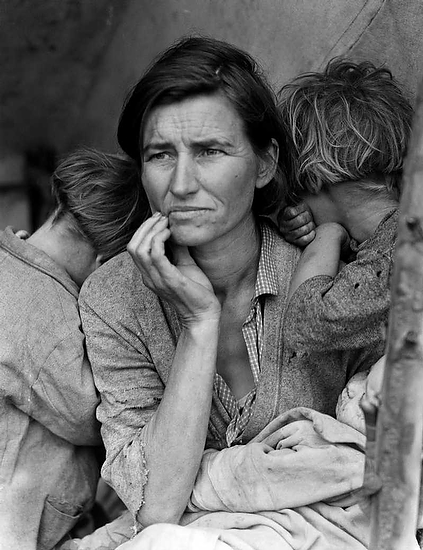
"Migrant Mother" is one of a series of photographs that Dorothea Lange made of Florence Owens Thompson and her children in February or March of 1936 in Nipomo, California.
Every other type of photography other than photojournalism goes through trends. You can even look at the hottest trends for each year. Here is a link to "The hottest photography trends of 2012."

Once you start using gimmicks to draw the attention of viewers you are tampering with the authenticity of the moment.

Howard Chapnick former president of Black Star Photo Agency had over fifty years of experience behind him when he wrote "Truth Needs No Ally: Inside Photojournalism" back in 1994. 

Howard Chapnick wrote "For documentary photography to be gripping and absorbing it must be imbued with immediacy, concrete reality and emotional involvement."

Photojournalism is about photos being relevant. To be relevant the photographer needs to capture what is impacting our world.

You cannot have concrete reality and trying to set or follow trends.

What really makes great photojournalism is a photojournalist who is passionate about the subject. They have become emotionally involved. This is not to say they have lost their objectiveness, but they have captured a real moment in a way the reader is pulled into the moment.

One of my favorite photo stories of all time is Eugene Smith's Country Doctor. Here is a link to the Time Life website with that story.

This story was ground breaking because Eugene Smith broke from the script of shooting photos on a list. He followed the doctor and captured whatever he was doing. The doctor drinking coffee at the end of a long day wasn't part of the script. It works because of it's immediacy, reality and emotional involvement. Here is that photo.

Photojournalists today have better cameras and technology to help them capture moments that those before couldn't even do. Tri-X film was not released in 35mm format until 1954, seven years after the "Country Doctor" story ran in Life Magazine. Smith was shooting with an ISO of 125 at best in 1948.

Today photographers can shoot at ISO 100 to 12,800 with the Nikon D4 and can even extend this range to ISO 50 to 204,800. You can now almost shoot in the dark and capture a subject.

In the future the only thing that will change in photojournalism is our equipment will get even better, but how we tell stories will remain the same.

The keys to great photojournalism:
  • Story ideas - You need to be able to find stories and distill them down to the nuggets which engage an audience.
  • People person - You need to be able to talk to almost every kind of person from the homeless to those who live in castles. You need to carry on conversations with the high school dropout to the research scientist.
  • Understand body language - The nuances of a head tilt, gestures and subtle eye movements are necessary to help not just communicate what is necessary to the story, but be sure it is honest and true to the character of the people.
  • Solid understanding of the camera - Getting a good exposure and in focus picture the camera can do with anyone. The photojournalist must understand when to change an aperture or shutter speed. They must understand which lens is the best to use in a situation.
  • Know light - Mastering light can help a photojournalist know where to stand to make the light work for them rather than against them. They also know when they must use auxiliary flash to reveal a story more powerfully without changing it.
When you start to feel like your work has plateaued this is not the time to think about trying a gimmick. You need to ask yourself if you are maximizing the technology to capture the stories. If you are a master at this you might just need to find a story that ignites the fire you have let go out.

Who do you know that could use someone help them tell their story? Who can benefit the most from your skills as a storyteller?

Maybe you just don't know of anything and this is the time to find some way to get plugged back into your community. Be sure you are reading the news for your community, region, nation and world.

Sometimes the best thing you can do is just take a break and recharge yourself. Vacations are needed for the creative to keep them fresh. Who needs a burned out photojournalist telling their story?

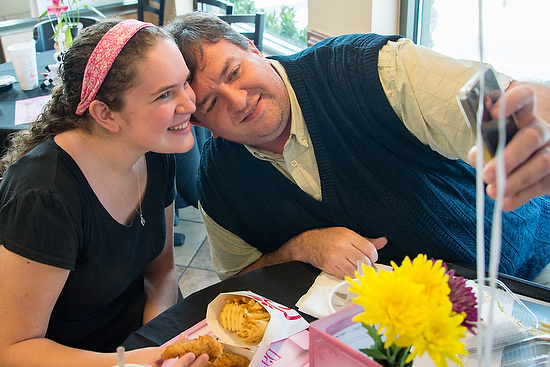
One of my favorite events to cover that will pull you out of a funk is Daddy Daughter Date Night at Chick-fil-A. This is from the event in Columbia, SC.
Photojournalism isn't about covering misery alone, it is about covering life. I suggest whatever kind of stories you have been covering to mix it up. Go and find a story on something outside your normal genre.


Friday, December 28, 2012

Christmas Holiday Moments


Fly On The Wall

Ever heard someone say that would like to be a fly on the wall during that conversation?  This means you would like to be over hearing the conversation as if you were not there. You want the situation to be real and them not know you are there.

Being the Fly-on-the-wall is also referring to the documentary style of photography where you are working as unobtrusively as possible to capture those candid moments.

In the first photo I was able to capture the newest addition to our family. His older cousin and great aunt are entertaining him and loving his reactions.


Body Language

I just love this photo of the nieces and nephews getting measured to see who is taller while their aunt looks on.  What also makes this photo fun for me is this isn't all that is going on, you have the youngest boy being held by his mother looking at me.

The body language tells the story that most likely happens during the holidays at many homes where the children are measured to see how much they have grown since last year.


Leaving some things out

You don't need to see everything in a photo for it to work. Here the proud mother holding her child comes through clearly. Do you need to see all of the kid for it to work? I don't think so. You may actually want more in the photo and if you took it you would include more. The strength sometimes by leaving something out makes you want to know what is really going on. By leaving something out you help peak the curiosity of the audience.  Keep everything in and often you loose that curiosity.


Details

So often the small things around the holidays help tell our family story. How often does your family talk about something grandmother cooks at the holidays? Do you have photos of this to pass along in your family.


My sister makes these rainbow cookies every year and so I thought I would be sure to document this for our family history. I keep talking about gathering our family recipes and creating a book. Now just imagine this photo with a photo of the recipe card in the original family members handwriting that started the tradition. Maybe you have a photo of them as well on the page of the family book.


The Patriarch Speaks

Every year my dad likes to remind us how important family is to us. This year he read The Dash Poem by Linda Ellis. Here is a link to that poem in case you might want to make it part of your family tradition.


Crawling on the floor

Please don't walk around the room and take all your photos from the standing position. Get down to the little ones level like I did here. What happens when you are eye level to the baby of the family. Well the last time most of us saw things from this perspective was when we were just children ourselves.

When you get down on the ground you help the audience feel like they did when they were children.


Have some fun

Here my daughter on the right with her friend are making music with Dan Cathy, the president of Chick-fil-A. He had these shakers with cow spots that are egg shaped.  During my daughter's Christmas break she had fun with not just her friends but Dan Cathy.

Where did you go?


We decided to drive just a few miles from the grandparents house to where they filmed some of the Hunger Games.


You may recognize this photo as the baker shop.


Maybe you remember Katniss running here in this scene.


Holiday's are about memories and here you can see my daughter is quite excited to be in front of the water falls where Katniss ran across.

How did you do with capturing your family this Christmas?