Showing posts with label decisive moment. Show all posts

Monday, August 04, 2014

Great Photographers are like Great Fishermen

Alaska [photo by Don Rutledge]
Fishermen know the habits of fish and know they are creatures of habit. They work hard to be in the best spot to drop their lines to catch fish when they are biting.

There is a lot of waiting for the fishermen. I have sat for hours waiting for nibbles then all of a sudden you can catch fish as quickly as you can put the line back in the water.

This takes a lot of time for the fishermen. The photographer spends time waiting for people, however too many people live by the saying, “Be picky with who you invest your time in, wasted time is worse than wasted money.”

Dominican Republic [photo by Don Rutledge]
I think way too many and especially myself for the first few years of my career didn't spend enough time with a subject when I had the time.

If I could boil down to one of the biggest differences between Don Rutledge and other photographers I would say his photos were better because he had more patience and worked situations longer than most anyone. He would be waiting for so long that many of the writers and people who traveled with Don would say he would just disappear into the woodwork of the room.

Oklahoma [photo by Don Rutledge]

Looking at Contact Sheets

I wish I could share with you the contact sheets of Don’s work, especially his coverage of Bailey King. I just don’t have easy access to them.

You would see situations with little variance back to back and over time, then there would be about two or three really nice images, then maybe a frame or two more then Don would move onto a new situation.

The difference between Don’s contact sheets and everyone else is how consistently Don would stay with subjects and then have an outstanding shot. You could almost just look at the last 3 to 5 images in a series and consistently pick a winner.

Today I watch many photographers relying on their LCD on the back of the camera. They look and if they think they got the photo they move on.

Brazil [photo by Don Rutledge]
Don would ask me when he saw some photos and I moved on to a new situation what I saw and why did I start taking those photos. What is it you saw that you were trying to capture? Then he would ask why didn’t you stay longer with the situation.

Over and over I watched Don review photographer’s contact sheets and the constant theme I heard over and over you need to stay longer on the subject and let it happen. If you felt like you saw something you will most likely see it again.

Creatures of Habit

People are like all animals we are creatures of habit. Dave Black knows this all to well with professional athletes that they work so hard and being a creature of habit that they will go through the same routine over and over. So he would study tapes of athletes so he could anticipate their actions.

Don Rutledge [photo by Ken Touchton]
Don wanted to do a better job of capturing moments so he studied other photographers to see what tips he could pick up. It was common for Don to call up a newspaper and ask if he could ride along with some of the photographers while they were working.

While Don picked up some tips he was also surprised at how many times photographers rushed through assignments. One time they were covering a factory when the president asked if they would like a tour to see how they make their product. Don wanted to go on the tour, but the photographer he was shadowing didn’t want to stay. They left the place so the photographer could go and sit at a restaurant and drink a cup of coffee.

When Don told me this story he went on to tell me this happens more often than he could remember.

The other day Mark Sandlin and I were catching up on memories of Don when this tidbit about Don came up. Mark pretty much talked about the same memories, but they were his of Don.

Maybe the one key thing that Don did better than everyone else was spend time with his subjects long enough to really get to know them and long enough to then capture those moments that encapsulated the person. He was so good at capturing a person’s character in a photograph.

The other thing that happens when you wait like a fisherman for a great photo—your compositions are stronger. You compose and wait for the characters to be the creatures of habit. You are able to anticipate just like the fishermen.

Maybe this is why so many fishermen enjoy certain fishing spots—they too become like a composition.

France [photo by Don Rutledge]
“What you invest your time in defines who you are,” said noted author & speaker Todd Duncan.

Don Rutledge spent his life investing into subjects with his camera telling their stories. His photos changed people's lives. Many readers of the stories he produced would feel a call to help those in the stories and people like them. The photos also blessed the subjects of the stories by changing their lives forever.

Don's investment in people changed their lives for the better.

Wednesday, March 27, 2013

Which photo is best? Another Example


Click on photo for a larger view.

This is a series I shot of a little Senara boy in the town of Konadouga, Burkina Faso, which is located in West Africa.

Which of the photos would you pick and why?  Here are larger versions of the composite above:

Photo 1

Photo 2

Photo 3

Photo 4

Photo 5

Photo 6

Photo 7

Photo 8
I think anyone of the photos will work. Yes I do believe they are all good and which one to use depends on what I am wanting to say to people. Now I might crop the photo a little depending on the photo I select and how it will be used.

I could easily see this photo running over two pages of a magazine with the headline and story on the left over the photograph.

I think the furrow of his eyebrows and his hands on the post change so much from photo to photo. The only photo I really feel like makes the child look content and happy is Photo 2. You could argue Photo 3 also he is playful and enjoying himself.

All the other photos he is looking at the photographer inquisitively which can be interpreted many different ways.

For the most part all the ones with the furrow of his eyebrows and tight grip on the pole communicate some type of desperation to me. These look more like the NGO photos trying to raise money for their programs that help children. The expression communicates uneasy feeling which can help the viewer feel responsibility for the child.

I am shooting slightly from above the child a few feet away from him. What I find interesting is in the last photo he raises his chin which makes his eyes look more level to the camera perspective. This in turn puts him more on eye level with the audience.

That last photo could be used where you may have the child making his on plea for help in the copy.

Which photo is best? The first question should be what are you trying to say.

Photographer Tip

When shooting situations like this in the field you have to feel the situation. Then you must know what you are trying to communicate about this person to people who are not hear but will be the audience.

There are two of the journalists questions I think you need to really understand and know what the answers are before you push the shutter release.

What and Why are the two question of the five I would stress.

Here are the five questions a journalist should ask:
  • Who is it about?
  • What happened?
  • When did it take place?
  • Where did it take place?
  • Why did it happen?
Some authors add a sixth question, “how”, to the list, though "how" can also be covered by "what", "where", or "when":
  • How did it happen?
What is going on that you need to communicate to your audience? This helps you pick the situation and moments out of everything that you are seeing and focus on the message.

Why should the audience care? This is a deeper question that I like to ask rather than just why did it happen. This helps me often work to find the peak moment that will engage the audience.
This is why I might crawl on the ground to get my audience eye level with children. When they are eye level with a child this should help them feel like a child, because to see this moment like this would mean being like a child on the ground.

Remember if you don't know why you are pushing the shutter release then no one else will understand either when they see your image.

Tuesday, March 26, 2013

Which photo is best?


I will take a few situations show you the take and help you see why one photo stands out over the rest.

First I am taking the drive of a basketball player to the basket. This is the series of six images shot extremely close in time. They are so close in time that the time from the first to the last image is only one second total time.

Take a moment and go through each photo separately and make your pick first. We may or may not agree, but in the end can you articulate why one photo is the best?

Photo 1

Photo 2

Photo 3

Photo 4

Photo 5
Photo 6

Sports is about competition

Rather than calling these rules lets call this list of mine guidelines. These are things I generally am looking for in a sports photo beyond the technical correctness of the photo.
  1. The ball
  2. Competition
  3. Peak action
I like three photos more than the others. I like 1, 2 and 4, because all three elements are in those photos.

The 3rd photo she is so much in front of the competition they don't really exist and in the 5th and  6th photo she has already blown by the competition therefore she is not overcoming adversity.

Anticipation

The moment before she blows by the player to the basket you can see the defender and the offensive player competing for the space on the floor. Now it is clear to me in photo 2 the offensive player has more desire on her face than the defender.

I think this face expression is the nuance that commentators talk about between the winning team and the loosing team. She wants the win and it shows and the defender's expression is complacent.

I think the pick is definitely between 1 and 2.  Let's look at them side by side.


I like the ponytail of the player up in the back, it gives it more motion than the other photo. I also like the defender's hand looking like it is trying to reach for the ball more in the second photo. I can also feel her next step being the jump step to the basket and completing the move to the basket.

The last thing I would do is the crop a little tighter and my final image would look like this here.


What do you think?

Do you come to the same conclusions? Maybe you can argue for another photo. The point is you really need to be able to break down your photos and talk about why one is better than the other.

A few things happen when you start doing this. First of all you will most likely notice you didn't shoot enough. The photo you want is either before or just after you moments that you do have.

Second, you will start to anticipate sooner the moments. Why is this? You now are training yourself to know what to look for in the photo.

Too many people are shooting just nouns and not complete sentences. Photo 3 is a great example of the noun and not a sentence. Yes you could say she is doing something, but notice the difference of having a competitor in the photograph.

The defensive player helps to tell the rest of the story. In photo 3 you have no idea who they are playing. This could be just her warming up before the game, but the other photos show the competition.

Some might argue to use image 5 or 6 because she is shooting. If I didn't have number 2 I would go with those, but I would much prefer to see the battle on the floor for position than the open shot.

This should be happening with all of your photo shoots, not just sports. There is a moment that is best. Stay tuned for other examples.

Tuesday, September 11, 2012

Comedians and still photographers have something in common

Dorie Griggs performs at the Punchline as part of her graduation from Jeff Justice's comedy class.
Mike Sacks discovered in his research for a book on comedy a common link of many comedy writers is OCD. Sacks is on editorial staff of Vanity Fair and the author of And Here’s the Kicker: Conversations with 21 Humor Writers About Their Craft.  

Sacks admits that he is OCD and believes it is true for 70% of comedy writers.

While not all my photographer friends are OCD and I haven’t done any research on it, I have noticed many of my photographer friends have OCD tendencies.

You need to be persistent to find the right words, just as the photographer must continue to look for the right moment to communicate.

Poets will spend years on poems looking for the right word for their poem. The difference between word choices is profound.

Advertising slogans can flourish or die with the difference in a word choice.

While “it” and “something” can both be anything, “just do it” is everything “Just do something” is not. See, copy does matter. --@leeclowsbeard Twitter


It’s the story

A well-developed character is core to good comedy and not necessarily the joke. Jokes are the sauce of comedy and not the steak. They often teach comedy writers to take out the jokes and if it is not funny, go back and rewrite it. Once the story is funny adding a joke just adds to the humor.

Photographers will work situations and find they have lots of photos of a subject. When they go through and edit the photos they need to boil down to those moments that tell a story effectively.

Analyzing why something is funny is a like trying to discover why people fall in love. It is not impossible to understand, but it does take a lot of experience and certain amount of talent to understand it.

Timing

Writing good comedy is a lot like writing music. The words must fit a rhythm and beat when delivered or it just doesn’t work.

My wife took a comedy class from Jeff Justice here recently. The last class is actually their performance at the Punchline. Getting to listen and watch their first performances as compared to listening to seasoned pros had more to do with their timing than with the words.  I could feel the lack of rhythm in their delivery and then when a seasoned pro closed the night off, could sense the next line and how wonderful it felt.

What the comedian must write into their routine is silence. It is one of the most important aspects of good comedy and music. The famous jazz artist Miles Davis used silence to create his melodic melodies create mood and an atmosphere.

The audience needs time to absorb the situation and understand it before they can respond to a punchline. Some of the best comedians can take you through a series of punchlines to a great crescendo by just spacing the lines a part from each other.

The key to timing understands the need for the audience to absorb a moment. This is the common thing that still photography and comedy have in common.

A visual moment needs time to be absorbed and depending on the moment may need longer for better impact.

It is all in the delivery

While the comedian has written all their material and practiced it over and over, then final piece of success and failure is in the delivery to the audience.

Printed on the page these same routines will be flat.  The comedian brings them to life.

For the photographer the deliver of the image to the audience needs space and time as well. This is where one good image with text is far more powerful than a video that doesn’t give the audience the time to absorb a moment.

Just as the comedian doesn’t pause after every word, neither does a video need to be all stills to have impact. The communicator understands what moments need a pregnant pause.

One thing I have come to believe is a key to when something needs a visual pregnant pause is when it is emotional. It can be on either end of the emotional spectrum from pure joy to despair, both ends of the spectrum need more time to breath.

As you move more to the center of fewer emotions then the time necessary is less.

Saturday, June 09, 2012

Which photo(s) would you choose and why?

This is part two of question series on which photos you would choose and why.

Again I was covering the Revive! Young Adult Track at the 2012 Eucharistic Congress put on by the Archdiocese of Atlanta.  These are photos of a speaker for the evening.

Your job is to help me pick the best photo or photos that would run with an article about her speaking to the group.

Here is the write up from the Archdiocese of Atlanta website, which is all I knew about her going into the evening. http://www.archatl.com/congress/revive.html

Come back and check out the discussions about why people choose one photo over another photo.  Be sure and vote below so you can see how you compare with others.


Mother Mary Assumpta

Mother M. Assumpta Long, O.P., is the prioress general of the Dominican Sisters of Mary, Mother of the Eucharist, in Ann Arbor, Mich. She was one of the four founding sisters of the community in 1997 as Pope John Paul II invited new religious communities to form and respond to the needs of the New Evangelization. The community now has over 100 sisters teaching in seven dioceses, drawing its inspiration from the rich heritage of the Dominican Order of Preachers and the vitality of the New Evangelization. The average age of the sisters is 28.

A former college president, Mother Assumpta holds a licentiate in sacred theology from the Pontifical University of St. Thomas Aquinas, Rome, Italy, and has taught at the elementary, secondary and junior college levels. In the early 1990s she was invited by Cardinal John O’Connor to assist with the initial formation of the Sisters of Life in New York. She is a well-known speaker throughout the United States.

Help me pick a photo or a series of photos 

Photo #1

Photo #2

Photo #3

Photo #4

Photo #5

Photo #6
Which photo would you use? You can pick more than one.

I would use the poll, but can't do two at a time right now on my blog.  Put your comments below.

Which Photo Would You Use?

I am covering the Revive! Young Adult Track at the 2012 Eucharistic Congress put on by the Archdiocese of Atlanta.  These are photos of the keynote speaker for the evening.

Your job is to help me pick the best photo or photos that would run with an article about him speaking to the group.

Here is the write up from the Archdiocese of Atlanta website, which is all I knew about him going into the evening. http://www.archatl.com/congress/revive.html


Fr. Leo Patalinghug

Known for his love of cooking and for inviting people to rediscover the kitchen as a place of daily grace, Father Leo Patalinghug is a popular conference speaker. A native of the Philippines who was raised near Baltimore, he studied writing and political science before seminary and earned a black belt in Tae Kwon Do. In seminary at the North American College in Rome, Italy, he developed his love of cooking. He was ordained in 1999 and as a parish priest authored “Grace Before Meals: Recipes for Family Life,” a book that blends simple recipes with ideas on how to bring meaningful spiritual discussion to the dinner table.

His cooking skills led to a Food Network episode where he defeated chef Bobby Flay in a steak fajita cooking competition on “Throw Down With Bobby Flay.”

Father Patalinghug is on the faculty at Mount St. Mary’s Seminary in Emmitsburg, Md., where he directs a pastoral field education program for future priests. He holds advanced theological degrees from the Pontifical Gregorian University and Pontifical Maranium Institute in Rome. He is featured in a 2012 EWTN series “Savoring Our Faith.” He speaks frequently at conferences, on college campuses and in prison ministry. His topics include spiritual combat, praying as a family, teen spirituality and the theology of beauty.


Help me pick the photo from below

Photo #1

Photo #2

Photo #3

Photo #4

Photo #5

Photo #6

Photo #7

Photo #8
Which photo would you use? You can pick more than one.
Please let me know why you chose one over the other below in comments. Looking forward to hearing people's thoughts on this one.

Wednesday, March 21, 2012

Anticipation is key to capturing a decisive moment

Three elements I look for in sports photo: 1) The Ball, 2) The Competition & 3) Expression
One of the more obvious moments in capturing a decisive moment in photography I think is in sports photography.  Most everyone understands what the purpose of the game—scoring points.

I have written in previous posts about what I think are some key elements to some great sports photos. (Click here for that link)

Key ingredients (Most of the time)

1.    The ball
2.    The competition
3.    Expression of the athletes

Decisive moment in sports requires anticipation. I know that the purpose is to score points and the best place to capture this is with a camera placed behind the glass where you can show the goal scoring. What else is helpful is the three elements again: 1) Ball, 2) Competition & 3) Expression.  Had I captured a major break away the slam dunk would be missing the competition because you couldn't see them in the photo. 
To capture these moments requires the photographer to anticipate more than just the ability to recognize the moment when you see it. The action is moving so fast in most sports that if you push the shutter button when you see it, in the time it can take to make the shutter trip to the time it captures the moment it has already passed.

Great sports photographers are the ones who consistently capture peak action. To do this a sports photographer has studied the sport, the team and the players and can anticipate those peak moments.

What about peak action outside of sports?

"the decisive moment, it is the simultaneous recognition, in a fraction of a second, of the significance of an event as well as the precise organization of forms which gives that event its proper expression."

--Henri Cartier-Bresson

Henri Cartier-Bresson is credited with coining the phrase of the “Decisive Moment.” He may have been first to express it this way, but painters like Michael Angelo were painting them long before.  I think one of the greatest examples of this is the painting of the Creation of Adam on the ceiling of the Sistine Chapel.  Many consider this the crowning achievement of all his work. 
The Creation of Adam by Michael Angelo

As you can see in the painting you see Adam almost touching God.  To me this epitomizes the concept of the anticipated moment in photography, which often is the decisive moment.

This is when the anticipation is often greater than the moment itself.  It is like the effort of the basketball player as they are scoring rather than the actual point.
A mother touching her dead son and having her husband and family with her communicates much more about the loss of this soldier.  While there were many other moments that showed parts of the funeral, this communicates the loss and those who must cope with the loss.
While we may wish to capture the moment just before people touch, the touch itself can be just as powerful of a moment.

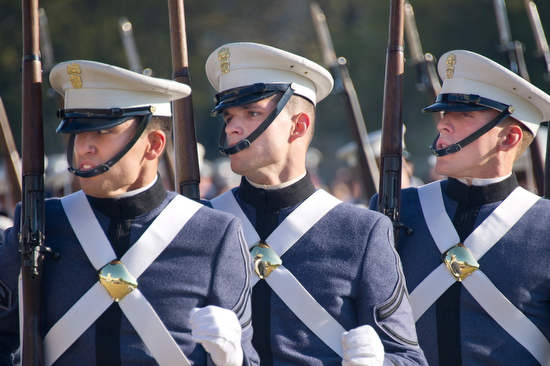
For me this is just an average photo of the Summerall Guards performing on Corp Day Weekend at The Citadel.
I was excited to capture this moment of the Summerall Guards performance. You see they perform this drill in silence and the only way they communicate is through small sounds.  Here you can see them sniffing, which is a small sound they can here next to each other.  I felt like I had captured the expression of the members doing all they could to stay in step and precision with each other.  This to me is a Decisive Moment of the performance of the Summerall Guard.
Moments are quite subtle indeed. I have written before about how the eyes are where true smiles are detected and not in the mouth.

Looking at the eyes of the guy talking and the guy listening lets you see there is a connection going on between them even though they are not looking directly at each other.  The eyes are giving away how this is a real moment and not something posed.

Here you can tell the lady is listening just by looking at her eyes.  There is a look people have when they are attentive with their ears that shows with their eyes.  You must capture these moments carefully by anticipating them.
Compare these two moments:


How do you capture the moment consistently?  You have to first shoot enough to begin with.  Way too many photographers never have learned to first overshoot.  Before you can learn to pick your moments you must first overshoot an event.

What happens when you overshoot?

First of all, over time you will discover that technically a lot of situations just will not work. I remember when I saw things and after a while would pick up the camera and shoot these only to discover later there were things from where I was standing making this impossible to capture.  Next time I saw something similar I was aware of either not making the photo or maybe doing something that would make it possible--like adding a flash.

Second, you realize their is a build up to a moment and then often just after the moment happens that the drop off is quite abrupt.  In sports there is the moment of the score and seldom just after you might see a moment when say a catcher at the home plate looses the ball in the tag and therefore the player is safe.  However for the most part the tagging of the player out is the moment.
Celebration after the touchdown.
Third, you start to see another moment develop shortly after the peak and give you a second great shot.  In sports this is often the jubilee shot.  The celebration after the score or sometimes the defeat you see on the defense or the loosing team after a score.

Last, you learn that moments are happening all the time and you must be on your toes watching and anticipating.

I tried to capture Tommy Bassett in many different moments in a desire to show the complexity of the man.  Here I have Tommy as a serious thinking and concerned person.

Here I think I have a lighter and humorous moment of Tommy with the ladies who formed a cooperative restaurant in Mexico.
Tommy Bassett is interpreting for our trip to visit the coffee farmers in Mexico for Just Coffee.

This is Tommy taking photos and getting contorted to get the right moment and composition.
When I went back through my coverage of my trip to cover the Café Justo in Chiapas, Mexico I realized I had a series of photos of our guide Tommy Bassett and one of the founders of the cooperative.  I also realized that had I wanted to do a story just on Tommy I would have wished I shot even more images of him.

You need to learn to think on your feet and continue to ask what are you trying to say.  What is the story? Then continue to shoot those things that will help you convey to your audience the story.  Remember you need to shoot enough to capture those moments that communicate.  Often these moments will have to be anticipated if you are to capture them.

Take that lens cap off your camera and get out there and start shooting.