Showing posts with label photography gear. Show all posts

Thursday, February 14, 2013

Photographers with Macs should travel with 2 external hard drives


When I travel I always carry two external hard drives. With the Mac computer you can have a complete copy of your hard drive on an external hard drive.

Making of mirror backup
I use the SuperDuper software to create a duplicate hard drive of my computer.

There are a few benefits to having a copy of your hard drive. First of all it is a backup. If your computer hard drive fails and is not recoverable then you have everything on your backup hard drive. Well you will have almost everything, from the time you backed it up till the time you use it all that material will be lost.
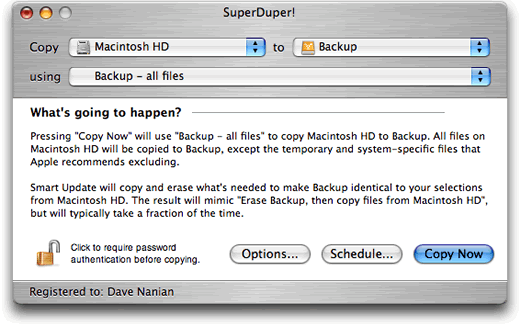
When the software launches it will look like this screen to the right. The hard drive on your computer is on your left and then the hard drive you are backing up to is on the right. 

There are a few options, but I pick the full backup. The first time it backs it all up and later it will only add the changes.

For the Mac user when you have an external hard drive that has everything on it, you can borrow another person's Mac and launch your computer.

Turn the computer off and then when you launch the computer just hold down the option key until you see your hard drive pop up as an option. Just click on your hard drive and now you are on your computer. Now it is not quite as fast as if it were built in, but it works great.

If your computer is giving you trouble then running repair permissions from your external hard drive will let you do an even better job of clearing up errors on your main hard drive.

You see your computer cannot fix something that is running. The only way to fix it is to run it from another hard drive sometimes.

To run "Repair Permissions" go to your utilities folder and click on Disk Utilities. It looks like the icon here with the stethoscope on the hard drive. Pick the hard drive you want to repair and then click on "Repair Permissions"

Now one more software I recommend buying is DiskWarrior. This software will do major repairs to your hard drive for you. However you must either use their CD or an external hard drive to run it. It really improves the performance of my computer.

I recommend running it about once a month.

It does more than just repair permissions. If your computer crashes ever, run DiskWarrior to clean up any damage done.

The reason I use an external hard drive to backup my system is to have a duplicate with me in case of emergency and to help me improve the performance of my main hard drive.

Hard Drive for Pictures and Video

My second external hard drive is where I put all the photos and video I shoot on jobs. I never put them on the main hard drive.

First of all shooting with a Nikon D4 in RAW mode creates a 24 mb file. My first hard drive was only 40 mb.  It will not take long to fill a hard drive shooting in RAW mode.  Videos are easily hundreds of megs in size as a bare minimum. Some run a few gigs and having this size file will wear out your primary drive if you put them on and off repeatedly.

Beyond Travel

I have more than one backup of my primary drive. I have at least two more of these back in my home office. I also have multiple backups of the photos on different hard drive.

My recommendation is to always carry at least two external hard drives to do at least at a bare minimum what I am doing.

Wednesday, August 01, 2012

Camera Insurance

Is your camera gear insured?
I woke up to sad news this morning, that two of my friends were robbed in London in the basement of a church behind two locked doors.  All of all their camera gear was stolen. Dennis Fahringer was the photography instructor for Youth With A Mission and his student Xiao Dong Yu from China had his gear and Chinese documents stolen. Keep them in your prayers and if you can help reach out to them.

They are doing this as a mission outreach for YWAM.  If you want to help Tom and Dennis you can donate here: http://dennisfahringer.com/DennisFahringer/Partners.html Please specify if the funds are for Tom. This is Dennis' account. When Tom canceled his credit card it made it so his PayPal account will not work.

This email prompted me to write today's blog.

Camera Insurance

There are many ways to insure your cameras and I want to give you three basic categories that I understand exist. My recommendation is to know your situation and if you are adequately covered.

Homeowners Insurance

If you do not make any money through the use of your equipment, a standard homeowners or renters policy should cover against theft and fire, even when your equipment is outside your home. This typically covers what most people would typically own and not maybe all the gear a hobbyist might own.

If you accidentally damage your gear, most homeowners policies will not cover this.

As long as you are not using your gear for commercial purposes the homeowners basic policy can then be expanded through a floater. Here you buy an "all risk" policy that will cover the gear for anything except those things they would exclude which often are things like "acts of war."  So if you are out boating and the gear falls in the water you would be covered.

For the Pro

If you are making money with your camera the homeowners policy will not work. You will need a commercial inland marine policy.  This is better than the "all risk" policy in that it will remove the exclusion of professional and usually have even more tailored riders such as covering you if someone trips over your tripod.

Because this is a commercial insurance policy you can expect to pay more.  Tyically  $1.75 to $2.75 per $100 worth of gear with a deductible of $250 to $1,000 per claim.

Additional coverage available on a commercial policy includes general liability, commercial property, workers compensation, commercial automobile coverage and umbrella liability to name a few.

Insurance: A reason to join a professional organization

One of the best reasons to join a professional organization is for its benefits like special healthcare and camera insurance. One of the best reasons to use their insurance companies is they understand what you need based on working with the organization.

Lesson Learned

A few years ago I was reading on a photography forum how people were getting great deals through their State Farm Insurance representative. I was with State Farm for my house and cars at the time, so I called them.

I explained that I do not have a studio and do location work all over the country and occasionally overseas travel.  The quote I got was for about 1/3 what I had been paying. I jumped on that and had the policy for more than two years.

On that same photography forum I later was reading that someone had a problem with State Farm's policy and found out they do not cover what was typical for what I was doing. I copied and pasted the forum post and asked my agent do you cover me or is this correct?

They investigated and came back and said I was covered through the end of the policy, but the forum post was correct and they would not renew my policy.

My suggestion is to find an organization like NPPA, ASMP, PPofA or another professional photographer's group and call the vendors that they have deals with.  I called all the insurance companies and after calling around finally settled with the ASMP's vendor Tom C. Pickard and company or TCP (http://www.tcpinsurance.com/).

Final Question

Do you know if you are covered if your gear was stolen? If you dropped your gear are you covered? If you are traveling overseas does this exclude your coverage?

You need to know the answers to these questions. Call your insurance representative and find out today, before it is too late.