Showing posts with label sharp photos. Show all posts

Monday, July 29, 2013

Check list for Sharp Photos

Nikon D4, 28-300mm [85mm], ISO 800, ƒ/8, 1/400
Squeeze the shutter — Don't punch the shutter release

Keep the camera as still as possible. If you can shoot with a tripod, all the better. If you can shoot with a monopod. The point it one the biggest reason most people's photos are not sharp is camera movement.

Shutter Speed and Focal Length work together

If you are not paying attention to which lens you have on your camera and how this affects your shutter speed, then your photos may not be as sharp as they can be. The rule of thumb is turn your lens into a fraction and use that to set your shutter speed. Put 1 over the focal length and then use the shutter speed closest to that as the slowest shutter speed for hand holding the camera.

A 200mm lens should give you 1/200 shutter speed. A 50mm should be held no slower than 1/50.  If you do not have 1/200 and the closest shutter speed is 1/250 use this, don't go under to 1/125.

Nikon D4, Sigma 120-300mm ƒ/2.8 with Sigma 1.4 converter, ISO 900, ƒ/5.6, 1/2000
Subject Speed

Photographing a building verses a race car is a big difference. You can have a shutter speed that lasts for hours and not affect the sharpness of a photo, but the stopping of a bullet in flight might require 1/10,000 to freeze the action.

I had always heard 1/500 to stop action. From my personal experience I have found that the razor sharp photos of sports tends to be about 1/2000 for me.

Aperture

The depth-of-field you choose can make a photo appear out of focus even if it is in focus. For example when you shoot at ƒ/2 and the subject is 15 inches from the lens the area that is sharp in front and behind the point you are focusing is most likely less than an inch. However, move that subject to 15 feet and your depth of field may now be a foot or more.  

Find the balance between ƒ/16 keeping everything in focus and wide open ƒ/2.8 with great Bokeh throwing the background out of focus. Often I find myself shooting ƒ/4 on a Nikon 400mm ƒ/2.8 to get more usable images.

Focus Miss

On many cameras today you can have multiple focus points. My Nikon D4 has 51 different points for focusing.
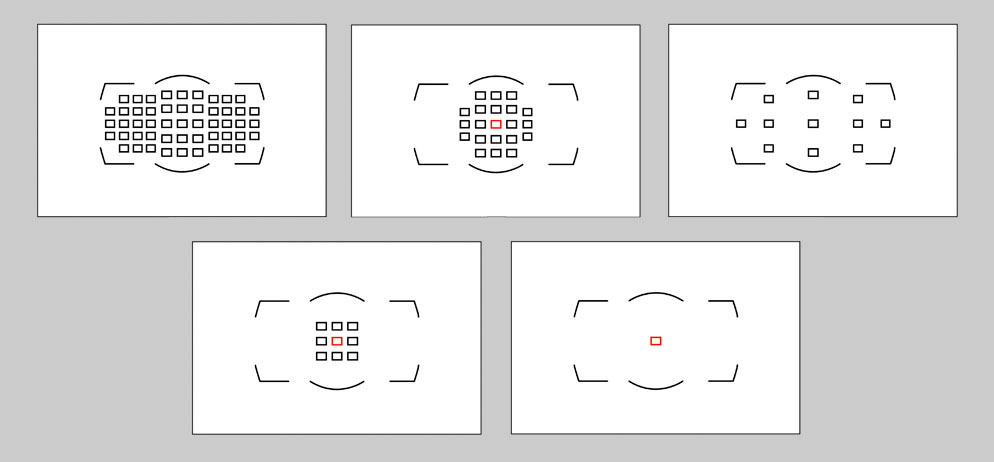

Depending on the focus mode I pick it is either easier to focus or more difficult. The point is many times people don't tell the camera where to focus. When doing portraits I try to use the eyes as my focus. If they are turned slightly to the camera one eye is closer than the other and I always try and get the closest eye in focus. This is when I may change my aperture to be sure they are both in focus.

With Nikon Capture software I can check later where I was focusing and see if I missed my focus. After using this to help me I was realizing I was missing focus more often due to me and not the camera's capability.



Post Processing

I use either PhotoShop unsharp mask or Lightroom to sharpen the image for how it is being used. Most all images could use just a little sharpening. If you over do the sharpening it will not look good. A little will give it a bit of a sharpness "kick". Use a small radius (perhaps a pixel or less) and a large amount.

Most all my photos are not process with sharpening until I export out of Lightroom.


If I am posting the photos to the web then I choose the setting here when I export of Screen and standard.

You have other choices you can choose when you export of paper quality as well influencing your choice.

Thursday, January 24, 2013

Nikon helps to continue solving photography's number one problem

Nikon D3, 24-120mm, ISO 6400, 1/50, ƒ/5.6 (shot at 112 focal length)
Photos are not sharp

While the photo above is not terrible it isn't sharp. Look at the enlarged section here below.


The reason the photo isn't sharp is not due to the camera or lens. You see the number one problem facing most photographers today is soft images due to camera movement.

No matter the camera you are shooting, the best thing to combat camera movement is a tripod. Your images will be the sharpest possible, that is if your subject is perfectly still during the exposure.

The second thing you can do is to increase the shutter speed. The rule-of-thumb is turn your focal length into a fraction. Put 1 over your focal length and then find the closest shutter speed on your camera faster than it and you are generally good to go. 

In the photo above I was shooting at focal length of 112. I would convert this to a fraction of 1/112 and then shoot to the closest shutter speed, which for my camera would have been 1/125.  Notice however I was at ISO 6400, ƒ/5.6 and 1/50.  I needed to go up by more than 1 stop to do that for this photo.

For various reasons I couldn't raise the shutter speed. To raise it would have been to push the ISO to 12,800 and the D3 really didn't look all that good at 12,800. I was already wide open and so I couldn't open up the aperture any more. I couldn't shoot with a tripod in the hair salon because I would be in the way of customers.

Nikon to the rescue

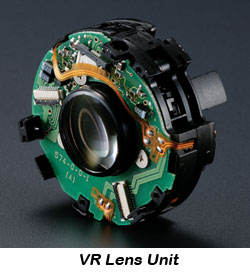
Nikon added two lenses to some of their lenses to help with camera shake. These lenses help with vibration and reduce the camera shake by counteracting it. They call these lenses VR which is acronym for Vibration Reduction. Nikon VR lenses use two angular velocity sensors, one that detects vertical movement (pitch), the other, horizontal movement (yaw), with diagonal motion handled by both sensors working together. The sensors send angular velocity data to a microcomputer in the lens, which determines how much compensation is needed to offset the camera's shake and sends that information to a duo of voice coil motors that move selected lens elements to compensate for the detected motion.

If you ever go on a cruise the ships have similar devices called gyroscopes that help stabilize a ship in rough water. If you have ever been on a ship and you still felt the roll of the sea this is because there is a limit to how much they can compensate.

The compensation of the Nikon VR II lenses is about equal to four stops. What this means is if you were shooting hand held with a camera lens at 1/60 then you should get the same sharpness as if you were shooting at 1/1000.  So you should be able to handhold a 1000mm lens at 1/60 based on this technology.  But if you have ever handheld a 600mm lens you know that few can actually hold one up.

The VR system can also detect the use of a tripod, recognize panning―an instance in which you wouldn't want the lens to compensate for movement―and address the specific shake caused by the ongoing vibration patterns produced when shooting from a moving vehicle. From my personal experience you want to turn off the VR function when shooting from tripod.

Nikon D4, AF-S NIKKOR 28-300mm f/3.5-5.6G ED VR, ISO 12,800, 1/80, ƒ/5.6 300mm
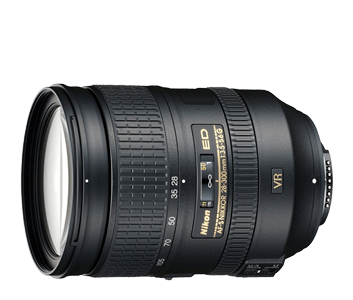
Just a few years later I now am shooting with a Nikon D4 instead of the D3 above. I can now shoot ISO 12,800 and I also have the newer AF-S NIKKOR 28-300mm f/3.5-5.6G ED VR that is a VR II technology.

I am hand holding this lens and just loving the results.

This is cropped area of the photo above. Notice how sharp the eyelashes are in the photo.
When I started shooting professionally 30 years ago I was using the Nikon FM2 film cameras. Let me list a few things that have changed making the above photo possible that I could have never done before.
  • Auto focus lenses
  • Highest ISO I shot in 1982 was ISO 400 for color and today I regularly shoot ISO 12,800
  • Vibration Reduction (letting me hand hold images four stops slower)
  • In Camera White Balance today (Only Daylight, Tungsten and BW film in 1982)
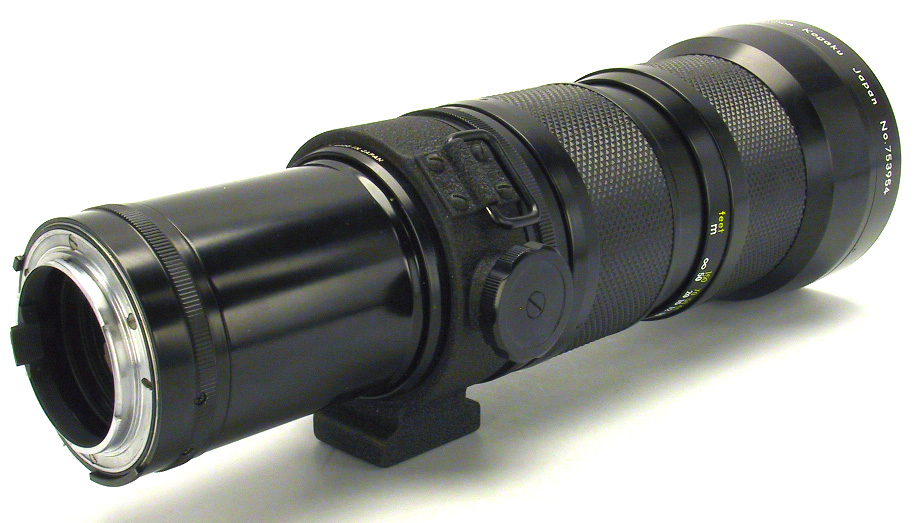
In 1982 Nikon had a 50-300mm that weighed 6lb 2.8oz

The lenses were manual focus early in my career and weighed a lot more than today. They are not as sharp as today's lenses due to the ability of computers to help in the design today.
Today this 28-30mm lens only weighs 28.2 oz and can focus faster than I could ever do with manual lens.
Nikon has helped me take photos I could never have taken before in available light, which is helping me provide services to my clients that have never been done before.

My go to lens

The AF-S NIKKOR 28-300mm f/3.5-5.6G ED VR lens might as well be bolted onto my camera. I do use other Nikon lenses, but this is always my first choice in majority of the situations I shoot. This lens with the Nikon D4 is one of the best combinations in camera gear today.