Showing posts with label visual workshop. Show all posts

Thursday, December 01, 2011

I am attending the Atlanta Photojournalism Seminar and you should too

The Atlanta Photojournalism Seminar
I have three friends that I have talked with in just the past couple of days who are driving in to go to the seminar today. All of us combined have more than 100+ years of experience, so why go to something like this when you have so much experience?

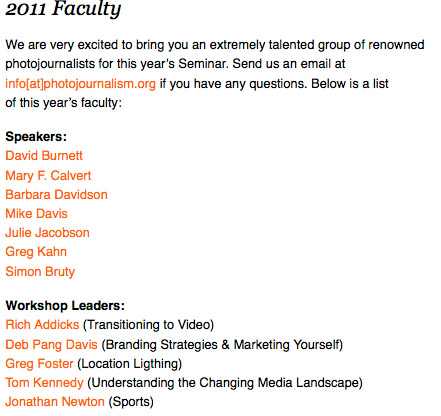
This years faculty
Deb Pang Davis
Some of the workshops intrigued me.  I was really interested in hearing from Deb Pang Davis on "Branding Strategies & Marketing Yourself."

While I even teach regularly on this topic, I am interested in how others are seeing the industry and places for growth.  With the economy so upside down and my industry taking a major hit these past years, many of the traditional avenues for income are not just down, but gone. I hope to hear about how some photographers are remaking themselves and finding income.

I am not interested in copying their path, but how they discovered the new niche may give me insights to where some potential growth for my work could lie.

I find that everyone sees things much differently and that when I am open and listen I grow and learn something new. I try to then see how maybe I can incorporate some of these perspectives into my life.


Tom Kennedy
The other workshop "Understanding the Changing Media Landscape" led by Tom Kennedy really appealed to me.

Kennedy is on the faculty of the S.I. Newhouse School of Public Communications at Syracuse University as the endowed Alexia Foundation chair in the multimedia, photography, and design department.

I first met Kennedy when he was the director of photography at National Geographic. I remember showing him my work and he commented that he didn't see any surprises. You can read more about this in my past blog on "To break the rules, you must first know the rules."

When I was co-president of ASMP Atlanta Chapter we invited Kennedy to speak. He packed so much in on this topic back then I just about got carpal tunnel syndrome from that talk. I am really looking forward to hearing him.

If you come to the seminar you will see more than the four old guys sitting in the room listening to some of these young folks.  You will see more of us, because we understand that when you stop learning you stop growing.

Keep yourself vibrant and growing by attending a seminar or workshop. If you are in Atlanta December 2nd and 3rd then come to the workshop.

Simon Bruty
By the way, Simon Bruty :: Sports Illustrated speaks on Saturday morning at 9:25 a.m. and this is free and open to the public, courtesy of Canon’s Explorers of Light program.

If you are an amateur you are welcome to attend as much as any professional or student.

While the speakers on the program are outstanding, I can tell you from my 30+ years of experience going to these events that those in attendance sometimes are on the same level and sometimes better known than the speakers.

Come and hang out with us. My daughter calls these events that Daddy goes to "Nerd Fests."

There will be Nikon and Canon gear to see and other vendors as well.

Hope to see you there. If you are there, come and say hello to me.

Friday, October 28, 2011

Do you have illiterates working on your communications staff?

Most organizations think that all their professional communicators are not only literate but are effective communicators.

Does your organization have managers putting out fires? I hear this a lot with managers. The root cause to these problems always seems to be poor communication.

When learning anatomy most students prefer seeing the parts of the body to help retain the information and also see how parts of the body interact with each other.
So if all your staff has college degrees in English or journalism why are there so many fires in the organization requiring managers to put out fires?

The reason I believe is simple most people are visual learners; a recent study by the U.S. Federal Government suggested that up to 83% of human learning occurs visually. The study also indicated that information which is communicated visually is retained up to six times greater than information which is communicated by spoken word alone.

All research points to we should communicate visually to be most effective. Psychologist Jerome Bruner of New York University has studied the art of communication, and his studies have shown that:
• People remember 10% of what they hear;
• 20% of what they read; and
• 80% of what they see and do.
Stages of Learning (from LeRoy Ford's book "Design for Teaching and Training)
I spoke students in a school camera club where the professional communicators for the school also were in the room. Both of the professionals who attended said they learned a lot. My topic was How Composition Communicates: Visual placement of subject communicates—do you know what you’ve been saying?

The camera club was created to help with the school yearbook, newsletters and for the professional staff to have some photos to use for the school website and publications. They asked me to come in and basically set the bar and help educate the students on what makes a good photograph.

When you take science classes there is always a lab component. This helps you retain the information according to Jerome Bruner's research in the 80% range. Personally I would prefer a doctor that has practiced and not just read about medicine before I see them.
If you enjoy my newsletters and blogs maybe your organization could use a workshop and have me come in and help everyone understand how to create and use visuals more effectively. Every organization that hires professional videographers and photographers all do their own work as well. Those organizations that help educate their people on how to create better visuals for their everyday needs will stand out from their competition.

“A common mistake I see many journalists make is that they write a visual story without watching the visuals in front of them as they write. Too often, a video or slideshow story is not connected to the visuals. A good story is hooked to the visuals and audio. In broadcast, disconnected shots are referred to as wallpaper video, meaning that the story could be told without the visuals.”
--Serena Carpenter, professor Arizona State University
I commonly see writers cover events and never watch the video they will use on the website or the still photographs before and while they are writing their story. 

While working on my masters of communication in the education department I was exposed to how people learn.  Surprisingly all my journalism classes spent most of their time on how to communicate but nothing at all on how people learn.  All my education classes taught me how people learn, but very little on how to communicate.  I used to laugh about this.

In organizations for the most part you need people who are not just knowledgeable as we show in the Stages of Learning chart (see above drawing).
  1. Knowledge: memorizing or recalling
  2. Comprehension: Translating (changing) into new forms, explaining
  3. Application: Applying learning to a new situation
  4. Analysis: Breaking communication down to its parts
  5. Synthesis: creating something new by putting the parts together
  6. Evaluation: Judging based on standards
I would say most writers are able to do all six stages when it comes to text, but when it comes to the visual literacy few move past stage one.

A good workshop will help your staff to learn how to use visuals with text to improve the retention of the information for your organization.

Stanley's Visual Training Workshops.

One-on-one tutoring in digital photography, photo-editing and visual communication. One day tutorial covers camera skills and Lightroom; 2-4 day tutorials add instruction in photographic expression & field shoots as well as matching visuals with text.

Costs: $495/1 day to $1,980/4 days.

If you would like me to help train your staff please call me for rates.