Showing posts with label photography workshop. Show all posts

Monday, February 17, 2014

12 week photography workshop for those who believe photography to be a calling

Fuji X-E2, 18-55mm, ISO 6400, ƒ/3.2, 1/280
Dennis Fahringer has been leading a photography program in Kona, Hawaii for more than 25 years. I first heard of the program back in the 1980's from my friend and mentor Don Rutledge.

Don was leaving on a trip to do work in Hawaii and at the time Don worked for the International Mission Board for the Southern Baptist. I joked with Don and asked what Hawaii had to do with international missions since it was a state.

This is when Don told me he was just teaching at the Youth With A Mission's University of the Nations campus in Kona, Hawaii.

Fuji X-E2, 55-200mm, ISO 6400, ƒ4.8, 1/250
Some of the past guest speakers that Dennis brings in for every class have included Gary S Chapman, Louis Deluca, Joanna Pinneo, Don Rutledge, Patrick Murphy-Racey, Gary Russ, Anacleto Rapping, Ron Londen and many, many more.

Most of the students are just starting out. The ages range in the class from 17 to 69 for the class I am presently teaching. Most of the classes I have taught the majority are from 18 to 30.

Fuji X-E2, 18-55mm, ISO 6400, ƒ/6.4, 1/25
Dennis has collected a large selection of books and videos for the students.


Dennis shares with his students many of his notes he has collected through the years on photography using Evernote app.  Dennis has shared some 3,700+ notes with the class that he has in Evernote: just short of 30,000(!) Just this alone is worth the price of admission.

If you are really wanting an intense photography program for twelve weeks then this is it. Before you can take this class you must do a DTS.  This is a 12 weeks lecture phase, plus 10-12 weeks outreach phase, thus 6 months total.  This is a Discipleship Training School where for part of your time will be a cross cultural experience. Many of these DTS groups go all over the world.

In my present class we have nine different nations represented. Those perspectives are great when learning photography.

Dennis has created a webpage for you to learn more about the program here.

Many who take the class go into business as photographers, other may use this in missions and even some just keep it as a hobby.

Saturday, February 15, 2014

Photography Workshop is the best way to learn photography

Fuji X-E2, XF 18-55mm, ISO 6400, ƒ/2.8, 1/60
I am really enjoying teaching here in Hawaii.  So you don't feel sorry for me soaking up all the beaches and warm weather, we are inside much of the day in class. Here the students are working on their assignment for 1:3 lighting ratio.

If you want to see their assignment here it is in an earlier blog post.

You will need to come back next week where I hope to post some of their photos.

Fuji X-E2, XF 18-55mm, ISO 6400, ƒ/2.8, 1/140
No matter how much I told the students it wasn't until they started shooting did they come to see if they really understood the concepts.

The cool thing is I don't jump in and help them. I let them work in small groups and teach each other. You see when they teach something they just learned they are now synthesizing the information.


If you just listen to someone you are probably only getting about 5% of the content. If you read about it then 10%, but when you start practicing you are now in the Kinesthetic level of learning and the average recall of the content after 24 hours is 50% or better.

You see based on research you will retain what your learned when you have hands on learning and get to practice. You will retain 75% of the content.

For those students who helped their classmate understand a concept that they just grasped then they will recall 90% of that concept the following day.

Give me a call. I do personal one-on-one workshops or you can have me come and lead your camera club in a hands on workshop.


Tuesday, October 29, 2013

International Missions Photography Workshop for Students


For many years a few of my friends have been talking about how to offer a hands on workshop for those who feel a call to use their camera in missions.

Jeff Raymond, ABWE Director of Visual Communications, called me and we talked for a while about our dreams.

There are a few things that needed to come together for this to work. Along with James Dockery, ESPN Video Editor, Jeff Raymond and myself we will be helping to train college students in storytelling for missions.

Next May we are taking 9 students to Lisbon, Portugal where each of them will work on a multimedia project telling a story about the missionary work in Lisbon.

The students will go through all the stages of the storytelling process. As they work on the project, each day they will receive instruction, opportunities to capture images and then receive critique so that they can then make adjustments the next day and continue to refine the story.

If you know of college students or are one yourself that is interested go to this link [http://www.abwe.org/serve/opportunities/photo-workshop] to learn more and register. We are taking applications and those who register prior to December 1st will be given priority. This is not the final deadline, but we encourage you to register early.

Thursday, July 11, 2013

Grandfather Mountain Camera Clinic

Jay Maisel, Bernie Boston, Hugh Morton and George Tames.  Four famous photographers in my book. I took this at the Southern Short Course in the 1980s.
In 1984 I graduated from East Carolina University and then went to work as a staff photographer for the Hickory Daily Record.  That year I would also go up to Grandfather Mountain for the Camera Clinic hosted by the mountain's owner Hugh Morton.

Hugh Morton was a photographer who enjoyed hosting this event each year for photographers.

This August 17 - 18, 2013 I am one of the guest speakers at the Camera Clinic.  You can register for the event starting on July 15th.

Here is a link to the event: http://www.grandfather.com/events/grandfather-mountain-camera-clinic/

I will be talking about the business side of photography.

Camera Clinic Ticket Prices

Working Press/PPA Member Participant (includes admission to the park, admission to all programs, plus Saturday evening meal)NC
Camera Clinic Participant (includes admission to the park, admission to all programs, plus Saturday evening meal)$50
2-day adult guest ticket (includes Sat.-Sun. admission to the park for ages 13+)$30
2-day child guest ticket (includes Sat.-Sun. admission to the park for ages 4 thru 12 – under 4 are free)$14
Guest Saturday night meal$10
Bill Fortney emcees a photo event in the 1980s.
This is where I first met Bill Fortney. Never know who else you might meet at events like this if you don't attend. If you are able to come I hope to see you there.

Sunday, December 02, 2012

Photographers need calibration

Bill Bangham, Gary & Vivian Chapman and Ken Touchton sit on the front row of the Atlanta Photojournalism Seminar in Atlanta on Saturday, December 1, 2012.
Industry Workshops and Seminars

Why do pros who have twenty, thirty, forty or more years of experience continue to go to workshops? You would think they know all there is to know about photography. Well for the most part they do know most everything to do for what they are currently doing. Sure they could use a tidbit here or there, but most photographers are not going to learn a tidbit at these workshops.

Michael S. Williamson is a two-time Pulitzer Prize winning photographer who joined The Washington Post in 1993 after working for the Sacramento Bee from 1975-1991. He taught at Western Kentucky University (1991-93). 
Review

Michael Williamson titled his talk to us "It Ain't The Tool. It's The Fool." He was helping us to understand it isn't about all the gear it is the what you do with it. While teaching at Western Kentucky University Williamson had two things he required the photographers put on the back of their cameras.
  1. What am I photographing?
  2. What am I trying to say with the photograph?
The seminar audience was "photojournalists" whose purpose is to tell stories with their cameras.  He even joked about not being an artist. "It must be art because I don't get it," is how he was trying to distinguish the difference between a picture just created for no reason and the other of having a message, which is the journalists' job.

Limits

Michael would joke about he was shooting a silouhet because he wasn't over his limit for that today. His joke was to remind us to look for different ways to engage our audience. "Photos that work are not good verses bad, they are interesting verses boring," commented Williamson.
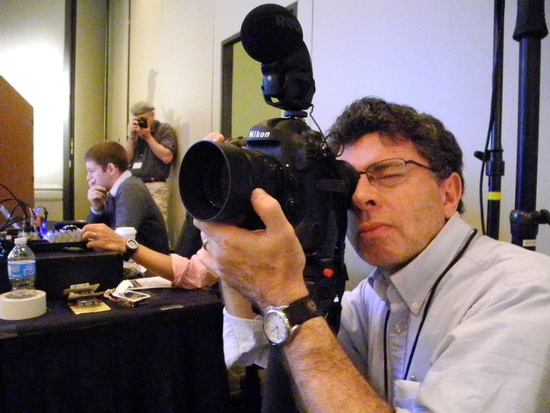
Michael Schwarz captures some of the event with his DSLR as video and is helping to put together a package on what the conference is all about.
Your gifts and talents

Vincet Laroret told us to know your role and those around you. He was helping photographers understand as they take on bigger projects some of the roles they play will change when they must collaborate with others.

Laforet used movies to help us know the role of those making them. You have your visionary Director, the director of photography,  ADs, Gaffers, talent and more working on a movie set to create the movie. He was emphasizing the need to be clear in your communication and why each person had roles that all needed to be flexible.

What I was learning from his discussion was that as the lone guy producing a package you must juggle all these roles. I reminisced that had I not spent time in different roles through my life I couldn't do this all by myself today at times. I also started to see how I was mentored to learn how to come up with an idea--the vision. 

Early in my career I was just executing many other creatives visions. I was like a first camera guy on a movie set. There was a senior photographer (Director of Photography) and they helped to guide me.

Today I bring on other pros to help me on projects as the budget allows.  

My take away to pass along:
  1. Learn how to work your camera
  2. Learn how to be a storyteller
  3. Learn how to create a vision (How to find a story)
  4. Continue to learn all you can about tools that will help you tell the story more effectively
  5. Learn to collaborate
David Gilkey is a staff photographer and video editor for NPR, covering both national and international news. He has produced award-winning photo essays, videos and multimedia presentations for NPR.org, as well as radio reports for NPR.
National Public Radio

Dave Gilkey talked about at NPR for the staff means "No Planning Required."  He has had to jump on planes at the last second to cover major stories around the world. 

Gilkey commented on coming to NPR that he learned from the best how to do audio. He knew he had to master it or face the wrath of his counterparts and is bosses. Before coming to NPR Gilkey knew how to shoot a photo story, but now he had to produce them with sound and at the quality of NPR.

Today he works on every story with basically two lists working simultaneously in his head. 1) Shot list like he had always done, plus more shots were needed and 2) Natural sound list.

He also was working many times with the NPR reporters and discovered the two of them were trying to get the same thing often. He needed a shot of the door opening and closing sometimes and so did the reporter need to capture that sound. So the lens and microphone were often needed to be close to get those clean shots and sound.

The Calibration

I was learning over these days of the Atlanta Photojournalism Seminar what was being produced today in the industry. This helps me know more than my little world. Without this time to come and see what others are doing I could easily become irrelevant to my clients.

Storytelling for the most part hasn't changed since before the invention of the camera. Writers were writing visual stories before we could capture them for the audience. 

Todays movies are using the latest technology to help communicate the storyline more effectively than before. The movie Avatar let us into a world that prior to computers could only be told with words.

I was learning some new twists on the storytelling to help me be the best I can be for my customers.

My question to you is have you calibrated to the industry yourself? Are you loosing jobs to other photographers and not knowing why?  

Going to a workshop will not stop you from loosing every job, but it will help you be more relevant in today's marketplace.

Besides calibrating myself, I was able to get my camera checked out and cleaned by Nikon. Hey there are many things to calibrate if you are a digital visual storyteller today.


Friday, November 30, 2012

Photography Workshops and more

Vincent Laforet is keynote speaker at the Atlanta Photojournalism Seminar.
The Stars

I always am interested in who is the faculty of a workshop/seminar. I come wanting to see their work and learn something that I cannot get from just seeing their work online or in a publication.

Vincent Laforet did a great job impressing us at the Atlanta Photojournalism Seminar with his work, which most of us will never shoot.  It was still inspiring.

While I learned years ago to go up and ask the instructors questions I learned how to make better use of my time. I learned that if I get to the event early I could grab the speakers before when few people were wanting their time.

The more I went to these events I got braver and then asked the speakers to eat lunch or dinner. I then got great time with some of the best in the field.

Christians in Photojournalism had dinner together at the Atlanta Photojournalism Seminar


Fellowship

Slowly I started to realize those people going to the seminar were just as valuable a resource as the "Stars."

Today I cherish my time listening to just about anyone. I love to hear what they are doing. Usually this gives me a very unique time to learn something new.

Ron Sherman shares with a few of us during lunch break.
 I love to sit around and just listen to stories people are sharing. Today I listened to a lot of photographers. Ron Sherman told us some fun stories.

Tip

While you may go the the seminar/workshop for the stars the people sitting next to you are just as valuable as a resource. The other thing is by just being interested in them and what they have to share you can learn a great deal. What I also learned is I get more time with them than the stars. They have more time and do not have a line of folks waiting to talk to them.

The key is spending time with someone. It is about getting to know them. Now when I see them again we acknowledge each other and catch up with each other.

Bill Fortney the Nikon representative has become one of my best friends and resources. 

Another great reason to go to conferences with Nikon is they often will do "free" camera cleaning.  I had two cameras cleaned that would normally cost about $30 to $50 each.  
Going to conferences is where I grow and learn. I get the side benefit of getting my cameras cleaned and learning about the latest gear. I can put my hands on the new gear and ask questions to those who are experts.

The first thing you want to be sure you do if you do not already have a photography seminar/workshop on your calendar is to put one on for next year.  I personally recommend joining me in Fort Worth for the Southwestern Photojournalism Seminar, March 1 - 3, 2013.  Here is a link to that conference www.swpjc.org.

Thursday, December 01, 2011

I am attending the Atlanta Photojournalism Seminar and you should too

The Atlanta Photojournalism Seminar
I have three friends that I have talked with in just the past couple of days who are driving in to go to the seminar today. All of us combined have more than 100+ years of experience, so why go to something like this when you have so much experience?

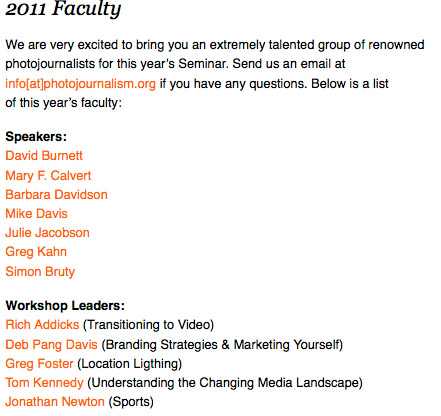
This years faculty
Deb Pang Davis
Some of the workshops intrigued me.  I was really interested in hearing from Deb Pang Davis on "Branding Strategies & Marketing Yourself."

While I even teach regularly on this topic, I am interested in how others are seeing the industry and places for growth.  With the economy so upside down and my industry taking a major hit these past years, many of the traditional avenues for income are not just down, but gone. I hope to hear about how some photographers are remaking themselves and finding income.

I am not interested in copying their path, but how they discovered the new niche may give me insights to where some potential growth for my work could lie.

I find that everyone sees things much differently and that when I am open and listen I grow and learn something new. I try to then see how maybe I can incorporate some of these perspectives into my life.


Tom Kennedy
The other workshop "Understanding the Changing Media Landscape" led by Tom Kennedy really appealed to me.

Kennedy is on the faculty of the S.I. Newhouse School of Public Communications at Syracuse University as the endowed Alexia Foundation chair in the multimedia, photography, and design department.

I first met Kennedy when he was the director of photography at National Geographic. I remember showing him my work and he commented that he didn't see any surprises. You can read more about this in my past blog on "To break the rules, you must first know the rules."

When I was co-president of ASMP Atlanta Chapter we invited Kennedy to speak. He packed so much in on this topic back then I just about got carpal tunnel syndrome from that talk. I am really looking forward to hearing him.

If you come to the seminar you will see more than the four old guys sitting in the room listening to some of these young folks.  You will see more of us, because we understand that when you stop learning you stop growing.

Keep yourself vibrant and growing by attending a seminar or workshop. If you are in Atlanta December 2nd and 3rd then come to the workshop.

Simon Bruty
By the way, Simon Bruty :: Sports Illustrated speaks on Saturday morning at 9:25 a.m. and this is free and open to the public, courtesy of Canon’s Explorers of Light program.

If you are an amateur you are welcome to attend as much as any professional or student.

While the speakers on the program are outstanding, I can tell you from my 30+ years of experience going to these events that those in attendance sometimes are on the same level and sometimes better known than the speakers.

Come and hang out with us. My daughter calls these events that Daddy goes to "Nerd Fests."

There will be Nikon and Canon gear to see and other vendors as well.

Hope to see you there. If you are there, come and say hello to me.