Sunday, January 22, 2012

One Week of Studio Lighting in Kona, Hawaii

YWAM School of Photography 1
Students work from 2006
In one week students go from not knowing how to turn on the strobes to doing some incredible work. My job is the take the fear out of trying new things and teaching them some basics from which they can build upon.

Take a look at each of these shows showing you some of the student's work through the years. I think you will be impressed as I was with their first time shooting with studio strobes.


This is the students work from 2006


In the studio
Mixing the strobes with available light


This is the students work from 2007
We shoot and let everyone see each others work on monitors, this way we are learning not just by doing but observing as well.
The school has a variety of lights for the students to practice with in the class.  Here we have the JTL battery pack system letting you shoot outside with studio lights and radio remotes.
Students learn they can shoot at dusk and night with the strobes. Here the students mixed strobes with available light and added a flashlight to write the word "Viking" beside the subject.  This was his nickname.


These are examples of my students in 2009 and what they did in one week.


Here is the students work from 2010

Saturday, January 21, 2012

Photo Tips I learned from Don Rutledge

Don Rutledge went to Russia a few times and this is his second trip.  The reason I am using his work as an example is because in my mind his work is stellar and has majorly impacted my work and many of my colleagues work as well.

While many would wait until the lady in front walked out of the frame, Don included her. The two men look very much like Americans, but the woman looked very much like the stereo type of a Russian woman.
What is important is how Don used all the frame for his work.  He also used it so well artists were complaining that they couldn't crop his photos. This usually did lead to some good discussions. When a designer crops a photo that is well composed they change the meaning.

A great designer who is working with a writer and photojournalist in a journalistic coverage will layout the story after looking through the images and selecting those that help tell the story.  Laying out the spread and then finding images to fill the holes is using photography as a decoration and not as communication.

Visiting the vertical photo above again look at how the men are looking one way and the woman is going the other. Do you pick up on the tension that the composition helps to create?

Don uses all the frame to help contain the message and to draw the reader into the photo.
The photo of the crowd walking towards you take a moment and look at the far left and right of the frame. Don has meticulously had the edges hold the man to the left and the woman on the far right in the photo.  Many photographers would often slice into the folks or have it too loose. The bottom of the frame is just below their feet giving extra space at the top of the frame. The top of the frame is where you have a sense of depth.

While the angle of the buildings roof line is at an angle creates depth, it is the open sky that opens the photo even more from front to back. Just cover the photo at the top and block off the open sky part and you will see how much that makes a difference in depth of the photograph.


Balance and context are achieved here in this photo of the pianist and the choir to the right.
In art class they teach about asymmetric balance.  Here in the photo with the pianist Don uses this technique to create a sense of calm and tranquility. The beams in the ceiling go towards the windows which helps to create a sense of depth. Some of the ladies in the choir are looking at the pianist playing which helps connect the choir back to the pianist.

While Don would have found this composition, he would have stayed here for a while until he had enough different frames. He is looking for the pianist to be playing and the choir to have a moment where they are paying attention to her.  Take out all those blinks or someone picking their nose (that happens a lot, especially during prayers) and you then are picking a moment that best captures the worship tone that Don was going for in this photograph.

Examine the edges of Don's photo. Why did he choose those edges? Then start looking for a subject. After you find the main subject look for something like a verb. After finding the verb look for secondary subjects.  What about some adjectives and adverbs, do you see any?
I love the little girl singing here in church. How do you know it is church?  Look at the pulpit to the right. Don left this in to help establish this as not a school play. Notice the women to the far left. Look especially at the lady on the front row. She really helps the photo because her expression really helps. You can see the lady to the right of her and closest to the girl singer and her expression also helps set a tone. The little bit of the objects at the top of the frame give a sense of even a bigger room.

As you watch the slide show look at the edges and see if you would change anything. Look to see if Don used things to help create depth and not make the photo look too flat.

While there is a primary subject look and see how the other subjects in the photo compliment the main subject. Do they create tension or just help establish a mood.

See if you see one guy laying in the background.  This was the translator who was thinking he was getting out of the way, but Don included him to add a little perspective.


If any of these photos moved you, please comment on it below.  Tell me why it moved you.

Friday, January 20, 2012

Creating images that recruit new students

Check out the slide show


Colleges and schools hire me to help them recruit new students. There are a few reasons I hear over and over why I am chosen.

Capturing a moment

Every school I have photographed used someone before me.  Many of these photographers were very competent. They had great exposures, good composition and nice light, but the photos just were boring.

To get the "moment" requires the photographer to take more than a couple of photos of any situation.  You need to connect with the subject and get to where you can anticipate them.  I might notice a teacher who walks over to a student and bends over to get close to hear them and see what they need.  They may only do this for 20 - 30 seconds.  If I miss them doing this once I can then move quickly to get into position the next time by seeing a student raise their hand.  I am moving before the teacher to get to the place to capture the "moment."

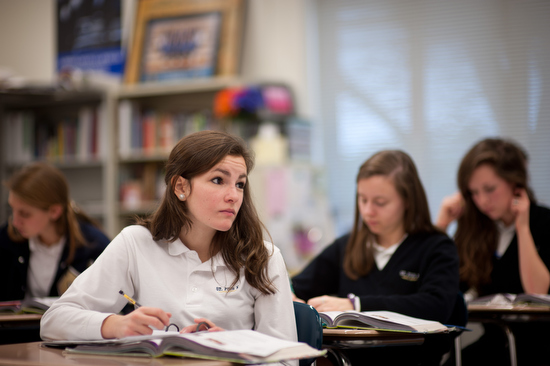
I like this image because I feel like the student is engaged in the subject and enjoying their time in school. (Nikon D3s, ISO 6400, f/5.6, 1/100, 28-300mm)
Color Correct 

Here is a great example of how many photographers shoot inside.  See the greenish color cast in the photo.


This photo is color correct and the skin tones look more natural.  The above photo is not color corrected.  (Nikon D3S ISO 2500, f/5.6, 1/100, 28-300mm)
When someone has really screwed up you can see banding of color in the photo.  This is when shooting under fluorescent or sodium vapor lights you get bands across your photos.  I am aware of the problem and make adjustments in how I shoot to avoid color issues with my photos.

Context

You need to do more than just get closeup photos of people's faces showing them enjoying themselves.
I like including posters on the walls to help give an idea what the students are studying.  It helps also communicate more than just they are in a classroom.  (Nikon D3S, ISO 1600, f/5.6, 1/100, 28-300mm)
One-on-One

I like this because the teacher and student one-on-one time is more than just two people it is about a teacher who cares and enjoys helping the student.  I like the student expression because they are serious and need help.  (Nikon D3S, ISO 5000, f/5.6, 1/100, 28-300mm)
One of the most important things colleges and schools report is the teacher to student ratio.  It is important to show students do interact with the teachers and not just being lectured to in the class.  This requires you to wait for those moments.  If you are like some people you just stick you head in take a couple snaps and leave.  You would miss so much by just documenting.

Engaging

Students need to be shown challenged by the course work and not bored.  However, in pre-school it can be fun to show a child yawning.  Sometimes humor is cute and just as engaging.  In older grades it isn't quite as cute.

The body language of the student shows deep thought and interest in the class. (Nikon D3S, ISO 4000, f/5.6, 1/100, 28-300mm)
Individualism

I look for moments where I can show the student is still independent and comfortable in being independent in their work and thoughts.

Using a very shallow depth-of-field helps to isolate this student. (Nikon D3, ISO 720, f/1.6, 1/100, 85mm f/1.4)
Using a shallow depth-of-field, I can make the student pop out from the other students. I see how this helps show they are an individual and yet also part of the class.  If you just crop everyone else out you do not have the same visual communication taking place. (Nikon D3, ISO 200, f/1.4, 1/125, 85mm f/1.4)
It is about communication and not pretty pictures

Too many photographers are trying to just make art and not communicate. For a photograph to communicate the photographer had to know what they were trying to communicate or it will often fail.This doesn't mean communication photos are boring.  It just means they need to communicate a message. They can do this and be just as much a fine art piece.

This is why I studied social work in my undergraduate and then did my masters in communication in the education department.  I wanted to understand how to use visuals to tell a story.

When you look to hire a photographer, look for someone who understands what education is about.

Thursday, January 19, 2012

360º Panoramic and how it can engage the audience

Click on any of the thumbnails to see a Spherical Panoramic 

2
Columbia Theological Seminary Classroom
2
Columbia Theological Seminary Courtyard
2
Columbia Theological Seminary Tower

2
Columbia Theological Seminary Front


This is a good place to compare and understand how you can use photography for a brochure and the web.

There is a building dedication in just a month and the building is still in process, but I was able to get into the building and make some photos.

The client needs still photos for a brochure which will be used at their dedication.  If you allow time for printing and a designer you quickly see we only had about a day to turn around the project.
This is inside view of the Tower. (Nikon D3S, ISO 200, f/11, 1/80 14-24mm)
As you can see of the still image of the Tower above this could work easily in a brochure.  It is strong graphically and pulls the reader to read a little more about the project.

This is a composite of 5 exposures and then some perspective correction to keep the building from leaning away from the viewer. 
While both of these images give you an inside and outside view of the Tower.  Please take a look at the above thumbnails and compare for yourself.

If you want to engage the audience then on the web I think the Spherical Panoramic works very well.  The audience can spin around and feel like they are their and except for smell it would look pretty much the same if they were there.

I would probably still use some of the still images on a website, because for those who are wanting a quick read this will suffice. 

When photographing a building to be used in a brochure you need to get some detail shots.  This is what replaces a typical drain spout on the gutters and is more environmentally friendly. (Nikon D3S, ISO 200, f/5.6, 1/60, 28-300mm)
When the building is a further along we will go back and add hotspots to the panoramic where you can click on a detail and a photo will pop up so you can see the detail larger.  Since the workers are still wiring the building many of the details we wanted to show are not even installed. 

Creating a unique image.  We used additional flash off camera to the left to light the bell drains.  (Nikon D3S, ISO 200, f/22, 1/160, 14-24mm)
This is the same as the above photo, but without the flash to light up the bell drains.
It is important today to not see "either or" as deciding what type of photography to use. You need to think "AND" as a possibility.

I can also see going back and interviewing the designer talking about a new feature in the building and having this as something you click on in the panoramic. Why not get some professors to contrast how this will improve their teaching.  Maybe getting a student or two talking about how much they will like some aspect of the new building.
While this photo works for the brochure purpose, I don't think it compares to the 360º Spherical Panoramic.  (Nikon D3, ISO 200, f/4, 1/4, 14-24mm)
I like the covered walk way. (Nikon D3S, ISO 200, f/11, 1/250, 28-300mm)
If you enjoyed reading this and seeing the images, please take the time and comment below.  I really could use some feedback and if you have suggestions for future posts let me know in your comments.

Monday, January 16, 2012

Russia from Don Rutledge's Eyes


Don Rutledge covered Christians in Russia in the late 1980s and I think there are a few things we can learn from his coverage.

Don has the ability to tie things together in a photo like few photographers have ever done.  Here he has the pastor with the kids signing. What is so cool is the last supper photo on the wall.  It just ties it together with the symbolism.
Don Rutledge had an ability to go to a different culture and cover it even tho he didn't speak their language or understand their customs.  During his career, Don covered more than 150+ countries of the world and all 50 of the United States.Here are some audio recordings of Don as well as some links to stories he had published.

John Howard Griffin and Don Rutledge during the production of Black Like Me.
Let's review his work on Russia to see how a photojournalist can help connect the subject to the audience through the use of images.

Background 

Don didn't speak Russian and had not been to Russia before. What little he knew was from reading and talking to some missionaries who traveled the area. Don wasn't an expert on the culture, but had read a great deal before he went to Russia.

Slide show is a snippet

Don Rutledge would typically go on a coverage like Russia for about 21 to 27 days.  He would pack about 300 rolls of color slide film and about 300 rolls of black and white film. Each of these rolls was a 36 exposure roll of 35mm film.

He would usually return with some film so he didn't shoot all 21,000 possible frames.  He would easily shoot half to three fourth's of the film.

The slide show I worked on in 1987 for Don to use when he spoke to groups about his coverage.

I liked using this as the opener for the Slide Show because I think it says Russia and announces where this story takes place.
How it is divided

The slide show is divided into an overview of the country, a section on the culture, section on the Russian Orthodox Church and then series of pastors and leaders with their families.

When this was being done the distribution of the story was done in The Commission Magazine. The magazine was regularly competing and beating magazines like National Geographic Magazine.

The magazine normally started stories with 1 to 3 double truck spreads to introduce the country.  Don captured things that not just showed what the country looked like, but in a way contrasting it to the audience in the United States.

You can see the architecture and the man trimming the tops of the trees. What struck Don was how neat everything was and this was something that not just showed what it looked like, but the man gives size and scale to the photo as well as showing how they keep everything so groomed.
Don ended taking tours of the churches in Moscow to help show the Americans how they view the church. On the tours they were showing all the gold and art work in the previous church buildings.  They would tell the people this is how the church acted in the past, they took all your money and then used it to decorate.

Showing the theater helped connect the Americans to something we had in common. Our love of the theater and the Opera in Moscow is considered one of the best in the world. 

Then Don helps us transition through the Russion Orthodox church to help the Baptists in the states see some sense of faith in Russia.

Baptists in Russia are so many and the church buildings are so small that they are overflowing into the street.  Here you see how they listen to the service inside the building. 
Don continues to show artistic moments that also communicate something similar and yet different in almost every frame.  The Russians outside in worship look like Americans but we don't sit outside our churches to hear the worship service.

Don helps the audience connect with the subject using everyday life moments. He captures people cooking, in their homes and with their families.

Pastor enjoys going around town with his family.
This is just a taste of some of the things I learned from Don from his coverage on Russia. 

If you really want to learn how to do a coverage like Don did on Russia you can join me in Tibet.  The workshop will help teach you how to put a coverage together like this and then also help you to keep your audience in mind as you shoot.  We will shoot together and then review our work in Tibet, this way you can go out the same day or next and fill in the missing holes.

I hope you will consider joining me in August in Tibet.  Click here to learn more about the Tibet Workshop.

Saturday, January 14, 2012

Photo Advice to Non-Professional Wedding Photographers


Today I was a guest at a dear friends wedding. I prefer being a guest than the photographer of the wedding.

They had a great photographer in Peter Hobbs. Since I am a guest I have some personal rules for covering an event when they have a professional already--like a wedding.
Peter Hobbs directing the bride and bridesmaids for a shot. (Nikon D3S ISO 9000, f/5.6, 1/500, 28-300mm)
First Rule: No Flash

One thing I did today is I shot all my photos without a flash for a reason. The family hired a excellent photographer who needed to deliver great photos. If I used a flash I could have had the bride and groom blink and most likely messed up their photo album they were paying for.

Second Rule: Stay Out of The Way

I am not in the wedding party and I am not the hired professional photographer. So if you are ever in this situation, try and shoot when the professional isn't shooting.

Third Rule: Look for something different

Most likely if you are a guest at the wedding you will know some of the people better than the photographer.  Shoot around the edges and capture guest and not so much the bride and groom as the professional photographers are doing.

Look for the things that the bride and groom would enjoy as a nice compliment to what the pro is providing.  Don't try and duplicate what the pro is getting.

The bride and her father. Well honestly this dance brought tears to everyone in the room.  Because they were slowly spinning in the middle I was shooting from a different perspective than the pro.  I might have a moment they couldn't get from their perspective that the bride and groom will still cherish. (Nikon D3S ISO 12,800, f/1.4, 1/125, 85mm)
One of my friends calls this just blessing your friends by taking some good photos and giving it to them.  I hope this gave them something they will cherish.
I sat in the back out of the way.  I didn't want to in obtrusive. (Nikon D3S ISO 12,800, f/5, 1/100, 28-300mm)
Fourth Rule: Take some photos for myself

When I am not being paid to shoot I enjoy just taking some photos for myself.  Here are some that the Bride and Groom might not want, but are part of my photos of the day.

Chelle, my daugher and Dorie, my wife were looking great in their dresses so I got a photo for us to have by the fire place. (Nikon Coolpix P7000, ISO 400, f/3.5, 1/15)
This is the lobby of Brasstown Valley Resort.  I just liked the fire place a lot. (Nikon Coolpix P7000, ISO 1600, f/3.2, 1/350)

Coyote, Raccoon and even a red fox hats were for sale at Pappy's Restaurant in Blairsville, GA (Nikon Coolpix P7000, ISO 1600, f/3.5, 1/125)

Pappy's Restaurant in Blairsville, GA (Nikon Coolpix P7000, ISO 1600, f/3.5, 1/125)

My pork BBQ plate with green beans and baked beans at Pappy's Restaurant. (Nikon Coolpix P7000, ISO 1445, f/3.2, 1/280)


Thursday, January 12, 2012

Are you out of focus?

I read a lot of books and they are not all about photography. I enjoy reading as much about business and it is here that I keep coming across ways to be more successful.

I have adapted some of what I am reading to photography. This is my attempt to help to get people to see we need to bring some balance into our business lives to achieve our goals over time.

Success is when preparation meets opportunity.
-- Henry Hartman

Preferences

Each of us have our strengths. I have written before about the strengths finder and encourage you to discover your gifts/strengths.

Stanley in Burkina Faso, West Africa on assignment.
Where you focus  

Where you focus yourself is where your energy will go. This tends to be along your strengths.

  • Comfort with Technology - In the days when we were processing film, there were many photographers who would love to take one negative and work on it forever.  Ansel Adams would fall more into this category.  He worked very hard to get the very last drop of detail out of the image.  Today PhotoShop or Lightroom is what can eat up all your time if you let it. It could also be being more comfortable with the camera and lights and therefore you shoot products because working with people distracts you too much from your comfort zone.
  • Comfort with the subjects - There are many photographers who really enjoy how photography gives them access to people and places. They will spend as much time as possible letting the camera introduce them to people and less time with the camera. Some of these photographers really struggle with the technical things they could do with their camera and may just learn how to do shoot a certain way and repeat this. On the extreme of this may be someone like a school portrait photographer.  You don't really have to know all the technical, just set it up the same way and it is your ability to get great expressions and knowing how to make people comfortable with the camera that sets you apart.
  • Comfortable with your gut - You like responding to situations and just can sense the right thing to do in a certain situation.  This could be the war photographer who doesn't necessarily like cover the death and destruction, but know they are good at making those photos that tell the story and can do so without loosing their life in foreign countries or in a war zone.

I have found a niché in multimedia.  (Photo by Ken Touchton)
What you develop as your niché

Photographers tend to play to their strengths and then work hard to develop them even more. Like a musician starts to play the piano due to an interest, then spend a lot of time taking private lessons and practicing to hone this skill.

Photographers need to spend time going to workshops with instructors who can help them develop the skills to rise to the top of the industry. Photographers will seek out mentors who they admire their work and can help coach them.
  • Going with your gut (Kinaesthetic Knowledge) If you have an interest in war photography you may spend your time reading books on war photographers, wars and study politics and culture at levels very similar to the experts in these fields.  The reason you do this is you know that to survive you must know more than shutter speed and f/stops.  You need to understand the culture and know how to get around in situations that there are not manuals for, because it is new. You may reach out to The Dart Center which helps journalists deal with Post Traumatic Stress Disorder.  
  • The empathetic photographer (Emotional Quotient) I have a close friend who has a special needs child and who has a heart for not just his child, but for all special needs people. This photographer goes to seminars, reads stories and today covers these subjects helping give a voice to the voiceless. 
  • The Strategic Photographer (Intelligent Quotient) May be looking for ways to use their mind to use maybe more technological answer to situations.  They may use multimedia, panoramic, post production skills and other things that play to their intellect to help a client achieve their goals.  
  • The Spiritual/Moral photographer (Spiritual Quotient) photographer lets their inner wisdom guide their compassion.  You see a lot of humanitarian photographers who are driven by doing the right thing. I think there is a difference between the empathetic photographer and the Spiritually guided photographer. Sometimes the spiritual minded photographer can lack some empathy just as sometimes the empathetic photographer can lack some pragmatic thought.
Stanley teaching in Kona, Hawaii. (Photo by Chris McCloud)
Moa Noble twirls the fire knife. It is part of the Samoan traditions in Hawaii. This is the photo I was showing the class how to make last February in Kona, Hawaii. 
DANGER - Too Focused

When you only go to what you perceive as your strengths sometimes this is the same as being a child who just wants only ice cream or macaroni and cheese for every meal.  It is unhealthy. I suggest expanding your horizons.  Go to events, seminars, workshops, or take up a new hobby just to bring some fresh air into your life. The reason you want to do this is to access your untapped potential.

Focus Inward for a change


I have been on Weight Watchers and learned that when I stay with the plan I loose weight, when I depart from it I put it on. What is the core thing I have learned--tracking everything I eat and sticking to a prescribed number helps me take weight off.  If I go above that number too often I start to put weight on.  The numbers that Weight Watchers assigns to a person is based on their height, weight and activity level.

Photographers need to track what they do. It is when you take some time for self observation that you will notice you are spending a lot of time at the computer and no time meeting new people and growing your business. 

You should be able to take a calendar out and see where your time is going. If you want to be successful it will look like a good balanced meal.  If all you have is all steak and no vegetables you cannot sustain a healthy business.

How do you become successful?

Same as the answer to how do you play at Carnegie Hall--Practice, Practice, Practice.  My sister-in-law is Pam Goldsmith.  She is one of the top violists in the world. She sits first chair in the studio musicians group of Los Angeles.  What this means is she plays on most of the recorded music for Hollywood productions.

These are the highest paid group of studio musicians in the world. When they record the music for a movie they hire this group for a good reason.  They play everything for the first time they see it and 90% of the time that is the last time they play it. They record them sight reading most all the movie scores.  It would cost too much to practice a few times and then play it.

Since I grew up playing the trumpet I was blown away at this. I didn't realize when you master the instrument at the highest level you can play a piece of music that no one has ever played before the first time as if you had been playing it for a lifetime.

How do they do it? When they are not performing they are practicing.

I too must perform on this level every day with my photography. I get one shot. I don't make a photo of someone and we evaluate it and then I try it a few time over and over till I get it right.  How do I do that? I practice everyday taking pictures and looking without my camera. When I pick up my camera I seldom think about what I am doing to make a photo--I just do.

Wednesday, January 11, 2012

Where my time goes as a full-time Pro Photographer

I have seen some pie charts lately on forums and blogs about how much time a professional photographer spends doing different things to run their business.  I thought about what I am doing and believe this is pretty close to what I do in the chart above.

In some ways I see some of these overlapping and not as clean delineations. For example I see blogging as much a part of "Marketing" and "Learning/Workshops" as something totally independent for the others. 

Stanley shooting an assignment. (photo by: Knolan Benfield)
Shooting

I may actually shoot even less than 10% of the time, but this is close.  When I first started doing this full-time I was lucky if this were even 1%.

When I was on staff I shot a little more percentage wise, but even as a staff photographer there were a lot of other responsibilities.

Even when I look at my time doing what many consider what a photographer does it is broken down into different parts.

I may shoot for a day with a client and then have to spend a full day or more ingesting the images, culling the take, editing the picks, converting them from RAW to JPEGs and then delivering the images. Often after booking the job and before I show up there are a lot of pre-production things you need to be involved in. You need to charge batteries, sometimes scout the location, line up assistants, talk the the client to coordinate and many other things to be sure the shoot is a success.

Estimates

When someone has contacted you for a photo shoot one of the first things is collecting all the information you can to encapsulate the clients expectations. After you have all this information you are going to need to prepare an estimate.

I write down all the hard costs that I can think of for the project. I think of all the time I will need to complete the project.  This is figured on how long it could take and not on if everything goes well. I try to under promise and over deliver.

After I know the costs of the project and what time I have involved I then start my estimates with the Cost-of-doing-business.  These are all the costs to just have your doors open for business that you must spread over all your jobs to recover.

After adding all this together I then compare this to what is the going rate.  While I could do a job for $1,000 why would you price it at this when the going rate is more like $5,000?  On the same note, if the going rate is $1,000 and my figure is $5,000 this has to somehow be justified.

The last part of writing an estimate is putting myself in the place of the client and creating the verbiage that will help them understand the bottom line and why I am the best for the job.

Book Keeping

I spend a lot of time invoicing, tracking my expenses, following up on outstanding bills, getting 1099 forms from assistants, providing 1099 information to clients and the list goes on and on.

I have bills, healthcare and taxes to pay. Knowing the IRS can call you in and want to see your books will cause you to spend time doing this or paying someone to do it for you.

Stanley teaching. (by Dennis Fahringer)

Educating Clients

I am often spending time helping clients understand why a certain treatment will help them achieve their goal. Sometimes I am having to put together examples of my work for other clients or from my portfolio to help them see what I am proposing.

In this industry seeing is believing and talking is cheap. 

Sometimes I have to find contrasting examples to make my points.

Often clients do not really know what they want and you are problem solving and proposing possibilities in order to get them to tell you if you are on the right track or not.

The best scenario is for the client to invite you into the process before they are making the decision to use a photographer. I do this for many of my clients.

Surprising to me I have found myself talking myself out of shooting a job because that wasn't the best thing for the client.

Portfolio Development

I really think you need to go and work on your own personal projects to create the material to show to clients and attract clients to what you enjoy doing the most.

What you often find is that clients may not hire you to do what you are showing, but hire you because you are showing them it. They may want to do something like what you want to do and because they feel good about your work will hire you to shoot other things in hopes that by bringing you in they might somehow get their bosses to see your portfolio pieces and want to do it as well.

Learning/Workshops

This really overlaps with Portfolio Development. I must keep current with the latest gear, software and techniques to see what things I can do to improve what I am doing now or even to do new things all together.

I enjoy being inspired by other people's work and then I also need hands on workshop time with some of the new software.

Blogging

Today you need to interact with your audience as much as possible. People hire the last guy they can remember.

Blogging helps me be in front of clients and potential clients.

Blogging also helps to differentiate you from others.

This is like how a series of photos will help you more than one photograph. Every one has at least one photo in them that could win awards, but consistently showing a variety of work shows you can deliver all the time.

The way blogging helps differentiate you is showing your expertise. When it comes down to it people are hiring you as a problem solver more than a photographer. Talking about how you solved a problem and then showing the images demonstrates your problem solving ability. Showing a portfolio of images shows you make pretty pictures.

Marketing

If people just would call me and I was booked for the rest of my life then I wouldn't have to do marketing.

No matter what business you are in you have to find those clients who want to hire you.

I think in many ways photography is more difficult to market than food, healthcare or housing. Photography to a certain extent more of a luxury than a necessity. If it were a necessity then you are marketing to everyone and then just trying to explain why to pick you over another grocery store.

Most people own cameras and will most likely take their own photos to use before they take the next step of hiring a photographer.  Getting people to want to hire you over them doing it themselves requires you to prove your value.

Even if you were selling widgets the numbers would be similar.  For every 1,000 companies you contact only about 100 of them will be impressed enough to take a second look at you.

Of those 100 companies that think they are interested only 10 will hire you for the job.

In this business of photography very few of those 10 that hired you will hire you again repeatedly.

If you are a wedding photographer your hope for the client is they only hire you once to shoot their wedding.

Unless your client has an ongoing need for photography like supplying a website with fresh material or a publication you will only be hire occasionally by them. 

A very successful corporate photographer will shoot maybe 100 days a year. If 8 of those 10 clients hire you only 1 time a year and the other 2 hire you maybe 3 times a year you will start to see the reason why you spend a lot of time marketing.

10 Clients who hire you 3 days a year = 30 Days
+ 70 Clients who hire you 1 day a year = 70 Days
Total of 100 Days

There is no formula except that you will spend a lot of time finding people to hire you.