Showing posts with label Theater photography. Show all posts

Saturday, March 19, 2016

Fuji X-E2 4.00 Firmware Upgrade

Fujifilm X-E2, FUJINON XF 55-200mm, ISO 5000, ƒ/4.7, 1/200–Electronic Shutter
As promised after I updated the firmware I shot the same theater show as last night and my last blog post.

Electronic Shutter

Well one of the first things I fell in love with was the electronic shutter. I turned the camera to this and shot a few image out my window of the backyard. Overall looked OK. Then I even turned the sound off on the shutter and I mean it is totally silent.

However as you can see in the top photo, that is suppose to be a straight line on the right for a wall. If you look at her lips you can see a softness there that shouldn't be there.  My friend Gary Chapman warned me about this banding affect.

Fujifilm X-E2, FUJINON XF 55-200mm, ISO 6400, ƒ/4.6, 1/500–Electronic Shutter
Here you can really see the banding affect. To compare this to one without the electronic shutter I reset the camera quickly when I started to really notice this and here is the one I shot after changing the setting.

Fujifilm X-E2, FUJINON XF 55-200mm, ISO 5000, ƒ/4.5, 1/300–Regular Shutter
Now I went back and read the upgrades in the PDF by Fujifilm:
High-speed electronic shutter with a maximum speed of 1/32000sec. (*) 
The FUJINON XF Lens series lineup includes a number of fast fixed focal length lenses which boast very high sharpness with the aperture wide open, producing excellent out of focus "bokeh". However, fast apertures are difficult to use if the light is too bright, so to ensure users can create shallow depth-of-field effects, the camera is now equipped with a fully electronic shutter offering a maximum shutter speed of 1/32000sec. The mechanical shutter will not operate at all when any speed for the electronic shutter is selected, which also delivers a completely silent shooting experience; perfect for shots of sleeping children, pets, weddings, and more. In addition, it is possible to set the electronic shutter in 1/3 steps from a range of 1sec to 1/32000sec. 
Notes: Shutter Sound 
The shutter sound can be muted if desired. Use the new "SHUTTER SOUND" and "SHUTTER VOLUME" options in the setup menu to choose the type and volume of the sound made when the shutter is released. 
I believe from my tests that if you are inside and shooting at a pretty fast shutter speed you can get the banding effect. I think the electronic shutter is better for shooting outside in bright light where you may want to shoot at ƒ/1.2 and need then the super fast shutter speeds.


Fujifilm X-E2, FUJINON XF 55-200mm, ISO 6400, ƒ/4.8, 1/180–Firmware 3.10
This is from the first night's performance with the older firmware 3.10

Fujifilm X-E2, FUJINON XF 55-200mm, ISO 6400, ƒ/4.8, 1/250
The main difference isn't in the end quality but while shooting the AF locked in on their faces and throughout the night was consistently finding faces better than before. So since the auto focus and face recognition was better the exposures were better because one the face was recognized the exposure was based off them.

Here are the notes about the improved AF
New AF System
(1) New AF system with Zone and Wide/Tracking modes for effortless capture of moving subjects. 
The AF System complements the fast and accurate 49-single-point autofocus system with new Zone and Wide/Tracking modes, which use 77 autofocus points across a wider area to substantially improve the camera's ability to capture moving subjects.
(2) Improvement of AF accuracy. 
Single-point AF divides the focus area into smaller sections to more accurately determine the distance to the subject for even greater focusing accuracy. The built-in phase detection pixels have the detection range of 0.5EV, an improvement from the previous 2.5EV, delivering phase detection AF performance that enables fast focusing in low-light conditions and on low-contrast subjects.
(3) Eye Detection AF. (*) 
The firmware update provides Fujifilm's Eye Detection AF, which automatically detects and focuses on human eyes. 
The function allows you to easily focus on the eyes even in difficult conditions, e.g. when shooting a portrait wide open to obtain a beautiful bokeh background.
Now while my hopes of using the Electronic Shutter all the time were dashed, the overall performance of the Fuji X-E2 was significantly improved and like buying a newer model camera. So thanks Fuji!

Fujifilm X-E2, FUJINON XF 55-200mm, ISO 6400, ƒ/4.6, 1/400
I had to post the one photo of my daughter's performance from tonight.

Friday, March 18, 2016

Love how the Fuji X-E2 is for Theater

Fujifilm X-E2, FUJINON XF 55-200mm, ISO 6400, ƒ/5, 1/125

NEWS UPDATE!!!


This morning I went to Fujifilm.com and discovered there was a firmware update on the Fuji X-E2. Go here if you need to upgrade to the latest firmware 4.00.

Due to the upgrade and having opportunity tonight to shoot the same play again I will write a new followup post on Monday about the firmware upgrade and how it helped improve my experience. Well that is what I anticipate.

One huge update is an electronic shutter release that you can make totally silent. The camera on default actually plays a recorded sound that you can change to different noises, just like ring tones, or turn it off completely. In essence a silent camera. So this I can tell you already will be better than last night.

Observations from last night's photo shoot


When shooting a theater performance you quickly can hear how quite the auditorium will get so everyone can appreciate the dialogue. Now in a high school play like the one I shot last night the ability of the actors to all project like professionals is just not the same.

Some of the actors required the audience to work hard to hear them and this is when you quickly realize how loud a camera can be in this type of an environment.
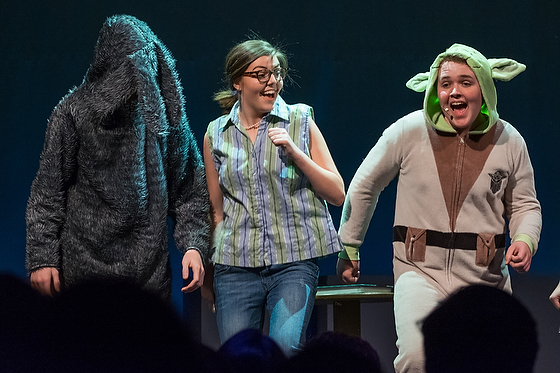
Fujifilm X-E2, FUJINON XF 55-200mm, ISO 6400, ƒ/4.5, 1/280
The Fuji X-E2 is pretty quite camera. One of the main reasons it is quite as compared to other DSLR cameras is the lack of a mirror.

If you get rid of the mirror do you get the same quality? Well in this case it does help. Because you have no mirror you are also eliminating one of the things that often affects the sharpness of DSLR cameras–the mirror. In a DSLR a mirror lets you see through the lens and when you press the shutter release the mirror goes up, the shutter opens and then the mirror goes back down. This introduces some vibration in the camera which often can add just enough vibration in the camera to make your images not quite as sharp.

Fujifilm X-E2, FUJINON XF 55-200mm, ISO 6400, ƒ/4.4, 1/110
Now the second thing that really helped with the photo quality was the Fujinon XF 55-200mm ƒ/3.5–4.8 lens. It has built into the lens optical image stabilization for effective 4.5 stops improvement. So if you breath a little in the photo the camera will in essence take care of the vibration you introduce into the camera.

The 55-200mm lens is quite sharp for zooms. Fuji makes some of the world's best lenses.

Fujifilm X-E2, FUJINON XF 55-200mm, ISO 6400, ƒ/4.4, 1/150
One of the best attributes of shooting mirrorless is the ability to see what you are shooting before you shoot. You are seeing the processed image in terms of exposure and white balance in the viewfinder or on the LCD before you shoot. You can see if the color or exposure is off and correct it even before you shoot.

With the DSLR you can REVIEW, but you cannot PREVIEW. This ability to PREVIEW an image really helps you know if you will be getting the image correct before you push the shutter.

Fujifilm X-E2, FUJINON XF 55-200mm, ISO 6400, ƒ/8, 1/80
While shooting this scene where the one actress on the floor is quite a distance from the other actors I knew that I wanted both of them in focus. So I cranked the aperture to ƒ/8. Now I could see everyone is in focus.

Fujifilm X-E2, FUJINON XF 55-200mm, ISO 6400, ƒ/4.8, 1/45
Now holding the 55-200mm and zooming all the way in to 200mm is the same as shooting with my DSLR full frame camera with a 300mm lens. The rule would be to have the shutter speed at 1/300 to avoid motion blur, but the camera and lens did a great job here at almost 3-stops lower than a recommended shutter speed for this lens.

Side Note


Since downloading the new firmware this morning I am falling in love once again with the Fuji X-E2. You see Fuji is doing what Nikon nor Canon is doing with their cameras. When the ability to write a better software comes along other manufacturers save this for the new cameras. Therefore forcing you to buy a new camera.

Tune in Monday for my review of my NEW CAMERA due to Fuji upgrading the Fuji X-E2 with new Firmware.

Sunday, April 19, 2015

What gear and where to sit to capture theater productions

Nikon D750, Sigma 120-300mm ƒ/2.8 DG OS HSM | S, Sigma TC-2001 2x, ISO 12800, ƒ/5.6, 1/200
If you were on the front row of the theater you would not see this photo. The reason is simple. The actor is laying down on the stage just above the orchestra pit area.


This is why I like to go to the very back of the auditorium to shoot photos of theater productions at my daughter's high school. If I need to I can even stand because no one is behind me.

Fuji X-E2, Fuji XF 55-200mm, ISO 6400, ƒ/6.4, 1/55
This is another photo of the same theater. You can see how people in the front few rows are actually below the stage.

Fuji X-E2, Fuji XF 55-200mm, ISO 6400, ƒ/4.4, 1/400
Now the downside to being all the way in the back of the room means you will need longer glass than a kit lens.

Nikon D750, Sigma 120-300mm ƒ/2.8 DG OS HSM | S, Sigma TC-2001 2x, ISO 9000, ƒ/5.6, 1/500 [600mm]
I love shooting with the Sigma 120-300mm ƒ/2.8 DG OS HSM | S and the Sigma TC-2001 2X converter. It lets me get pretty close like in this photo from the play Little Shop of Horrors at Roswell High School.

Most of the photos I take are between 200mm to 600mm.

Nikon D750, Sigma 120-300mm ƒ/2.8 DG OS HSM | S, ISO 2200, ƒ/2.8, 1/500 [300mm] 
Here I took the 2X converter off and zoomed all the way in to get this photo.

I highly recommend shooting with a monopod so as to keep the camera steady and also that is one big beast with a Nikon D4, Sigma 120-300mm ƒ/2.8 DG OS HSM | S and the Sigma TC-2001 2x.


This lens combination is great with a lot of events and situations other than sports or wildlife.

Nikon D750, Sigma 120-300mm ƒ/2.8 DG OS HSM | S, Sigma TC-2001 2x, ISO 2000, ƒ/5.6, 1/100 [550mm]
Theater Camera Gear Recommendations:

  • Nikon 28-300mm ƒ/3.5–5.6
  • Sigma 120-300mm ƒ/2.8 DG OS HSM | S
  • Sigma TC-2001 2X
  • Sigma TC-1401 1.4X
  • Nikon D750
  • Manfrotto 294 Aluminum 4 Section Monopod
  • Manfrotto by Bogen Imaging 323 RC2 System Quick Release Adapter w/200PL-14
Mirrorless Camera System Recommendations:
  • Fuji X-E2
  • Fuji XF 18-55mm
  • Fuji XF 55-200mm
Nikon D750, Sigma 120-300mm ƒ/2.8 DG OS HSM | S, Sigma TC-2001 2x, ISO 7200, ƒ/5.6, 1/500 [550mm]
Camera Settings Tips:
  • Auto ISO – when shooting check the LCD and to compensate use the EV dial to under or overexpose. 
  • Check Histogram for accuracy. 
  • Use Blinking Highlights to let you know what has no details. Be sure faces always have detail.
  • Custom White balance for "White Light" if possible. Many theater lighting schemes use a lot of color, be careful that you are balancing to the lights without gels.
  • Tungsten is often the correct white balance for theater lighting–but not always. Don't try and color correct every scene when the lights are often intentionally giving a color cast.
  • Scene brightness will change the color temperature as well. A dimmer set at 10% will make the light more orange than at 100% brightness.
  • Try to use shutter speed that is closest to the focal length. If 200mm use 1/200 and if 500mm then use 1/500. This is why having a monopod will let you shoot darker scenes to help keep the camera steady.

Wednesday, February 18, 2015

Theater photography with Sigma 120-300mm ƒ/2.8 DG OS HSM | S

Nikon D4, Sigma 120-300mm ƒ/2.8 DG OS HSM | S, ISO 5000, ƒ/2.8, 1/1000
I love using the Sigma 120-300mm ƒ/2.8 DG OS HSM | S for shooting things other than just sports.

My daughter is in the high school theater and I am getting lots of opportunities to capture her and her friends on stage. In a few years she will be off to college and these photos of her performing are going to be even more valuable to our family.

She is in the center in the photo above playing a blind girl.

Nikon D4, Sigma 120-300mm ƒ/2.8 DG OS HSM | S, ISO 12800, ƒ/5.6, 1/640
Why is the lens what I like so much? It is a zoom. I never know if I need a tight shot or wide shot of the stage. By being a little back shooting over the audience I can get those closeups and not miss some of the wider shots.

Nikon D4, Sigma 120-300mm ƒ/2.8 DG OS HSM | S, ISO 5000, ƒ/2.8, 1/1000
The other thing is in theater you may have just a few actors or many in a scene. Sometimes I just need a little more depth-of-field and other times I just need a shallow depth of field. The lens lets me open up to ƒ/2.8 and close down as needed.

Nikon D4, Sigma 120-300mm ƒ/2.8 DG OS HSM | S, ISO 5000, ƒ/2.8, 1/1000
For the first four photos the audience was smaller and I was much closer to the stage. But another play I was in the very back of the room. Here I used a Sigma 2X converter to change the lens to a 240-600mm.

Nikon D4, Sigma 120-300mm ƒ/2.8 DG OS HSM | S, Sigma 2X, ISO 4000, ƒ/5.6, 1/250
Had I been shooting with my Nikkor 28-300mm I would have to use ƒ/11 if I put a 2X converter on it, but I was shooting at ƒ/5.6 with the Sigma.

There are many times where I need this specialty lens. Maybe you only need it once in a while. If that is the case then rent the lens. I decided I use it enough to justify buying the lens.

The key to getting the photo is sometimes having the right gear for the situation. Consider the Sigma 120-300mm ƒ/2.8 DG OS HSM | S for more than just sports.