Saturday, December 17, 2011

What’s a good camera for me this Christmas?

I have updated this from 2008 blog post with today's latest cameras. 

Canon PowerShot G12 Digital Camera $379.95

Panasonic Lumix DMC-LX5 Digital Camera $369.95

Fujifilm X10 Digital Camera $599.95


Nikon COOLPIX P7100 Digital Camera $499.95

When I speak to groups someone usually asks me what camera I use. Next someone else will ask, “Would I take better pictures if I had a better camera… maybe one like you use?”

The best answer I’ve ever heard to “The Camera Question” came from Joanna Pinneo, a former colleague of mine. Joanna is an outstanding photographer who has worked for Newsweek and National Geographic. Joanna had just finished wowing an audience with some of her photographs when a little old lady asked, “If I had a camera like yours would I take better pictures?”

“Probably not,” Joanna said, “you will take the best photos with a camera that is easy for you to use. When you see something you want to photograph the less you have to think about the camera the better your picture will be.”

Joanna went on to point out that professional photographers are so familiar with their cameras that using them is second nature to them; like driving a car. She told the little lady that unless she planed really study photography she should find a camera that was simple and easy to use then just concentrate on the subject of the photograph she wanted to make.

She was right, of course. In general most of your best photographs are taken to capture a moment. If you are switching lenses, fidgeting with a flash, or trying to remember how your camera works you’ll miss the moment. By the time everything is set just right the shot is gone, the moment has pasted.

On the other hand, if you have a point-and-shoot camera you can just (pardon this) you can just point-and-shoot and capture the moment. You’ll take a better picture precisely because you did NOT have a “better” camera.

Not long ago I was photographing the keynote speaker at an event in Atlanta. Beside me was Ambassador Andrew Young with his point-and-shoot camera. He was photographing the speaker as well. Later he showed me his shot and it was quite good.

This was not the only time I’ve seen him making pictures. I’ve worked with him on several occasions and once I asked him about his photography. He reached into his pocket and pulled out the small point-and-shoot camera. He said he always carried it with him and that he loved to take pictures and share with his friends.

Then Ambassador Young laughed. He told me he even pulled it out of his pocket at his daughter’s wedding. He was officiating the wedding, but he still took a photo during the ceremony at the altar.
 
Point-and-shoot cameras are not just for amateurs.

My good friend Dave Black, who shoots for Sports Illustrated, used one for a job. One of the greatest qualities of these point-and-shoots is they make no noise. They are so quite that manufacturers have put a speaker in them and created a clicking noise you can turn on or off to let you know when the shutter fires.

PGA rules will not allow a picture to be taken of a professional golfer during their back swing since the noise might distract the golfer. Steve Williams, Tiger Woods’ caddy has thrown a few cameras into lakes when people have fired away during Tiger’s backswing.

When Dave Black showed the editor from Sports Illustrated at the event the photos of Phil Mickelson in his back swing you can understand why the editor started to quiver and gasp for air. Dave pulled out the little camera and made a picture or two of the editor. When the editor found that he couldn’t even hear the little quite camera he began to breath normally again.

No one had any photos of golfers in their back swing before Dave so Sports Illustrated ran the photos big made with the little point and shoot.

Today’s cameras are so much better than before. Take for example the point-and-shoot Nikon P7100. 
 
While the hallmark of a pocket camera is the ability to shoot on fully automatic, Nikon knows you want to do more than that with the P7100. That's why they gave the camera versatile manual controls. There's even a front command dial so you're fully in charge of operating the camera at all times. Other features, such as an ISO of 3200, bracketing options, and even a virtual horizon, ensure that you'll get just the shot you want. Of course, the choice of four classic exposure modes (P/S/A/M) is essential to this type of shooting. Add the aforementioned in-camera special effects and other features like macro capture and HDR setting, and you've got one great little camera that puts the joy back into point-and-shoot photography.

Another camera similar to the Nikon P7100 is the Panasonic Lumix DMC-LX5. It is equipped with a Leica lens and is similarly priced to the Nikon P7100. Canon G12 and the Fuji X10 are similar as well. All of these cameras shoot JPEGs and RAW.  They also all have controls that were missing for many of the other point and shoot cameras.

Joanna Pinneo said it so well, when she said, “You will take the best photos with a camera that is easy for you to use.”

Guess the old adage is true after all. I’ll paraphrase: It would be Stupid not to just Keep It Simple.

Thursday, December 15, 2011

Its not what you know but how you perform

Same photo but different color balances, cropping and exposure.
Which photo above would you use? Now unless you see them side by side you might not be as quick to make changes to the photo before sending it to the client. However, if you are meticulous you will give the client the best possible photo.

While the client may not have four identical photos like this to choose the photographer they would hire again, I know from what I have seen photographers put on their blogs, websites and even given to clients are all these and more.

Losing Teams vs Winning Teams

I think we have all heard the loosing coach after a team looses saying we just didn't execute very well. I don't think I have ever heard the coach say we just didn't have a game plan.

The golfer who wins the tournament is normally the golfer who performed consistently each day. Rarely do you see a golfer with poor scores one day and the great scores the next win the tournament.

Just the other day I asked my friend Mark Miller and the author of The Secret of Teams: What Great Teams Know and Do and the book The Secret: What Great Leaders Know and Do, how a company remains competitive as more and more people are copying their formula.

Miller said it is the execution of their formula that makes the difference. He went on to use the metaphor of the West Coast Football. Who hasn't seen it by now? The thing is who can execute it well?

More than the photo

I think one of the largest mistakes I am seeing over and over is photographers often think it is all about the photograph.

While there are many photographers making the mistake of the 4 photos above, Many may have gotten the perfect photo, but a great deal of the execution was in your attitude and words you used with the client.

I will admit it that many in my industry of creatives are strange people. I sometimes think many in society tolerate our kind. We are not trying to fit in as much as stand out and in the process get kicked out.

The president of the college I went to for my masters gave a talk one day saying that the one course they needed to add to the curriculum was on common sense.

You can't please everyone

When it comes to customer relations your ability to pay your bills relies heavily on you having customers.  There should be enough incentive for you to go that extra mile and be hospitable and courteous.  Will they be kind to you in return--not always, but as they say you have to take the high road and know you did everything possible to make it work.

X-Factor for Success Photography Business
There are two things that when are executed at the highest levels simultaneously together create a whole new product.
  1. Quality - The quality of the photographs for the photographer is something that when executed at the highest levels will separate you from the pack. This is what you provide the customer.
  2. Service - From the first phone call or email till the delivery and beyond of the product is an experience. The attitude of your performance can go a long way with a client. This is the how you do you work.
Do you have the X-Factor in your business model? You may need to benchmark yourself to others to find out if from the customers perspective you are at the top of the industry in both quality and service.

Remember it isn't what you know that makes a difference in this game it is executive of what you know that matters.


Wednesday, December 14, 2011

Ever hear of Referrals and Testimonials?

YWAM School of Photography 1 2011 in Kona, Hawaii
I get Jeffrey Gitomer's newsletters every week. This week's topic The 100-year path to a sale is over: Road Closed. You should read it. I have finally taken his advice about using referrals.

The main reason I took his advice is Brian Hirschy asked me for referrals for the workshop we are putting on in Tibet.

Since the workshop is geared to teaching, I contacted Dennis Fahringer, Mark Johnson and Jim Loring who have had me talk to their classes regularly. I figured they wouldn't invite me back unless I was worth their time.

I also contacted Ken Touchton who has been in this field longer than I and a mentor to me. He has encouraged me and I have listened to his advice.

Gitomer says
REALITY: The days of selling the old way are not only gone, they're annoying! Not to me. They're annoying to your customer and your potential customer.

Ever hear of referrals?
Ever hear of testimonials?
Ever hear of networking?
Ever thought about speaking at civic organizations?
Ever thought about writing a column for the local business weekly or your industry trade publication?

If you spent the same amount of time earning referrals as you do making cold calls, your numbers would increase, you'd close more sales, your aggravation factor would drop to zero, you'd make more money, you'd be infinitely happier on the job, and your job happiness would skyrocket ... read more
Testimonials

“Stanley Leary’s been a guest teacher for me every year since 2006 in the School of Photography 1 which I lead at the University of the Nations in Kona, Hawaii. Stanley’s able to combine decades’ worth of experience in photojournalism and commercial photography with a acute sensitivity to the needs of my photo students. He teaches here in a very practical hands-on way on lighting as well as business practices. Those are just a small fraction of his expertise. It’s a joy each time we invite him back to teach."

Dennis Fahringer-  Kona, Hawaii;  School of Photography

“Stanley has been a regular guest in my photojournalism classes here at the University of Georgia’s Grady College of Journalism and Mass Communication. Officially, I bring him in to talk about business practices. Unofficially, I bring him in because the way he talks about business practices demonstrates so many of the skills I want my journalism students to have.

His level of preparation is staggering – his presentation is detailed and well researched, his examples meticulously culled from his experiences. He talks about the why that supports the what – why developing relationships with clients leads to what they will hire you for. His presentation style is to engage the audience, to ask them to participate at a high level and then to adjust his presentation to the level the students are at. (I am forced to admit that my students are no where near as prepared for his visits as he is, something I now know how to fix based on his last presentation.)

Outside of his formal presentations, Stanley has become an excellent resource for me. Our conversations run the gamut from the technical minutia of photography to the overarching reasons of why visuals communicate so well in some situations and not so well in others. His real-world experiences help me shape what I teach every semester, his blog entries help me fine tune individual lessons and his friendship helps keep me sane and grounded, both at work and at home.

So, why does Stanley come out to talk to my classes? There’s an easy, and correct (if limited), answer that if everyone’s business practices get better, then everyone in the industry will do better. But I think he does this because Stanley, at his core, is a sharer – he is programmed to share, to help others, to guide, to teach.

The thought of exploring a new culture with Stanley, who sees in such a different way than I do, is awfully enticing. I think the 10 participants who get to wander the backroads and villages of Tibet with him are in for an educational experience that will go far beyond lenses and light. They’re going to see the world in front of them in a very different way.”

Mark E. Johnson-  University of Georgia; Journalism & Mass Communication


“Sensitive and insightful photography always has the capacity to inspire others and cut through to the heart of the issue. With a deep understanding of photography’s unique story telling capacity Stanley brings insight and depth as he shares from over 30 years of experience.”

Jim Loring - North Georgia Technical College


"Dedicated storyteller and visual communicator, Stanley Leary exhibits his enthusiasm and passion for photography with the large diversity of images that he produces. His depth of skill, technique and photographic knowledge is the foundation of his strategy to engage people at all levels and to create dramatic images that demand dialogue. His methods and personal drive keep him on the cutting edge of the constant equipment, software and computer upgrades, which increases his performance and productions for his diverse clientele. Learning with Stanley provides the opportunity to increase your craftsmanship, your expertise and artistry as you developed an intense knowledge of your equipment. When you engage that dramatic moment of light and artistry, your personal methods and strategy will deliver the performance that you gained from spending time with Stanley."
Ken Touchton - Freelancer in Washington DC

Monday, December 12, 2011

2012 VISUAL STORYTELLING WORKSHOP IN TIBET:

I wanted to invite you to go with me to Tibet next summer. So many people continue to ask me to help them with visual storytelling I decided to put together a hands on workshop. Partnering with Brian Hirschy and Plateau Photo Tours, our goal is to help participants engage new cultures photographically, respectfully, and effectively as photographers.

We are excited to be able to offer this hands-on workshop in historic Tibet. Participants will walk away with a better understanding of how to engage a culture and effectively tell compelling and complete stories through their photography. All this while having the chance of a lifetime to engage, understand, and photograph the unique culture of eastern Tibet.

Contact me if you are interested and I will answer your questions.

click here to get more info

How I photograph a family and dogs

Getting all the expressions in one photo can be a challenge. Nikon D3S, Nikkor 28-300mm f/3.5-5.6, ISO 200, f/5.6, 1/60, Alienbees 1600 at 1/32 power triggered by CyberSync radio remote.
The sun is lighting all the scene well, but the Alienbees 1600 firing at 1/32 power is giving just a kick for fill-flash helping with a catch light in everyone's eyes. another benefit of the flash is it helps with the color temperature and giving good skin tones.
Don't attempt this alone as I did, unless the person you are photographing can really trust you. I was lucky, I was able to photograph my good friend Yaniv with his bride to be Shannon and her son Aidan.

I worked at getting everyone in place creating some nice triangles for composition. I prefer not to have everyone's head in a straight line. 

Yaniv, Shannon and Aidan had great smiles and needed very little help giving great expressions. It was like working with professional models.

The hardest part of the entire photo shoot is getting the dogs to have great expressions to compliment them. 

I am holding the camera making squeaking noises, whistling and doing all I can to get the dogs to perk their ears up and look attentive.  Honestly, unless these are dogs trained to work for modeling and TV you are not going to have lots of moments.

What I recommend is a team for these photos.
  • Animal person - someone off camera who's sole responsibility is to get the animals to look their best.
  • Wrangler for the small children - you need someone other than the mother holding a baby getting the attention of the child. Usually this person is playing with kids before the shooting begins. They are building a relationship and finding what will work for them in the photo.
  • Photographer or one more person - to get the expressions of the adults. 
  • Stylist - can be great to have help. They are paying attention to wardrobe malfunctions, hair and makeup. 
  • Photo Assistant - this person is being sure the flashes are firing, moving them and help changing the power on the flashes to help the photographer.
 The key is planning and everyone understanding their rolls. Shoot lots of photos and then you will have trouble picking one image when everyone does their best.


Saturday, December 10, 2011

Fighting the creative blues during the Christmas Holiday

I feel like Lucy from Peanuts writing this blog. Just like Lucy I am sharing what works for me.
Everyone knows about the holiday blues. I think creative professionals can feel them because we are trained to tap into our emotions to create.

Since you are always trying to communicate to audiences on emotional levels you might find yourself feeling a little bipolar.  I know I go through this a great deal.

Here are some things that can trigger these blues:

  • Pressure to feel merry - People are inviting you to parties and decorations are going up all around you. You can get confused when the disparity between what you think others expect you to feel and how you actually feel. This can be like throwing gasoline on a fire.
  • Missing of loved ones - This is the time of year we remember our family and friends that are no longer with us. The decorations, sounds and smells of the holidays are powerful triggers for our brains. This feeling of loss can spoil even the most awesome event.
  • Loneliness - If you don't have a significant other this can be a hard time of year.
  • Financial Hardship - This is the season of giving and when you don't have the finances to give this can bring on depression. You might feel like you are on the outside looking in on the holidays.
  • Lack of sunlight - Some people are affected by the lack of daylight in their lives. This is a seasonal affective disorder.
  • Not much booked on the calendar - This kind of goes with the financial hardship, but I find this affects me the most.
The Story of Amahl: Somewhere in the world lives a crippled little shepherd called Amahl, with his mother, an impoverished widow. Nothing is left to them of the little they ever had, and they are now faced with hunger and cold in their empty house. (Christmas production at Roswell Presbyterian Church) [Nikon D3S, ISO 11400, f/5.6, 1/100, Nikon 28-300mm]

First of all you need to realize you are not the only one who goes through this. Many of us do. Here are some ways that I deal with not just the blues of the holidays but the rest of the year I can go into a funk and feel depressed.
Jeremy Cowart's project
  • Acknowledge you feel depressed - It is perfectly OK to be bummed out at times. This is why we appreciate those good times. We know life has its ebs and flows.
  • Sunshine helps - Get outside in the sun for about 20 minutes a day. It will release endorphins that can help fight depression.
  • Pay it forward - Volunteer in some way to help others. Jeremy Cowart came up with the "Help Portrait Project" that gives back to those who cannot afford a photograph. I think one of the big reasons it has spread like wildfire is so many photographers seek a way to use their talents and this really helps the photographers as much as those who have a professional photo made.
  • Fill your calendar - Put some fun events on your calendar of your choosing. Too much time alone will bring you to that familiar depressing spot.
Fill your calendar with fun stuff to do

These are tips you will see many different places. The one thing that I find that has helped the most in my life is keeping a journal. Sure my journal has recordings of depressing times in my life, but it also has a lot of good times recorded for me to remember.
Amahl finds healing when he and his mother focus on giving rather than receiving. (Christmas production at Roswell Presbyterian Church) [Nikon D3, ISO 6400, f/5.6, 1/80, Sigma 120-300mm f/2.8]
Count your Blessings - Even if you don't have a journal of things to help jog your memory there are always things to see as positives, no matter how bad it is right now.

I remember going through:  
  • a divorce; 
  • being laid off; 
  • being fired; 
  • loosing family and friends 

I also am so very thankful for: 
  • my wife;
  • my step-sons and my daughter;
  • a lovely home; 
  • friends;
  • my parents;
  • my sisters and their families;
  • I have jobs and fun on my calendar

I can tell you honestly that all of those blessings have not been enough sometimes for me. The one thing that has sustained me more than anything else has been my God. It is faith that has gotten me through the toughest of times. 

"Hope is the Assurance we have of victory in the future, Based on evidence from the past, the first Easter, which gives us Confidence and strength in the present."
- Dr. Lane Alderman, pastor Roswell Presbyterian Church


Wednesday, December 07, 2011

Photo Tips from National Geographic writer Scott Wallace

Scott Wallace, National Geographic writer, talks to Dorie Griggs about his latest book The Unconquered.
Scott Wallace with Stanley during his book
tour in Decatur, Georgia.
I had the opportunity to meet Scott Wallace a freelance writer who is regularly published in National Geographic Magazine. Dorie Griggs, my wife, met Wallace through The Dart Center for Journalism and Trauma. Wallace is a Dart Center Ochberg Fellow.

Wallace is on a book tour promoting The Unconquered: In Search of the Amazon's Last Uncontacted Tribes.

He is working on another coverage for National Geographic with photographer Alex Webb.

I asked Wallace a few questions which I thought you might want to know about.

Keep your gear dry

His first tip is for those traveling in rain forest or extremely high humidity locations. It is important to keep your camera dry as possible. He recommends taking a water proof case like the Pelican 1504. You will want to buy some Silica Gel packs that you put into the case. You can put it in your oven at 300 degrees for about 3 hours to dry out the Silica or just put it next to the campfire to help dry it while on location.

Whenever you go to bed, put the cameras in the case to help dry them out each night.

National Geographic writer Scott Wallace interviews Sydney Possuelo while on expedition in the Javari Valley Indigenous Reserve, Brazil. © Scott Wallace

Get Permission

Another tip is to get permission of the subjects before photographing them. This is not always put in a question to the subject, but by being aware when they don't want you to photograph.

Over time you will become more aware of their body language which is telling yes or no. The other thing is to be aware of the local culture. Wallace often asks his guides about the local protocol before taking photos.

As a general rule you are seeking to remain in good social standing so the indigenous people will want you to stay. This is very important for the National Geographic writers and photographers, because they are not like a tourist and just popping in and out. They plan to stick around for a few weeks or even months to get the story. Even if they are not coming back to this location their reputation of how they work will spread quickly through the region one way or another. They need a reputation in the community to be positive.
Matis scout Kwini Montac  © Scott Wallace

Patience

Wait for your turn. We learn this in kindergarten, but I think sometimes writers, photographers and videographers who work together need to be reminded of this basic respect for others.

While we might like the writer to stay out of our shots, we need to wait our turn and sit quietly through interviews. While some may see this as a time to day dream or do something else, I can tell you from my experience the best photographers learn to listen.

After the writer is finished I might then ask a few questions myself that the subjects comments made me think about.

Take this time to make either a mental note or actually write down all the possible visuals you hear during the interview.
Kanamari returning from the hunt (Márcio center, Wilson at right)  © Scott Wallace
I find that when I work with a writer on a story, I prefer first letting the writer interview the subject while I listen and maybe make some photos of them talking during the interview. I want to listen as much as I can, because this will lead to better photos.

The book is available through Amazon as hardcover or Kindle eBook.

Tuesday, December 06, 2011

Mike Davis' list of five things in good photos

Mike Davis speaks on photo editing at the Atlanta Photojournalism Seminar.
Creating images that last beyond the day has been Mike’s mission in settings as diverse as National Geographic Magazine and The Albuquerque Tribune, The White House and pdxcross.com
Mike Davis started his presentation giving us his background. As he transitioned into his educational part of the program on how he does photo editing by walking into the audience.

He got right up in a person's face and asked has this changed the presentation for them? You bet it did.

Mike took the time to demonstrate to the group what he means by house a photographer's distance from the subject, not lens choice, makes a big difference on the impact of a photo.

Distance to the subject is one of the five things that make a difference in good photos.

Five things that impact the effectiveness of a photo:
  1. Color
  2. Light
  3. Composition
  4. Moment
  5. Distance to the subject
I talked about the Distance to Subject and how to maximize putting your audience into your photographs using a wide angle lens in an earlier blog. Click here to read it.

(Nikon D3, 14mm, ISO 6400, f/3.2, 1/100) I love how the wide angle puts the viewer inside this little room (closet).
As Mike went through photos and took a photo shoot from all the images down to the 6 - 7 images he would pick for a photo story, the layout was more from how the photos created a mood. He could lay them out chronologically or systematically as most people do, but this is why he is sought out so much.

"Mike Davis is a virtuoso. He can take a pile of photographic notes and chords and arrange them to make a breathtaking score. Back in early 2001, I was struggling to put together a cohesive portfolio from my work…"

– Scott Strazzante, Staff Photographer, Chicago Tribune
Chicago, Illinois
To lay out photos based on the emotions, the photographer will have had to use those five elements to help create a photograph that communicates on a gut level. Mike Davis talks as he is editing photos and puts into words some of his gut reactions to the photos.

This photo is much better "moment" than the one before or after because the person's hand is almost touching the bucket. Once they touched the anticipation element is gone. This was how the edit was going. The difference with Mike is as he eliminates the images from a gut reaction--he can articulate why his gut reacted a certain way.

I love getting up close and pulling the reader in. I also like light, the colors and the moment I caught here.
Mike enjoyed using PhotoMechanic for editing. It is my favorite as well. It doesn't help with editing the individual photos like PhotoShop or Lightroom, but you can easily sort your picks and put identification in photos with this software.

Mike also talked about how he knows photographers takes are a series of photos where the photographer will work the same angle and composition for the right "moment." The moments rise and fall.
You can see how in the series of photos the teacher turns his head and there is one moment that captures the moment better than the rest. This is where we say the photographer is working it. Looking for the "Decisive Moment" where it all comes together.
When you edit your photos look for all five of the elements and how they make a difference in the ones that stand out from the rest.

Shoot enough photos that you have some comparisons to look at and see differences in peoples expressions and body language from one frame to the next.

If you don't see it get someone to look with you through your photos. They don't have to be a pro to see which ones they like better. They may even tell you why or at least acknowledge it is a gut reaction.

Sunday, December 04, 2011

Speaker Tips for Photographers

David Burnett co-founded Contact Press Images in 1976, one of the last independent photojournalistic agencies, and continues to work on both journalistic endeavors and for commercial clients. Burnett is speaking to the Atlanta Photojournalism Seminar.
I just finished two days of presentations by photographers. There were some really good presentations, but there were some poor presentations.

For the past twenty years I have helped to put on photo conferences. When our team evaluates a conference we decide who we will invite back. Some of the team was at this event and we critiqued the presentations. Why, because we might want to invite some of the speakers to our conference to speak.
Tom Kennedy, Greg Thompson, Vivian & Gary Chapman, Stan Kaady, Bill Bangham and Ken Touchton eat lunch after Tom Kennedy did a workshop at the Atlanta Photojournalism Seminar on "Understanding the Changing Media Landscape." We took some of this time to give Tom some feedback. We were all impressed with his presentation.
Over the years there are some common things we have noticed. There are things that good speakers do that make us want to hear them. There are things that turn us off.

Here are some tips I would give to speakers of things we often raise:
  • Prepare your presentation. Put aside time and work on your thoughts and what you want to share. I have watched in the older days of slide trays photographers showing up with slides not even in slide trays and speakers literally putting it together minutes before speaking. Today those same type of speakers have just thrown images into a folder and not organized them and edited them for the presentation.
  • Have a goal. What one thing should your audience know that you feel passionate about? If you don't know then your audience will not know what you tried to tell them.
  • Refine the goal to something you can share in the time you have. Once of the biggest mistakes is some people want to tell people all about themselves and even what they are planning on doing. 
    • Maybe share one story you did and what you learned from this experience.
    • Maybe you have discovered you have a cheat sheet you work from for all your stories and you can share those.
    • Sometimes you discover something later in your career that you noticed most other people know, but you wish someone told you earlier about this.
  • Leave the audience wanting more, rather than wishing you had stopped speaking a lot sooner.
    • I have seen only once in my career how someone took this to an extreme. We paid to fly a person out to speak and they got up and read from their notes and sat down in just 10 minutes.  
    • If you can point people to your website or blog to get more on your topic, then do that. 
  • Got a secret? If what you share isn't like a secret and they already have seen your coverage then why are you speaking?  Share something they couldn't have gotten from your website. 
    • If you have a story on your website that you are really proud of and even won a Pulitzer, don't just show this package. Share something that they wouldn't know by seeing the story alone. 
    • Maybe you were arrested and detained by the police. While covering the subject. Why did they stop you? 
    • Maybe there are stories about how you found the story.
  • Something new. The Chris Matthews show on NBC Sunday Mornings has a segment called "Tell Me Something I Don't Know," where the four panelists report to Matthews new information they have gleaned from their reporting. It is successful for a reason--it works. Remember the reason you were asked to speak is they saw your work and are familiar with it. Don't tell the something they already know, tell them something they don't know.
    • A lens that helped you
    • A camera that you used for this project
    • New App that you used to help make the project more successful
  • Use multimedia. You are a photographer whose imagery is consumed by an audience. Your clients and publications put your photos into a presentable form. Don't give your audience the uncut or unedited version.  Package your images.  
    • Put a slide show with audio together. Maybe you narrate the package over music. Please put together the visual story in such a way that you can play this 2 - 5 minute package and they get what you did.
    • Maybe you show 2 or 3 small packages and then either before or afterwards explain some things about the package.  
      • Why did you do the project?
      • How you and the editors worked together?
      • Did your personal project get reimbursed by your the publication that you work for on staff?
    • Maybe you do another multimedia piece by interviewing the subjects and they tell the results of what happened after the story ran.  
  • Don't Rely On An Internet Connection. If you are at a hotel and you are trying to stream a video you might make your audience wait. This happened this weekend.  
    • Put all your material on your computer.
  • Know your time limit. The conference planners have other speakers planned. Going over your time needs to be at the invitation of the group, not by you. We have a time keeper who stands up off to the side of the room at 5 minutes to go. They come onto the stage when your time is up. If you still haven't stopped they take the microphone from you and will stop you. [Side note to those running the conference: It is perfectly OK for you to cut off a speaker going long, even if they are famous--everyone in the audience wants you to do so. You will not embarrass yourself by doing this, but might get a cheer as a hero from the audience.]
    • We have other speakers that the: audience; the speakers; and everyone wants to hear rather, than you drone on and on.
    • If you cannot meet the time frame you will only demonstrate how unprofessional you are and do damage to your brand.
    • Demonstrate to everyone you know how to communicate effectively in your time allotment and allowing for questions to clarify some of your points. 
  • Plan for 5 minutes for questions. 
    • People may need to clarify something you said.
    • You may have helped people think of something new and want to see if they are on the right track since you have been down that road.
  • Backup Copy. Have the entire presentation backed up on one of these ready in case your computer crashes. If this is your primary way of presenting have a 2nd copy ready--digital Grimlins seem to appear right when you are ready to present.
    • Jump Drive
    • External Hard-drive
    • DVD/CD
Tom Kilpatrick and Ken Touchton catch up over dinner. Seminars and workshops are not just about the presenters. the people in attendance often get as much from others in attendance as from the official program.
Gil Williams, Tom Kilpatrick, Ken Touchton, Bill Bangham and myself all enjoyed catching up with each other at Shane's Ribshack after the conference.
Bill Fortney, Nikon Rep, talks with Billy Grimes. Nikon offered a free clean and check for those in attendance at the Atlanta Photojournalism Seminar.
Jody Grober, Rep for Robert's Imaging, is one of everyone's favorite people. Jody is who I have been buying equipment from for many years.
People line up to have their Nikon cameras cleaned and checked by Nikon.
Bill Bangham talks with a student from Elon College. This is a great time for students to interact with professionals to get tips and job leads.
Greg Foster, is a long time contributing photographer for Sports Illustrated, he has also worked for editorial clients such as Fortune, Golf Digest, ESPN the Magazine, The Sporting News, and The New York Times, as well as corporate clients including The Coca-Cola Company, Kodak, Royal Caribbean Cruise Lines, and Norfolk-Southern Railroads. His work has also appeared in a variety of books and television documentaries for such clients as The NBA, ESPN, Fox Sports, and NFL Films. Greg taught a workshop on lighting.
Vivian & Gary Chapman and Ken Touchton enjoy a meal with friends. When we go to these events we love to go out and eat together in between the program events.
Bill Bangham is a photojournalist, writer and editor from Richmond, Virginia. He serves as director, Media Production: Editorial, photography and Video, for IMB (International Mission Board) where he is also editor of CommissionStories, and International Bureau Chief for Baptist Press news service. In the past he has served as editor-in-chief, theCommission, associate editor, MissionsUSA, and editor, World Mission Journal. Bill loves to blog almost everyday. Check out his blog here. He likes to post photos of those he meets everyday, so I just wanted to be sure he gets the same treatment he gives to all of us.

Thursday, December 01, 2011

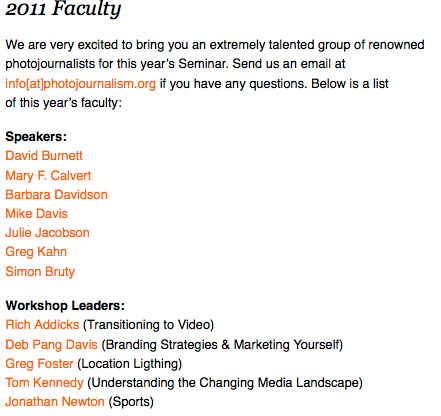
I am attending the Atlanta Photojournalism Seminar and you should too

The Atlanta Photojournalism Seminar
I have three friends that I have talked with in just the past couple of days who are driving in to go to the seminar today. All of us combined have more than 100+ years of experience, so why go to something like this when you have so much experience?

This years faculty
Deb Pang Davis
Some of the workshops intrigued me.  I was really interested in hearing from Deb Pang Davis on "Branding Strategies & Marketing Yourself."

While I even teach regularly on this topic, I am interested in how others are seeing the industry and places for growth.  With the economy so upside down and my industry taking a major hit these past years, many of the traditional avenues for income are not just down, but gone. I hope to hear about how some photographers are remaking themselves and finding income.

I am not interested in copying their path, but how they discovered the new niche may give me insights to where some potential growth for my work could lie.

I find that everyone sees things much differently and that when I am open and listen I grow and learn something new. I try to then see how maybe I can incorporate some of these perspectives into my life.


Tom Kennedy
The other workshop "Understanding the Changing Media Landscape" led by Tom Kennedy really appealed to me.

Kennedy is on the faculty of the S.I. Newhouse School of Public Communications at Syracuse University as the endowed Alexia Foundation chair in the multimedia, photography, and design department.

I first met Kennedy when he was the director of photography at National Geographic. I remember showing him my work and he commented that he didn't see any surprises. You can read more about this in my past blog on "To break the rules, you must first know the rules."

When I was co-president of ASMP Atlanta Chapter we invited Kennedy to speak. He packed so much in on this topic back then I just about got carpal tunnel syndrome from that talk. I am really looking forward to hearing him.

If you come to the seminar you will see more than the four old guys sitting in the room listening to some of these young folks.  You will see more of us, because we understand that when you stop learning you stop growing.

Keep yourself vibrant and growing by attending a seminar or workshop. If you are in Atlanta December 2nd and 3rd then come to the workshop.

Simon Bruty
By the way, Simon Bruty :: Sports Illustrated speaks on Saturday morning at 9:25 a.m. and this is free and open to the public, courtesy of Canon’s Explorers of Light program.

If you are an amateur you are welcome to attend as much as any professional or student.

While the speakers on the program are outstanding, I can tell you from my 30+ years of experience going to these events that those in attendance sometimes are on the same level and sometimes better known than the speakers.

Come and hang out with us. My daughter calls these events that Daddy goes to "Nerd Fests."

There will be Nikon and Canon gear to see and other vendors as well.

Hope to see you there. If you are there, come and say hello to me.