Showing posts with label fill-flash. Show all posts

Tuesday, January 20, 2015

Thinking and Shooting Cinematically with Fujifilm X-E2

Fujifilm X-E2, Fujinon XF 18-55mm, ISO 1250, ƒ/8, 1/125
Learning to think "Cinematically" when framing your images is to think about the end user. Today more than ever most of my audience will experience my images on-line through the internet.

Computer displays with aspect ratios wider than 4:3 are also called widescreen. Widescreen computer displays are typically of the 16:9 or 16:10 aspect ratio. In 2008, the computer industry started to move over from 4:3 and 16:10 to 16:9.

Basically most of today's audience that is working on a computer newer than 2008 are using a widescreen and most likely with a 16:9 ratio.

Now when shooting for print I am considering magazine covers.

Fujifilm X-E2, Fujinon XF 18-55mm, ISO 1250, ƒ/8, 1/125
This vertical photo would work much better for a cover of a typical magazine rather than the horizontal.

How it would look on a computer screen
Fill the frame horizontally. This is even more true with video. Turn your smartphone horizontal when making movies. If you don't the image will be shrunken to fit the horizontal limits of the screen.

So two things you are doing to make an inferior photo/video. First the images will be displayed even smaller than if they were shot horizontal, second you give up visual impact.

Fujifilm X-E2, Fujinon XF 18-55mm, ISO 1000, ƒ/8, 1/125
Learn to see not just edges of the photograph, but from front to back of the photo.

How this would look on a computer screen without cropping
Composition Tip

When photographing like a tourist where you want to capture you friends and family at the different locations you are visiting here are some quick tips to compose a more effective photo.

  • Start with the background. Compose first for what your subjects will stand in front of for the photo. Fill the frame to the edges as I have done here.
  • Have subjects closer to the camera and not closer to the background.
  • Move the subjects around to find the best place where you can easily see them and the place. Be careful that they don't block so much of the background that you no longer know where they are for the photo.
Fujifilm X-E2, Fujinon XF 18-55mm, ISO 6400, ƒ/4.5, 1/20, -1EV, flash 0 EV Slow Sync
When shooting at dusk or night here is another tip. underexpose the background by -1 EV. That is one stop under. I do this with dialing the EV dial and keeping the camera in Aperture priority, and Auto ISO. Then just add flash. Here I didn't compensate with the flash, but you may need to experiment with it.

What this does is pull the subject out from the background using the light value to do so. Because the flash is on Slow Sync the camera will figure out the best exposure without the flash and then the flash will just be added just enough using the TTL function of the camera flash.

Cropping

If you put your photos into a typical video I recommend filling the frame and therefore you may end up with a little crop top and bottom of the typical 4:3 ratio camera to the typical 16:9 ratio for video.

If you start to crop photos to dimensions other than the 16:9 or 4:3 to something more like a square you will be giving up space on the screen, which for the most part will diminish the impact of the photo.

My suggestion is to learn how to fill the frame of your camera and not rely on post production.

"God gave you two eyes side by side and not top and bottom so learn to compose for the eyes." Robin Nelson.

Friday, May 02, 2014

Make your photos "DIFFERENT" at events or don't get hired

Nikon D4, 14-24mm, ISO 100, ƒ/10, 1/100, off-camera flash using the Neewer TT850 flash & Neewer 433MHz Wireless 16 Channel Flash Remote Trigger
I get hired a great deal to cover events. Everyone with a camera could cover these events, but I make my photos look different every chance I get.

Here in these photos I am using off-camera flash to help improve the photos. This first photo the sun is behind the ladies on the left hitting the man's face. This puts them in a silhouette and the way I fixed this was to have my assistant hold the flash on a monopod up high pointing down at them.

Nikon D4, 14-24mm, ISO 100, ƒ/7.1, 1/50, off-camera flash using the Neewer TT850 flash & Neewer 433MHz Wireless 16 Channel Flash Remote Trigger
Here the flash is off to my right pointing at the ladies on the left. Here you can see again that without this flash their faces would have been silhouetted. Had I used a flash on the camera I would have flattened the features. By having the assistant hold the light up high I still get some shape to the cheek bones of the ladies.

Nikon D4, 14-24mm, ISO 640, ƒ/5.6, 1/200, off-camera flash using the Neewer TT850 flash & Neewer 433MHz Wireless 16 Channel Flash Remote Trigger
Here the assistant is bouncing the flash off the ceiling inside the room. I am just raising the light level inside so that the outside is balanced and not washed out with no details.

Nikon D4, 28-300mm, ISO 2000, ƒ/5.6, 1/40, off-camera flash using the Neewer TT850 flash on S2 [slave setting] with the Nikon SB900 and SB800 on Pocketwizard TT5 triggered by the TT1 and AC3 to control their output. 

Nikon D4, 28-300mm, ISO 1250, ƒ/5.6, 1/100, off-camera flash using the Neewer TT850 flash on S2 [slave setting] with the Nikon SB900 and SB800 on Pocketwizard TT5 triggered by the TT1 and AC3 to control their output. 

Nikon D4, 28-300mm, ISO 800, ƒ/5.6, 1/100, off-camera flash using the Neewer TT850 flash on S2 [slave setting] with the Nikon SB900 and SB800 on Pocketwizard TT5 triggered by the TT1 and AC3 to control their output. 
There are three flashes in the room all being controlled by the camera. I have the Nikon SB-900 and Nikon SB-800 working on TTL and triggered by the PocketWizard system. The Neewer TT850 has a 2nd flash setting to work with TTL flashes.  The light in the room was so mixed with different color temperatures that I wanted to clean this up with the flash.

Nikon D4, 28-300mm, ISO 10000, ƒ/7.1, 1/100, off-camera flash using the Neewer TT850 flash & Neewer 433MHz Wireless 16 Channel Flash Remote Trigger 
Nikon D4, 14-24mm, ISO 640, ƒ/2.8, 1/25, off-camera flash using the Neewer TT850 flash & Neewer 433MHz Wireless 16 Channel Flash Remote Trigger
With all these photos the camera was on Aperture priority and I am winking the flash just slightly brighter than the ambient light. Often same light value or +  1/2 stop greater to just clean up the color and give a little pop to the images.

I know that if anyone was shooting with the iPhone or point and shoot camera they would not be getting this quality of images. They are different. This is very important if you want to be hire to shoot, because if my images didn't look different than what they are able to make with their own cameras then why hire you?

Monday, April 21, 2014

How did your Easter family photo come out yesterday?

Fujifilm X-E2, 18-55mm, ISO 200, ƒ/8, 1/180, flash is set for -1 EV
If you look closely you will notice another family on the opposite side taking photos.  They get the direct sunlight. By standing on this side of the cross we were not staring into the sun and our faces were in the shade. All I did was to add fill-flash with the pop-up camera flash on camera. While not my preferred placement of a flash did work OK for this family photo after church.

The photo was taken at 12:34 pm. One of the worst times to take a portrait of people outside.

Fujifilm X-E2, 18-55mm, ISO 5000, ƒ/5, 1/500
Now last Thursday our family went to the Alive After Five event that we have from April till next fall every Thursday in downtown Roswell. After we ate at Mac McGees went strolled around and found these two Union Soldiers. I took this photo without a flash. The main difference is the time of day I took the photo. This is taken at 7:17 pm and the sun sets at 8:10 pm.  Due to the sun being below the buildings there was no direct sunlight—just tent light effect. This is where the whole sky is lighting the subject with equal light from all directions. Even under the hat the guys face is OK without a flash.

With off-camera flash 

Without flash
Remember that when taking pictures outside, especially during the midday sunlight, be sure and use a flash. Don't think of flash inside as much as outside.

Friday, October 25, 2013

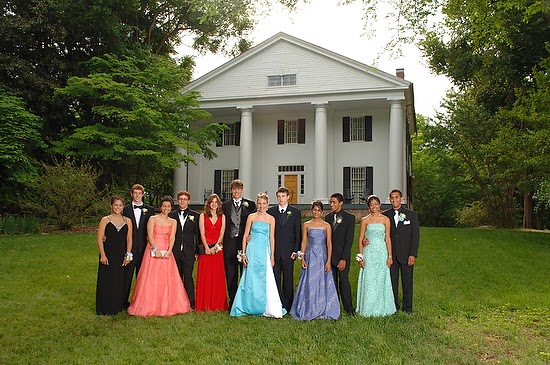
Want better posed group photos, pick better locations

Bulloch Hall Plantation located in Historic Roswell, GA
Location, Location, Location

Just like real estate, your photos will look better when you choose your location. This is the time of year for holiday parties, school dances and even weddings. While going into your yard and finding a clean background is a great idea, picking a location in your town that stands out may be a better idea.


Here you can see all the parents watching as I am taking the group photos and couple photos. If you look closely you will see my one Alienbees B1600 with the original vagabond battery by Paul Buff. It is to the far right in back [yellow head].


Another tip is to use a tripod. There are a couple of good reasons to do this. First your photos are sharper when the camera is rock steady still. Second if one person in a group photo blinks and then another person in another photo, you can always cut and paste one person into the other photo using PhotoShop.  This way everyone will look good in one photo.


Fill Flash

The subjects are all back lighted by the sun in all these photos. Unless you use a flash you will have a hard time holding the background and their faces to get a good exposure.  I metered the scene which was ISO 100, ƒ/8 and 1/50.  I then set the flash to ƒ/5.6 or one stop under whatever I would have metered for the over all scene.


Here I composed a wider shot to show Bulloch Hall where the grandparents of President Theodore Roosevelt, the 26th President of the United States, and great grandmother of Eleanor Roosevelt, First Lady from 1934-1945 lived.


I like the closer composition over the wider shot.  But I did both in case couples preferred one over the other.


Any time my family is with me and I have gone to this much trouble for photos, I always get a photo of them.

Tuesday, November 20, 2012

How I covered Hurricane Sandy Disaster Relief

This is just some of the damage to homes by Hurricane Sandy in Union Beach, New Jersey that I saw last week while covering a companies work there.
Ken is one of my mentors helping me with business practices.
My good friend and fellow photographer Ken Touchton, pointed out to me how we are called on day to day to cover the ordinary and make it look extraordinary.

Photographer's on tour

The camera manufacturers and even our professional organizations often have photographers who create some cool photos doing their "dog and pony show" at seminars and workshops. Many of these photographers create these incredible images which help them to be professional speakers and lead workshops.

My hats off to these guys. They do an incredible job and create some outstanding images. The reality is that in my lifetime I will most likely have very few if any of these types of photo assignments.

Lately those photographers on tour are no longer using dogs and ponies. Now they have elephants, dancers and just find the most exotic people and places to capture. It does make sense that to have a great photograph start with great material.

It would be fun to have the budget to hire a few exotic animals, a few models and fly them all to an exotic location. I also think it would be cool to have all that equipment to light the subjects and make a truly memorable photo.

However, Ken and I are often called on by companies to tell the stories of normal every day folks doing what may visually appear to be mundane, but are truly extraordinary.

This is some of my coverage of Chick-fil-A cooking sandwiches that they do everyday and giving them to people in need.

Chick-fil-A has a food truck that they use to distribute sandwiches at large events. Here it is in Howell, NJ where they were distributing sandwiches to Hurricane Sandy victims, first responders and volunteers.
In total over four days, Chick-fil-A's food truck produced and distributed 13,650 Chick-fil-A Sandwiches to folks in northern New Jersey and Staten Island.

Eddy Taylor from Chick-fil-A gives sandwiches to workers helping to clean up Union Beach, New Jersey. (Nikon D4, 14-24mm, Nikon SB-900 shot on TTL on camera on slow sync. Camera settings ISO 100, ƒ/8 and 1/250)
My objective was to capture Chick-fil-A personnel giving away sandwiches to those affected by Hurricane Sandy. When in a disaster I don't get to scout the area and then plan which models to bring in for the photo shoot. I don't get to come in and light the scene to make this pop as I might do in an advertising photo shoot. This is finding moments as they happen to tell a story. These moments were in short one to two minute intervals of the volunteers giving out sandwiches. It doesn't take long to give them a sandwich and give a quick word of encouragement.

The hardest part of the coverage was showing people receiving sandwiches that you could tell by the visuals alone they were part of a disaster.  I needed the food distribution and I needed to show this was about Hurricane Sandy. The photo above comes very close to communicating the two in the same photo.

(Nikon D4, 14-24mm,  ISO 100, ƒ/8 and 1/160)
One of my favorite photos from my coverage isn't necessarily the best storytelling shot, but I love the motion of the Chick-fil-A personnel walking down the street of Union Beach, NJ where there is major damage. You can see all the debris stacked behind them that had to be cleared off the roads for vehicles to get into this neighborhood.

Chick-fil-A delivered free sandwiches to the Union Beach command post where they had setup a dining room in a tent to feed all the emergency responders. Here the State Troopers from all over the country are taking a lunch break. (Nikon D4, 14-24mm. Camera settings ISO 8000, ƒ/8 and 1/100 and AUTO White Balance)
Most of the time in disasters people are in the centers where people can come to get clothing, counseling or information about their homes. While the photo above of food being distributed to the first responders communicates the food distribution it lacks the context of Hurricane Sandy without some text.

While you can put a series of photos together on a page to help tie the communication package into a more cohesive package, the photojournalist is trying to do this with one photo, because often that is all the space they have.

Running and Gunning

In all of these photos I was what I call running and gunning. As a photojournalist I don't stop people and ask them to do it again. You keep the camera up to your eye a lot of the time and quickly fire shots as they come up.

Now when I shoot for a company where we need certain things to look a certain way it is OK to make changes--it isn't photojournalism it is advertising or corporate communications. However, my photojournalism background helped me stay focused during my coverage. Chick-fil-A was on a timetable of delivering these sandwiches to people in less than 20 minutes.

They know that food safety is important and also gives the customer the best experience.  If you look closely you will notice they are on the move in giving these sandwiches out to people.

(Nikon D4, 14-24mm,  ISO 100, ƒ/5 and 1/500 No Flash)
I wanted to show how at times the photojournalist will use on camera flash in a fast moving situation to help hold some of the shadow details. In the photo above I was believing this would work OK since the skin tones of the people getting sandwiches was light. When the darker skinned volunteers came up and they were all backlit I didn't want to risk not seeing their faces so I put on the Nikon SB 900 and using the high speed sync mode and slow-sync was able to pop a little fill flash ensure I was capturing people's faces.

Another side note you can see how I altered the frame in the two photos. I don't need multiple shots with just the people changing, I wanted to tell more about the location, but had no time to move around. I just composed to show how the devastation to the left of the house was there in the second photo.

By the way we were in this location for less than five minutes. We had hot sandwiches that needed to be delivered to more places.

(Nikon D4, 14-24mm,  ISO 100, ƒ/5 and 1/500 with Nikon SB-900 on camera fill flash on slow-sync)
The Results

You might wonder how all this went for Chick-fil-A. Here is one person's response to the call center for Chick-fil-A:
Customer Comments: The customer stated that he and his family are
survivors of Hurricane Sandy. He stated that the Howell Restaurant
delivered Chicken Sandwiches to people in his area.  He informed me that
the Red Cross has not even made it into his area yet but Chick-fil-A has
come two times.  He and his family really appreciate the gesture. 
It is due to all my training as a photojournalist that companies need me. They cannot turn the hurricane disaster coverage into an advertising location photo shoot. They need a photographer that can in any situation come away with photos that communicate.

Ken Touchton and I are going to the Atlanta Photojournalism Seminar next week the first weekend in December. It is their 40th anniversary and Ken was there 40 years ago.  I am also one of the organizers for the Southwestern Photojournalism Seminar that is March 1 - 3, 2012. Both of these are great places to learn from storytellers and ask them how they handle situations.

Many of the speakers are photojournalists who also shoot commercially. Maybe the reason some of them make great advertising photographers is they know what looks authentic and have a knack for helping creating those impactful moments.

I still advise anyone starting in this industry to try and get a job with a small town newspaper. The experience gained from shooting day to day assignments will help you know how to get the best possible photo in any situation. It will also help you appreciate the ability to plan and do preproduction to get those advertising shots where you are in control.

Saturday, April 14, 2012

Off Camera Flash Examples

Nikon D4, 28-300mm, ISO 100, 1/250, f/4.5, Off-Camera Fill Flash with Alien Bees 1600 and fired with Pocket Wizard Plus System.
Walk and Talk

This past week I was privileged to photograph on a college campus. I was combining two things that give me some of my best photos. By combining off-camera flash and having people moving I get two great results; great expressions and good color.

The very first thing I started with on the assignment was a group photo, but the best results as far as expressions was not when they were standing still, but when they all walked towards me. Now mind you I almost lost my photo assistant a few times. He was having to walk backwards and keep the same distance from the group constant. This was to ensure I had good exposures.

Nikon D4, 28-300mm, ISO 100, 1/250, f/6.3, Off-Camera Fill Flash with Alien Bees 1600 and fired with Pocket Wizard Plus System.
Since I had a good group and we finished early with the group photo, I then broke them up into small groups and then had each of those do what I call walk and talks. We assign one person to talk and the others to listen, not just with their ears but their eyes. So, the person talks. The others listen and then they all are walking towards me.

Thankfully we didn't have the assistant ever fall this week while walking backwards, carrying lights and watching the subjects to be sure the light was on them.

Nikon D3S, 14-24mm, ISO 200, 1/50, f/5.6, Off-Camera Fill Flash with 2 - Alien Bees 1600 and fired with Pocket Wizard Plus System.
Buildings

I love shooting buildings at dusk. The photo here of the building and the students walking is at 7:55 p.m. and sunset is at 7:58 p.m.  I love this digital camera. You can see all the information, like what time I shot the photos.  While the sky looked better at about 20 minutes after sunset, we had to let the students go to another commitment.

We had them walk through the scene a few times.  The building is being lighted by my two Alien Bees 1600 on full power.  They are being powered by the Vagabond batteries made by Paul Bluff. 

Nikon D3S, 14-24mm, ISO 200, 1/1.6, f/11, Off-Camera Fill Flash with 2 - Alien Bees 1600 and fired with Pocket Wizard Plus System. The flash sync was set to Rear Sync to get the car lights behind the car and not in front of it.
The photo above was taken at 8:24 p.m. and as you can see the sky is much darker blue, but not black.  I use the Alien Bees to light up the building since this campus didn't have lights on their buildings at night.

Fill flash in the woods
Nikon D4, 28-300mm, ISO 250, 1/80, f/9, Off-Camera Fill Flash with Alien Bees 1600 and fired with Pocket Wizard Plus System.
One of the ugliest lighting is under trees. You get a green cast due to the light going through the leaves. What I did here is used the off-camera flash with the Alien Bees 1600 to kick in light from the front to mainly offset the green light. I also benefited from having light in their face rather than raccoon eyes. Raccon eyes are caused by top lighting, which you see during the day and gives you dark circles around the eyes.

Fill flash in direct sunlight

Nikon D3S, 14-24mm, ISO 200, 1/200, f/13, Off-Camera Fill Flash with Alien Bees 1600 and fired with Pocket Wizard Plus System.

Why use a flash in direct sunlight? You need to avoid raccoon eyes and also if you want you can help drive the audience to the subject by the use of the light as I have done here.

Fill flash inside
Nikon D4, 28-300mm, ISO 3200, 1/125, f/6.3, Off-Camera Fill Flash with Nikon SB900 with the lightest green gel that comes with the system. Also, I am using the Radio Poppers radio transmitters with the Nikon SU-800 and Nikon SB900 so that I do not have to be in the line of sight for the infrared to work in triggering the flash.
When I am inside and people are working like this lady on her computer, you are just as prone to get raccoon eyes as outside. Why? The reason is the fluorescent lights above her are acting like the noon day sun. I have the photo assistant hold the flash and direct it to her face. The Nikon SB900 is zoomed to 200mm and therefore is light using a grid on studio strobes.  It is directing the light to just her face. 

To balance the flash to the room lights I used the lighter green gel that comes with the Nikon SB900 system. To get the correct lighting I took a custom light reading by using the ExpoDisc and had the assistant point the flash to the lens when I did this.  I tried both green gels that came with the camera and the lighter of the two gave the best result in balancing the color with the rest of the room.

The sync speed was set to Slow-Sync. I shot the photos in Aperture Priority on Auto ISO with the maximum shutter speed set to 1/100 so I would avoid the color shift that happens with fluorescent lights.

Wednesday, November 30, 2011

Why I photographed them this way (Part 3)

Nikon D3, 14-24mm, ISO 200, f/5.6, 1/1000
Flash Outside

I love to use two different Flash systems outside.

1) I use the Nikon SB900 with SU800 on my Nikon DSLR or on my Nikon P7000. I also use the Radio Popper PX system to be sure the signal is consistently firing outside.

2) I use the Alienbees 1600 with a Vagabond Mini Lithium batter and the CyberSync system to fire them.

The first photo i used by SB900 to shoot the photos. I could shoot the photo and fill-flash with the hot shoe flash quickly and move around. The flash had to be very close to the people outside to be useful.

Walk and Talk photo I like to use. Nikon D3, 24-120mm, ISO 200, f/5.6, 1/160
Walk-and-Talk

The next two photos are using a technique I learned from Jeff Smith a corporate photographer back years ago.  Back then I was shooting film and with today's flashes this is easier to do.

I like having the subjects walk side by side talking to each other. Often as in the first photo they walk straight at me and other times like in the last photo they just follow the path of a sidewalk for example.

I have an assistant either carrying the Nikon Speedlite system or my Alienbees system.  The advantage of the Alienbees is I can have the assistant further away and still with the power of this flash fill in easily.  Actually, most of the time the Alienbees are firing at 1/16 or 1/8 power.

The assistant walks off to the side, usually lighting them at 45 degree angle to the camera.  They walk just outside the picture frame and keep an even pace with them as they walk. You need to hire an assistant who can walk and chew gum at the same time for this technique.
My portable system for Walk-and-Talk. AlienBees 1600, Vagabond Mini, CyberSync radio remote control

CyberSync Radio Remote Control

Vagabond Mini
The reason I like the Walk-and-Talk technique is it gives something to the subjects to do. I find this not only helps to focus them, but after a couple times doing this they tend to not only relax, but I get great expressions.

Tip

If you use this Walk-and-Talk technique I recommend you tell them to walk close enough to each other they feel each other occasionally touching. In addition, I recommend one person talk and the other listen. Lastly, I ask them to look into each others eyes or at each others faces.  There is a tendency for people to look at the ground or off somewhere else.  I want them to look interested in each other.


Friday, October 07, 2011

Example of shooting an event to tell the story

1
This is our family at Nelson's graduation from the US Army Armor School at Fort Benning, GA. 
The event: Our Son Graduation from The US Army Armor School at Fort Benning

I wanted to lead with the most common photo many of us take at a graduation. The family has a group photo with the graduate. I setup the photo before I got into it, so there are some things I did for this first photo that I recommend.
  1. Turn the flash on. In this photo you will quickly notice that had we not had the flash on you would have not seen our graduate's face due to the shadow of the hat covering his face.  If you look closely you will also see how on my daughter the shadows would have been worse around her eyes without the flash.
  2. I used the background to help our family remember a little about the event. Nelson is part of the Cavalry and the statue behind him helps capture that as well as his hat.  In addition the building is the main building for the Armor Division and is called Maneuver Center for Excellence.
  3. Spacing of the group is done so you can see everyone's face but we are not too far apart so that when you take the photo the faces are too small.  
  4. The front to back is well used. We have the family closest to the camera and not right next to the statue or the building.  This is a common mistake many make, because to then show the statue for example and the family you would back up and everone's face would be like the size of a dot in the photo.  
  5. Some angling to not be perfectly parallel to the building.  This helps create depth to the photo.
2
Statue to help communicate this building is the home of the Cavalry.
Detail shots help round out the coverage for the day.  I took a moment and walked around the statue until I found an angle that helped to communicate the power of the statue.  Shooting up really close made it where I was shooting almost straight up.  This helped make the statue look powerful.  Further away would have taken away the emotion of the power.

Look for details and then notice I had a purpose for the photo.  I wanted communicate something.  If you don't know neither will your audience.  Take a moment and think why you want the photo.

3
Capturing emotions helps to communicate
I know that if you go through some of the intense training the military, then you most likely have developed some emotional connections to others on the team.  This was not an event for me, this was our son's graduation.  I needed to show what this school meant to him.  One of the ways to do this is to show people reacting to their friends. 
4
While this was not my son, capturing others enjoying each other help to communicate the bonds formed in the school.
5
When a subject looks into the camera they are looking at the audience.  While I prefer unposed photos of subjects reacting to people and not the camera, sometimes their a moments where the subject engages the viewer.
I notice people using their cameras probably more than most since I do this for a living. What I think this captures is how important an event is to a community.  When I take a photo of others taking photos it shows that to these "photographers" this is important to them. 
6
His role is to help update the social media pages for the unit and here he is getting some visuals for his next post.
7
At attention for the national anthem.
Patrick Lencioni, author of the New York Times best seller "The Five Dysfunctions of a Team" says ceremonies are important for people to move on in life.  He even said that weddings are as much a funeral for those leaving single life as it is about the joining together. 

After hearing Lencioni speak on this topic I realized how important the symbolic ceremony is to helping us with changes in our lives.  The simple act of listening to the national anthem changes everything when you are at a military ceremony. It brings to your mind and heart the commitment of soldiers for our country.
8
Capturing not just a prayer, but for me I see the elected official and the military in this photo.
In the middle of the two officers on stage was the Governor of the State of Georgia. Our elected officials are responsible for calling for war on a country.  It highlights the importance of going to our polls to elect not just someone because they may believe in similar ideals that we want fostered. It means electing someone to office you trust will have the mind and heart to carefully consider what the right thing to do is when we ask these soldiers to lay their lives on the line.
9
I shot this as tight as I could and tried to use the American flag to help communicate this is an elected official.  This is Governor Nathan Deal of Georgia giving the keynote address to the graduating class.
10
Our son Nelson is being given the Iron Man Physical Fitness Award for having the highest Physical Training score in the graduating class.  Nelson scored a 347.  Presenting him the award is Governor Nathan Deal.
The moment Nelson reached out to take his plaque and give a handshake to the Governor is the pinnacle moment in the ceremony for our family.  "The Decisive Moment" was when I thought would be the moment that helped tell the story of the day.  While this is what I thought prior to the days event as the story telling moment, I am not sure that some of the other photos don't do just as good of a job.

If I were transmitting the photos to the Associated Press this would be one of the ones I transmitted, because it is something you would expect to be in the group of photos. While you want to be sure you have it, the editor may pick another photo that works.

A good reason not to use the photo is because it is what you expect--that's right.  Sometimes the reason you don't use a photo is because it is cliche.  Does this photo really make you want to know what is going on?  I think not. Our family likes it, but you reading this article may be just as happy with another photo that is stronger in your opinion.
11
Get the 2nd fiddle as well. While the first handshake by the Governor was cool others should still be photographed. My son didn't spend one moment with the Governor during his schooling, but he did spend time with this leader. Which one will mean more to the graduate? Get both and he will love them both.
12
The standard establishing photo.
Sometimes we get to focused and just get the photo of the handshake at a graduation and then one more photo of the family. Round out the story.  Show where the event took place. It gives some context to the situation.  The thing this photo does better than all the other photos is it gives an idea as to the size of the class and how many of the soldiers families came for the event.
13
This is the only graduation that the Governor has come to this year. It was newsworthy because he came. How do you tell the audience how important it was that the governor was there? Show the media coverage and you help communicate how big of a deal this is to the state of Georgia and the country by taking this photo.

14
When you get the award for "Iron Man" you want your photo to show the "big guns." Putting him in front of the tank works for the Armor Graduate. Notice the flash was used here.
While you can have people pose for you, you can get some cool photos of when they are not posing for you but for someone else. One of the reasons these photos work is they are different.  Look through all these photos again. Count how many of these photos you would always expect most people to get, then count those that are different.  What did you notice?
15
When people are posing for others get those photos too, but from a different perspective.
Okay if you are reading this you made it to the end. Did this give you some ideas for your next event? If so please take the time to let me know by writing below your comments. It is through your comments that others will get more out of this than just from my words alone.