Showing posts with label photography composition. Show all posts

Friday, April 18, 2014

Composition Tips from world renowned photojournalist Don Rutledge

Don Rutledge took this in 1967 inside the Arctic Circle. People are so comfortable with Don that he is able to be apart of the woodwork.
This is my favorite photo that Don Rutledge took. I have enjoyed seeing the world approximately 150+ countries and all of the United States without ever leaving my own home.  Most of the traveling was done with the help of The Commission Magazine and Missions USA.  Both of the magazines have won some of the highest awards in the country.  The Commission Magazine has placed third in magazines in the “Pictures of The Year” contest sponsored by the National Press Photographers Association in 1989 and 1990. CommissionStories a newer version of the magazine just won as Finalist for Magazine division of the Pictures of the Year contest behind National Geographic Magazine for 2014. Missions USA has earned similar awards.  These Southern Baptist magazines are in a league with National Geographic and Life Magazine for their photography and design.

The reason for their success can be tied greatly to Don Rutledge.  Prior to coming to work for these religious magazines Don was one of the staff photographers for the elite photography agency Black Star. During the 1950s until 1980s if you were to look for the credits of the photographers in the major magazines you would find Black Star the agency that handled getting their work published.

The shoeshine man had to be told by Don that John Howard Griffin was white and not black.  He could hardly believe that this man was really white. [by Don Rutledge]
One of the biggest news stories, which Don covered, was following and documenting John Howard Griffin who transformed himself with drugs and makeup from a white man into a black man. He would later write about his experience as a black man in the book Black Like Me.

"Don discovered these two youngsters who proudly displayed the results of their morning hunt.  In that section of Cincinnati, rats were not particularly difficult quarry to locate." [Walker Knight, See How Love Works]
Don's story is really a series of stories. Using the storytelling model I introduced in the last blog here is a short story of Don.


Don Rutledge knew he loved to take photos and looked and noticed the Black Star agency in all the magazines. He wanted to learn more and work for them. He contacted Howard Chapnick, the president of Black Star.

Howard asked for a portfolio, but Don didn't have one. So Don pitched story ideas which Howard liked. Howard pitched these to his clients and told Don one was interested. Before Howard had a deal Don had already shot the story and sent it to Howard.

Howard wrote back and told Don his mistake and also told him what was wrong or missing from that coverage. Don went ahead and went back and filled in those holes in the story and sent it to Black Star.

The client loved the package and requested Don for more coverages.

Volunteer Mike Edens taught these two pastors Mikhail Shehata Ghaly and Anwar Dakdouk MasterLife Discipleship training in Cyprus during 1984.  [photo by Don Rutledge]
When I got the chance to work with Don I jumped at it. This was for me the Luke Skywalker and Yoda opportunity for me.

Within the Frame

One of the lessons I learned from Don was to scan the edges of the frame. Make the most of the entire frame from edge to edge and from front to back.

If you look at the photos I have posted so far of Don's pay attention to two things: First how the edges include details and do not make sloppy by cutting off legs or other things in the frame. Second see how much layering is from front to back in all these photos.

Do you see all six people in the photo of the Eskimo family in the first photo. Notice how these are all over and Don has introduced the family, the social status and where they live in that one photo. He also has captured the excitement and happiness that they experience.

Take each photo and notice the edges and how people are anchoring the photos. Their feet are included, but not too much. The people are placed in context with the environment. The environment tells you a little about the people. The expressions of them show how much they love life.

Notice that had Don cropped in tighter to the shoeshine man and Howard Griffin you would not know he was a shoeshine man. You need the shoe polish and the foot rest to help tell the story.

In all these photos there is also just a little tension. Each photo has the reader asking some questions. The photos make you want to know more about each situation.

In the Philippines families cluster together for meal. [photo by Don Rutledge]
One trick Don used often was just including a sliver of light just to see beyond the initial scene. With the Eskimo family it is the tundra to the right. With the family in the Philippines it is the door and the floor that give you a sense of there is stuff beyond them. The photo of the men walking in Cyprus you can see beyond them the man walking away.

Notice in all these photos you have a sense of a problem facing the characters. The boys holding the rat is probably the most obvious, but each one you can feel the tension. You can also sense a victory over their situations.

Surgeon Tim Pennell was able to get five of his colleagues from Bowman Gray School of Medicine to commit weeks of vacation time and thousands of dollars to meet their Chinese counterparts. [photo by Don Rutledge]
Editors and presidents of organizations sought out Don to help tell their stories. They saw in Don's photos more than just a pleasing photo—they saw that Don was capturing the inner souls of people in ways others just didn't.

Don captured moments. President of the Foreign Mission Board Keith Parks said,
Although Don took hundreds of pictures, I hardly noticed because he did it in such an unobtrusive way.  When he put it all together he had really caught the highlights of the meeting and the impact that he wanted.  I just think that he is a first rate fellow from every measurement professional.  Of course, he can and does meet the highest standards of the secular world, and yet his deep spiritual commitment has caused him to give himself to the spiritual cause he believes rather than selling his skills to the highest bidder.  I just think that quality and character come through in his pictures.
Dan Beatty, the design editor of The Commission Magazine commented,
Don is the one person who has completely influenced the direction of the magazine. Before Don came we knew that there was a certain way we wanted to present the missions material in the magazine.  None of us had a firm grasp on what direction we should go to achieve our goals.  Don really provided the direction for us to go.  Don never expressed any strong feelings about—in a critique type way—on the magazine.  Just Don's presence and constant example of someone who always strives for the best is what guided us along. He was constantly putting us into contact with different individuals in the field of photojournalism and layout and design.  He felt these would be good influences on the magazine or influences that would help us along the road where we wanted to be with the publication.
I would not be doing what I am doing, at the level I am doing it if it hadn't been for Don. He is an example of consistency and integrity in a field where that is not always a constant with the different people that I've met.  He represented something that I wanted to achieve myself.  He has been the biggest influence that I can think of on me personally and the different photographers that I have worked with along with Don.  The thing that impressed me most with Don is his sensitivity and his regard for human beings.  I think that is what made him the asset that Dr. Parks was looking for in communicating about Foreign Missions to Southern Baptist and other people as well.  The dignity of the human being no matter what the situation is so very important to Don.  To me that is the real strength of Don's work.  
Note

Don Rutledge spent his career photographing more than 150 countries and all 50 states.  He was published almost every single month of his career in magazines. Few photojournalists were more published on a regular basis in magazines more than Don. He died February 19, 2013 at the age of 82.

Monday, April 07, 2014

Dissecting a photograph

Photo #1

I wanted to walk you through a few photos and let you see what I think makes the photos work.

In photo #1 there are a few things that I think help make this photo work. Here is a quick bullet list of things that I think help make this work.

  • Rule-of-thirds—The man gesturing is on the right top thirds
  • Good use of Light—The light is coming onto their faces and brightest where the two men are in the photo
  • Gesture—The mans gesture helps you know that he is talking to the man next to him. also the little girl's finger under her nose shows possible sniffles. The little girls eyes also redirect you back to the man gesturing
  • Shallow Depth-of-field [DOF]—The photo drops off in sharpness as you go back into the photo. This helps keep your attention towards the front to the man
Photo #2
I really like this image of the ladies talking. Who can't resist good "Window Light?" The rule-of-thirds is also working here. Shallow DOF keeps your attention on the lady listening. Catchlights in the eyes give life to her expressions. The hands communicate tension. I feel like she is dealing with some stress due to the position of the hands. With her head leaning on the wall I also feel like she is relaxed and comfortable with this other lady. The other lady is slightly taller and her body position and the lady listening to her communicates some authority.

Photo #3
Street photography is a lot of grab shots. Here the wall is helping communicate the neighborhood where this young boy lives. You can tell that education is important due to the signage. The little boy is relaxed in his body posture.

The photographer has a lot of space behind the boy and very little in front. This helps create the tension that the future isn't as hopeful. The boys expression is questioning and wondering who this photographer is and thus communicates to an audience a little tension. The color palette is simple yet the colors communicate Caribbean. 

Photo #4
Photo #4 is of NBC news reporter Robert Hager covering a tornado disaster. Here the DOF is increased to be sure the viewer looks towards the debris in the background. You can tell Hagar is waiting to go on the air and talk about the situation. 

This is where the elements of the videographer and his gear helps tell the story and is in essence helping to frame Robert Hager and the destruction.

Photo #5
In this photo #5 the subject is dead center, please pardon how this sounds, but this is why I put the subject in the center. This is normally what you want to avoid, but here it helps create even more tension. The edges of the photo are trying to contain everyone in the photo. The lack of color around the photo and then with the American flag center helps to really make it pop and draw the audience's attention.

Photo #6
Here the photo #6 is using color to help create interest and set the mood. the light is off too the side and lets the viewer see the design of the lamp post.

Photo #7
Using Rule-of-Thirds helped with the composition in photo #7. Also using a shallow DOF the eye goes to the sharpest part of the photo which is the guys face. Here the expression of the man and the man he is looking at keep you going back to the obvious friendship here between the two guys.

Photo #8
The light on the video camera in photo #8 helps start the eye looking and then you look for where the it is pointed. Also all the cameras on the left are helping to direct the eye to the right and the guys holding the trophy.  Here the photographer has moved as close as possible and basically trying to contain everything in the frame. 

Can you break down each of your photos? Take a moment today and really study not just your photos but those photos that catch your attention. Break them down so that later you can use some of those techniques in your photos.

Friday, June 28, 2013

Make your photos 3D for interest

Nikon D4, 14-24mm, ISO 500, ƒ/10, 1/200
Too often people are isolating their subjects so much that the context is lost. If you just give a peak in the photo of things behind the subject you can create depth into the photograph.

In the above photograph I used the ally to help create depth.

Nikon D4, 14-24mm, ISO 1000, ƒ/10, 1/200
See the difference between that photo and the one below?

Nikon D4, 14-24mm, ISO 560, ƒ/10, 1/200
Here I am just capturing some individuals in this same ally. Here I faced the subject and kept the background simple.

Nikon D4, 14-24mm, ISO 320, ƒ/10, 1/200
By just letting some of the background be of the ally in the lower photo you create a little more interest beyond the subject.

Nikon D4, 14-24mm, ISO 280, ƒ/10, 1/200
I am not trying to compare the photos in terms of best expression and moments.  I am just trying to show how the composition can create more of a three dimensional photograph over a two dimensional one.

Here all the people were trying to stay in the shade and I like the photograph, but it is a little flat. The tables in front of them help, but compare this to the one below.

Nikon D4, 28-300mm, ISO 250, ƒ/7.1, 1/100
I am using the reflections in the window in the background to help create depth here.

Nikon D4, 14-24mm, ISO 2200, ƒ/10, 1/200
In the photo of the chef garnishing the food, I just have a small slither of sky in the top left hand corner of the photo. This helps with the depth as well as the reflections in the windows.

You will also notice in most of these photos I like working with extreme wide angle lens. I just love my Nikon 14-24mm ƒ/2.8 lens. By me getting close to people even where the background doesn't help create depth the lens helps bue to the perspective and puts the viewer [you] right there in the ally with me.

Nikon D4, 28-300mm, ISO 100, ƒ/7.1, 1/125

Wednesday, June 12, 2013

Photography Composition Tip: Anchor Your Subjects

Nikon D4, 28-300mm, ISO 180,  ƒ/10, 1/500
Anchors Away

I am still in cruise mode after last week. It takes longer to do everything since I got back. You see I think I need to stop every 45 minutes and find food.

Being on the ship and see those huge anchors made me think of a simple composition technique to improve your photos.

Anchor your subjects.

Nikon D4, 28-300mm, ISO 12,800,  ƒ/3.5, 1/160
When you crop off the feet of a subject or in this case the front of the car the subject isn't well anchored.

Just lower the camera a bit and give the subject a little room at the bottom.


See what a difference the composition is by just moving the camera a millimeter?

The reason so many of us forget to do this is we are looking too much at the subject. You need to scan the edges of the photo and correct for this problem.

Many photographers tend to have too much space above the subject and this is due to centering of the subject.

Thursday, April 04, 2013

Vacation Photo Tip: Long Lens can compress the scene


Nikon D4, 28-300mm [56mm], ISO 100, ƒ/10, 1/80
We were on our quest to get a good photo of the Hollywood sign by going up the road to the Griffith Observatory in Los Angeles. After parking we immediately took our first attempt here.

Nikon D4, 28-300mm [68mm], ISO 280, ƒ/29, 1/60
Now we move up the road to the observatory. Here the photo is a little better. Had there not been cars and road right behind me I might have backed up a little and used a longer lens. While I like the photo, I still feel that the Hollywood sign is just too far away.

Nikon D4, 28-300mm [190mm], ISO 280, ƒ/29, 1/60
To get the last photo we went further up the mountain. I used a longer focal length and to be sure the Hollywood sign was readable I stopped down to ƒ/29. I like this photo so much I did another one of my wife alone.

Nikon D4, 28-300mm [280mm], ISO 280, ƒ/29, 1/60
One last thing about that latest photo, notice how I zoomed in even more to 280mm focal length. The sign is even closer in feel and based on this if I had shot this with a 600mm it would appear even closer.

Just a couple of posts ago here I recommended composing the background first. This is still the case, but sometime You need to consider bringing the background closer.

Remember this is just the opposite of what they are doing when they shoot TV sitcoms. They are trying to make the most of the small space they often work in and therefore are using moderate to wide angles to expand the set.

Tuesday, April 02, 2013

Vacation Photos: Compose Background then add family and friends

Nikon D4, ISO 12,800, ƒ/5, 1/100, 28 - 300mm [No Flash]
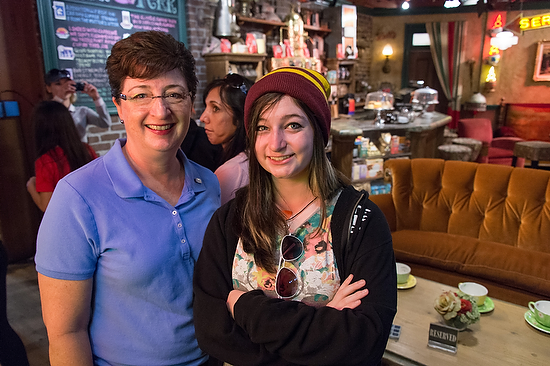
Today I was touring the Warner Brothers Studio in Burbank, California. We made a stop to see the set of the Friends TV show set.

While I enjoyed seeing the set and took many photos.  I took this shot and then put my wife and daughter into the photo.

Nikon D4, ISO 12,800, ƒ/5, 1/100, 28 - 300mm [No Flash]

I had my wife and daughter get as close to the camera as possible without totally blocking the background.


The diagram shows how their was neon sign lighting my wife and daughter just over my shoulder.

Had we had more time and no one else in the room with us I might have tried a few other angles.

Nikon D4, ISO 12,800, ƒ/5, 1/100, 28 - 300mm [No Flash]

My tip is simple, first compose the background and then get the people as close to the camera as possible. This means they are most likely between three to five feet from the camera at the most.

Nikon P7000, ISO 128, ƒ/2.8, 1/250, -1 EV flash

Earlier we went to Disneyland. Here I just carried my Nikon P7000. I have a already programs my U1 [User Setting 1] where the flash is -1 EV. So in this last photo I used similar technique and got everyone close to the camera. I popped up the on camera flash and because we are so close to each other the subjects faces don't have those nasty raccoon eyes due to the sun directly overhead.

So the only last tip is to use a flash outside to fill in those shadows.