Monday, December 16, 2013

Christmas Trees and Cameras have something in common

Fuji X E2 with the 18-55mm on a ProMaster XC525 Tripod

Both Christmas trees and cameras do better with tripods that support them and hold them steady.

Now for the past few weeks I have been testing the Fujifilm X E2 camera. Lately I was taking Christmas tree ornaments and enjoying using the Wifi to help upload the JPEGs quickly through my iPad using the Camera App you can download.


I also was taking portraits which I posted on the blog earlier. What I noticed right away was my pictures were not as sharp with the Christmas tree ornaments as compared to the studio. Well of course the ƒ-stop was greater, but really the sharpness issue was with camera motion.

Sure the Fuji camera has vibration reduction, but even when this is flawless a camera on a tripod cannot be beaten.

ISO 6400, ƒ/4, 1/35
Once I started taking photos with a good tripod the photos looked so much better.  It wasn't camera error, it was operator error that was causing my photos to not appear as sharp as they could.

ISO 6400, ƒ/7.1, 1/10
The other thing I was able to do by shooting on a tripod was vary my depth-of-field since the camera movement at a slower ƒ-stop wouldn't affect the sharpness of the photos.

ISO 6400, ƒ/7.1, 1/9

ISO 6400, ƒ/4, 1/30
While the photos were definitely sharper there is another benefit with shooting on a tripod, composition.


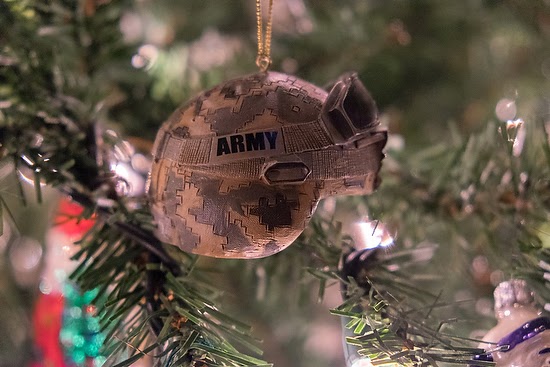
While these photos don't win a pulitzer for composition, I was able to keep the camera still, which is hard to do when you are focusing as close as the camera will do on such small ornaments.

ISO 6400, ƒ/10, 1/7

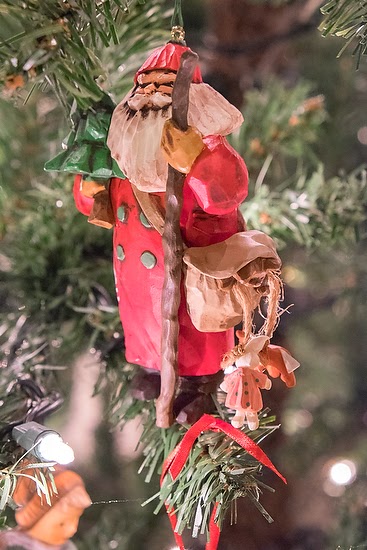
Some of the ornaments like this of Snow White were tricky to shoot if you shot them wide open and that would be ƒ/4 on this camera and lens. I stopped the lens down to ƒ/10. How did I know that is what I wanted?

Fuji X E2 Feature Bonus
On the Fuji X E2 when you push the shutter release half way down the camera aperture closes to the setting you have and the viewfinder automatically adjusts in brightness so you can see your depth-of-field as it will look when you take the photo. On a traditional DSLR you have to wait for your eye to adjust to see the DOF. This is one of the really cool things about this new camera.


Now all these photos are using the existing light in the room, which was primarily the lights on the tree. By getting so close on all the ornaments the depth of field was pretty shallow and helped to pop them out from the tree and the background was cleaned up in the process.


My suggestion for any photographer who has a Christmas tree and a tripod is to take time and record some of your ornaments and maybe just post them to your Facebook, Instagram, Twitter or Pinterest account.  I have gotten more comments about these than many other posts I have done.

Maybe the reason is the ornaments is something many of us collect and understand.


At our house you are just as likely to see The Citadel ornaments, photography ornaments in addition to what the season is all about, those that remind us of Jesus.


Go get your tripod and let it slow you down this season to take the time to remember the reason for the season.

Taking photos mindlessly will result in an image that is worthless


Dr Linda Henkel, conducted a study at Fairfield University in Connecticut where they led a group of students around a museum and asked them to either photograph or try to remember certain works of art and historical exhibits.  She said: "People so often whip out their cameras almost mindlessly."

What many writers are taking away from this is "photographs STOPS our brains remembering what happened." Just Google "photography doesn't help you remember" and you will see the articles all quoting research.

I think the research got it right and even Dr. Henkel clarified her comments, but what do writers want you to hear? I think they are tired of hearing "a photograph is worth 1,000 words."

Photos that are worth the category of a 1,000 word story are not where the photographer just pulls out their camera and snaps a quick photo.  I think if we look at how Norman Rockwell used photography to come up with a great illustrations. Rockwell would have many different photos for him to pull from to create his masterpiece.


When a photo is going to not just help you remember, but tell a story to those who were not there with the photographers then the perspective the photographer chooses and the moment can help capture a story.

Too many people just pull out their phones today and because it is with them they are even more careless than when they had to think to remember to bring a camera. Since it is with them all the time and they are not having to buy film and pay for each shot--they cheapen the moment by mindlessly just clicking the photo.

“Research has suggested that the sheer volume and lack of organization of digital photos for personal memories discourages many people from accessing and reminiscing about them,” said Dr. Henkel.


Photographs that tell stories require the photographer to think before pressing the shutter release. What should they be thinking about to have photos that will later tell the story?
  1. Why am I taking this photo?
  2. What is the story?
  3. What do I want those who see the photo to do after they see it?
  4. How do I feel about this story?
  5. What can I do to help convey my emotions about the story in the photograph?
  6. What must be "Within The Frame" of the photograph?
  7. What will be left out of the frame of the photograph?
  8. Where do I want everyone to look first?
  9. How can I compose this photo so that the secondary is secondary, but still relevant.
In the photo above of the gift of a viola to a young man you can see the lady, who is his mother, looking on and conveying pleasure. The son is thrilled not just for himself, but for his mother.

The story is that this single mother works several jobs to put food on the table and roof over her family. They do not really have the money for her son to be playing a viola, but the viola may just be his ticket to college and a career.

I wanted to capture this moment of telling the story of why this gift was such a big deal. I don't think you will think I just pulled out my phone and took this photo. You can tell it is more than a memory jogger. Because I thought about it not only will I remember the moment--my photo will help others who were not there to know the story.

Saturday, December 14, 2013

Custom White Balance vs Presets

Custom White Balance using ExpoDisc
Today I shot the Wreaths Across America Day event at Roswell Presbyterian Cemetery.

While shooting this I realized many folks assume those presets for white balance will give good enough results. Well sometimes they do. They will put you in the ballpark for each type of situation.

Auto White Balance 
Now you maybe satisfied with Auto White Balance. The point here is notice it is different than the custom white balance above.

It was raining and they really don't have a rainy preset.

Cloudy Preset
While the cloudy preset is closer I think it is a little too orange.

Daylight Preset
Even the Daylight preset is different.

Shade Preset
I think the Shade Preset is the closest, but still some minor differences.


The latest version of the ExpoDisc 2.0 comes with warming filters. They are slightly a cyan color of different densities to let you pick how much you want to warm up your image. So without them you get a pure 18% grey and by adding these you warm up the photo just a bit.


You just put the warming gel in the front of the ExpoDisc and then take your reading. This way you can keep a consistent warming to all your photos.

So what should you do?  I would advise always doing custom. You can always change it later using Adobe Lightroom if you shot it RAW.

To the left here is the pull down menu that is available to you in Adobe Lightroom if you shot it RAW. These are very similar to the presets on your camera.

Sometimes the perfect custom white balance maybe not your preference in the end.

Just click on the link below to see more of the photos from Wreaths Across America Day at Roswell Presbyterian Cemetery.

Friday, December 13, 2013

Loving the Fuji X E2 for Portraits


I am really loving the Fuji X E2 with the 18-55mm kit lens for shooting portraits.

The first time I was shooting in the studio on manual I discovered a problem with the default setting is the screen will be black when shooting in a studio with say settings of ISO 200, 1/180 and ƒ/11. I was talking with my friend Gibbs Frazeur who had bought the Fuji X100S and he called me up after I complained and told me to go to the manual on page 40.


You can change the preview exposure in manual mode to off so you can see what you are photographing with the available light. Then when the camera takes the photo it will capture the settings you have set on the camera.

What I really like with the camera is how sharp the photos are from the camera.  Here is a closeup of the eyes from the photo above.


Here is another photo of my daughter and then a closeup as well in that photo.


Closeup of the photo above.


Thursday, December 12, 2013

Fuji X E2 vs Nikon F4 with x-rite Mini ColorChecker

Fuji X E2, 18-55mm, ISO 200, ƒ/11 Custom White Balance with ExpoDisc [Click here for Full Resolution]

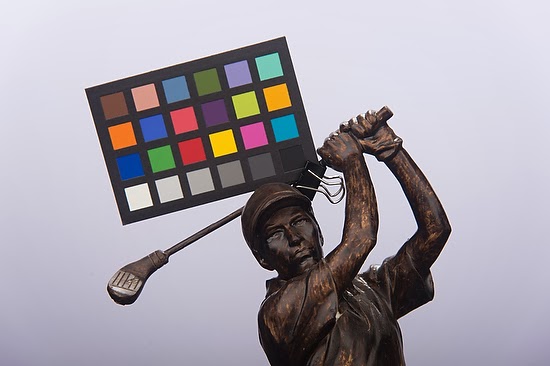
For this test I used the Munsell Color x-rite Mini ColorChecker chart as the comparison.  They stoped making it, but I still use it.

Closeup of photo above

The top photo is  the Fuji Camera.

Nikon D4, 29-300mm, ISO 200, ƒ/11 Custom White Balance with ExpoDisc [Click here for Full Resolution]
Closeup of photo above


Wednesday, December 11, 2013

Nikon D4 vs Fuji X E2 in Studio


Studio Comparison

First of all after importing the RAW images from the Nikon and Fuji into PhotoMechanic I noticed one thing right away—file size. The Fuji RAF file was 32MB as compared to the Nikon NEF 18.2MB.

After import I went into Adobe Lightroom and selected lens profile to change. The Fuji doesn't have that data yet for Lightroom. They have lens modulation optimizer built into the camera.  Here is how it works:


You may want to read about the Quest for Highest Possible Resolution by Fuji HERE.

Second step was getting the comparison closer to each other, so I used the eye dropper and clicked on the white background to get similar white balance.

Then I exported them.

See for yourself

Nikon D4, 28-300mm ISO 100 [Click on here for high res]
Fuji X E2, 18-55mm ISO 200 [Click here photo for high res]
I shot at the lowest recommended ISO for each manufacturer.  Click on the links above to see full resolution JPEG images.


Nikon D4 cropped version of the photo above
Fuji X E2 cropped version of the photo
I suggest downloading the high resolution and do all the pixel peeping you like.

Tuesday, December 10, 2013

$50 Headshot December Special


I sent out an email using similar photo above for a promotional piece.

Why?

I was seeing too many friends out of work with terrible or no headshot on their Linkedin profiles. They either looked unprofessional or like creepers.

Too many of these people would not spend the money right now to get a professional headshot. I wanted to give them a way to get one without appearing to be needy.

What I sent out
[first name], The software puts their name in the spot to personalize the email.
I am offering this special to those who would like to stop by my home studio for five minutes for a quick portrait. I will make no more than a dozen photos for you to choose one photo for $50 that I will then email to you for you to use however.
Keep in mind, that you want it to put you in the best light possible -- literally. Lighting is key to having a good headshot and amateur headshots are pretty obvious. 
The pose in your headshot is important as well. The trick to a great headshot is one that exudes your personality. You want the people looking at it to be able to discern the kind of person you are simply by taking a glance at the photo. 
Stay with solid colors for your outfit. Patterns are distracting and pull your attention away from your face. I would avoid white shirts they can have a problem depending on the monitor someone is seeing them on. 
Stop by the hair salon or barber before coming if you like.  
I recommend men shave just before to avoid those five o’clock shadows. 
I am hoping that this will help many out there who have been looking for jobs and need to do something to help them standout. Hopefully a good headshot on their Linkedin page and Facebook can help put them in their best light to land that next job. 
If you know someone who could benefit from this send them my way. It would make a great present for them. 
Thanks,
Stanley

Results

I have had many people contact me to schedule an appointment. Some are who I was targeting and some just knew this is a good deal that they couldn't pass up.

I also received emails from photographers asking to use this same promotion in their market.

Here is one of the best emails I received. I like it because someone got what I was trying to do.
Hi Stanley - I just want to say hi and what a really terrific service this is that you are providing to people. It reflects the generous heart you have and is a lovely thing to do at the holidays.  I miss not seeing you and Dorie often, but love keeping up via newsletters, etc.
Warmest and best to you for a very Merry Christmas! 
I think the rewards are greater than the immediate financial. I am building my brand and what I choose to offer as a special builds or tears down the brand.

Sunday, December 08, 2013

Is all your company communication treated the same?


Are you a good steward of your communication budget for your company? What am I asking?

First we need to understand really what stewardship is all about. According to Webster's Dictionary it is “the conducting, supervising, or managing of something; especially:  the careful and responsible management of something entrusted to one's care.”

In the headlines this week and spreading all over the web "Corporate profits almost double historic norm."  Check out this article by Jay Bookmen on it here.

When things are going well and you are not pinching pennies is when you are most prone to wasteful spending.

Be strategic and plan out your corporate communications. Do this using the pyramid above. Every corporation has main objects for the year and then there are other things that still need to be done, but are always behind those key initiatives.

A Level 

In your top category put those things that are the most important. Now this is where you will dedicate more time, space and budget to communicating this than all the other items. For example you would have this lead or be in every newsletter you send out. You will make videos here because you know you will use those over and over again.  You commit to writing about this in different ways. It may even be a special place on your companies main webpage.

B Level

These are items that had it not been for those in A Level would be. You commit to only communicating regularly on these topics maybe once a month in the newsletter rather than the weekly newsletter. You will make less videos on this because they will not get used as often.

C Level

This level means that you are committed to the topic and may do a quarterly story or project to keep this in the companies mind.

You still may do a few pieces that do not fit in A, B or C, but those are more of a one off and not committing the resources at a level to really tax the budget. You may have also departments coming to you for help, but if they don't fit into the plan you may turn them away explaining how they are not part of what the company has decided as a priority. Maybe they fund that themselves.

Possible Scenario

Your company is rolling out a new product. You decide to produce a video for the company internal people to get everyone on board. You decide that you will use this piece in the annual meeting, quarterly meetings and in department meetings. Due to the wide use of the project and the importance of it, you want to be sure it is a high impact piece. The production quality is important since it will be used on large screens.

Contrast this to one of the many C Level projects that go up on your company website every week and come down after a week or so. Do you commit the same level of production to something that has a short life span?


Gold, Silver or Bronze

Many companies like a certain quality of video. They are producing what amounts to a small Hollywood Film. The problem is they are producing this quality all the time when the simple news cast quality we see each night on the six o'clock news would work not just fine but perfect for communicating our message.

Consider in your communications about creating levels of product and when they will be used for your tiered communication strategy.  You may have a news cast, documentary and Hollywood produced videos all used in the A Level. However, you may only have documentary and news cast quality in the B Level.  You may be fine with using a news cast quality or non at all for the C Level.

Being a good steward is putting the right amount of resources to accomplish the goal. Don't over do it even if it is A Level.

Just because you have the money, don't always spend it all.  Spend what you need and no more.

Are you filling holes in an organization or using holes to fill the organization?

Pastor Emanuel Yameogo is in front of the church he pastors in Koudougou, Burkina Faso, Africa.

Many photographers are enjoying giving of their time to travel the world for a NGO in exchange for access to subjects. You can get hooked on doing this for the wrong reasons. Getting one more country stamped on your passport can feel good to even those who are doing it for all the right reasons, but be sure this is not the motivation for you to see the world.

I just had someone post this on a forum that I contribute to and enjoy.  I posted this as a response and believe too many photographers with big hearts and giving to organizations are often doing more harm than good in the big picture for those organizations.

San Antonio Catholic Church in Tikul, Yucatan, Mexico
"NGO/NPO's have a budget for marketing. Do not let them tell you they have no budget."

Sadly this is not true in all cases. While there are many reasons they have no or inadequate budget for marketing there is one that many of us contribute.

Altruism is one of the biggest problems with these organizations. Many media professionals out of wanting to help actually have hurt many of these organizations over time.

A giving photographer isn't able to give to their charity $20,000, but chooses to give of their time of what would amount to a $20,000 gift. This is how many organizations are able to do more with less.

Let's say that for the next 20 years this photographer gives annually a week of their time doing projects from multimedia, still photography and maybe some writing to help with marketing materials for this organization.

Jacob Tarnagda [left] and Jay Shafto walk through the Jacob's courtyard. Jacob is a leader in the church in Soumagou, Burkina Faso, West Africa.
Sadly the photographer dies one year for whatever reason. Slowly this organization is loosing traction. Their marketing is not as good as it was. They cannot find a veteran photographer like the one they had before. Now they rely on college students and amateurs who give of their time.

Sometimes they just stop doing any photography. That was something someone gave to them but not something they needed in the minds of the NGO.

While the photographer was alive and giving the organization flourished, but once he/she was gone they started to wither. 

Street scene in Tikul, Yucatan, Mexico.
Please don't be that photographer.

Be altruistic and give of your time just like the photographer did all those years. However, this is how you can be different and help the organization.

Take the time to have conversations with the leadership. Sit them down and get them to understand the real costs and encourage them to start creating a marketing budget. Get them to put it into the budget that they vote on each year.

Your gifting of time can cover the costs while you are able, but by this being on the visible budget you will be helping the organization slowly create a budget. 

I would help them over time realistically put together a budget just like each of us who are independent have to do for our budgets. Maybe get them to slowly hire a few independent media specialists to help your projects be better. 

Night street scene in  Tikul, Yucatan, Mexico.
Once more thing besides creating a physical budget for the organization, help them to know how to use entry level communications people. Help them to understand the importance of strategic creatives and how they can mentor the newbies. 

Maybe you help them by training students and having them work with you on these projects for internship credit. Be sure if you do this, that you are communicating the importance of the seasoned pro. Let them know how this is saving them money in the long run. Show how new fresh perspectives of the students can also help them grow. Just be sure they understand the importance of strategic communications rather than just photos and videos being created to have something "visual."

This is the hanger used for the ministry story point in the bush village of Sabtenga, Burkina Faso, West Africa.
You need to help the organizations understand the difference between filling holes and using holes to fill the organization.

Saturday, December 07, 2013

Keys to Good Rates for Photography

The Citadel Summerall Guards
Summerall Guards as a Visual Example

My step son went to The Citadel in Charleston, SC. We were very proud of him making the very elite Summerall Guards rifle team. Here is a description from The Citadel:
The Summerall Guards, a silent precision drill platoon from The Citadel, The Military College of South Carolina, demonstrate The Citadel ideals of honor, integrity, loyalty, leadership, self-discipline and patriotism.
Consisting of 61 members, the Summerall Guards are first-class (senior) cadets who go through a rigorous physical training and initiation process and are chosen for their physical stamina and drill proficiency.
Membership is considered a high honor at the military college. 
The precision of the team is awesome and if just one person is slightly different then the unit looks bad.


Actually this understanding of the standards makes it difficult for parents to find their son or daughter.

Rear Guide helps to lead the movements.
The leaders stand out at The Citadel. They have mastered the role all must play, but then have something special that separates them for leadership. 

We enjoyed watching the Front Guide and Rear Guide for the Summeral Guards. You see them what appears to be a solo dance, but the two of them are acting just like drum majors helping the unit keep time and in step.

The same type of standards exist in photography. When you are not up to par you stand out from the crowd as one making the mistakes. When you master the standards you may be the ones that are leading the field.

How to Charge the Best Rates

It really comes down to how well you know your client. The better you know them the chances are you have a good idea of what they really can afford. Today it is very difficult to obtain this information because vendors realize they are often a commodity and they cannot afford to level the playing field.

Your work must be at a pretty high caliber to compete, but today you can be pretty awesome and still be competing with many other vendors. Like the Summerall Guards are a group of elite students at The Citadel, there are still 61 one of them. In that group their are leaders. 

Anytime you get a job based on your price, it is almost impossible to ever raise that rate. You also may get a job based on some pretty awesome work, but if the job you do for them doesn't come up to the same standard as what your promotional material displayed, then you not only will loose future work they will talk about you not in a good way. This will hurt your reputation for other clients.

The Summerall Guard not only will let down themselves by someone being out of step, they let down the whole school. It is the consistency of the performance that has fans staying during half time to see them perform.

The second thing that you want to address is the over all experience with you. This includes your personality, your service and those things that are hard to put into words, but impact the client. Either you disappointed, came in as professional or you exceeded expectations. When you exceed expectations they they desire to have that experience again.

The third thing that will help you is your ability to be strategic. This is where you are thinking ahead of the client and able to anticipate their needs. You become like a Steve Jobs. People don't even know they need a tablet, but Steve Jobs saw how this could improve their lives.

If you can deliver on being strategic and if you do it often enough then you too will have people lined up at your door every time you come out with something new like Apple.

As you can see having pretty pictures will not really cut it today without some business acumen. 

You must know your market, your clients, and your clients needs in order to command high rates or even good rates today. If you know this content as well as you understand photography you will have a confidence that customers respond to as treating you as the expert their to help them.

The cadets at The Citadel learn to stand out for the right reasons. The top cadets are not the ones with the brass shined just perfect and spit shined shoes. They are well groomed, but when you encounter the leaders it is how they carry themselves that really what separates them from the others.

Can you look to your left and right and know you are in line with the profession? Do you know how to stand out that has your peers admiring you? 

Remember the Summerall Guard is 61 cadets of the 2,250 cadets at The Citadel. They are only 2.7% of the student body. I would say that among professional photographers the 2.7% are the ones getting the good rates.

Nelson Lalli, my step son, is in the middle with his other friends from the Summeral Guards. On the left is Matt Spyzinsky and on the right is James Harrell