Saturday, February 15, 2014

Photography Workshop is the best way to learn photography

Fuji X-E2, XF 18-55mm, ISO 6400, ƒ/2.8, 1/60
I am really enjoying teaching here in Hawaii.  So you don't feel sorry for me soaking up all the beaches and warm weather, we are inside much of the day in class. Here the students are working on their assignment for 1:3 lighting ratio.

If you want to see their assignment here it is in an earlier blog post.

You will need to come back next week where I hope to post some of their photos.

Fuji X-E2, XF 18-55mm, ISO 6400, ƒ/2.8, 1/140
No matter how much I told the students it wasn't until they started shooting did they come to see if they really understood the concepts.

The cool thing is I don't jump in and help them. I let them work in small groups and teach each other. You see when they teach something they just learned they are now synthesizing the information.


If you just listen to someone you are probably only getting about 5% of the content. If you read about it then 10%, but when you start practicing you are now in the Kinesthetic level of learning and the average recall of the content after 24 hours is 50% or better.

You see based on research you will retain what your learned when you have hands on learning and get to practice. You will retain 75% of the content.

For those students who helped their classmate understand a concept that they just grasped then they will recall 90% of that concept the following day.

Give me a call. I do personal one-on-one workshops or you can have me come and lead your camera club in a hands on workshop.


Thursday, February 13, 2014

Photographing the Island Breeze Luau cast on the beach of Hawaii

Nikon D4, 14-24mm ƒ/2.8, ISO 200, ƒ/16, 1/200 with 2 Alienbees with CTO 1 for off camera flash. These are triggered with the Pocketwizard Radio Remotes
I enjoyed shooting these photos of the Island Breeze Impact Tour cast at the Old Kona Airport State Park on the Big Island of Hawaii. In this setting I was able to take control of the situation as compared to the night before where I was photographing them while they were putting on a Luau.

While the stage lighting is nice, the amount of light they use in the show is minimal.

Fuji X-E2, XF 55-200mm, ISO 6400, ƒ/4.6, 1/125
The show I was shooting at ISO 6400 with ƒ/4.6 and a 1/125 setting as compared to the controlled shooting on the beach with ISO 200, ƒ/16 and 1/200.

Nikon D4, 14-24mm ƒ/2.8, ISO 200, ƒ/14, 1/320
I am in Hawaii teaching lighting to YWAM School of Photography students. We went to the beach for them to see me shoot mixed light where I am adding light to the scene to help make the photos better.

Nikon D4, 14-24mm ƒ/2.8, ISO 200, ƒ/14, 1/400 no flash
As you can see in the photo where their is no flash it is more of a silhouette.

Photo by David White
In this photo you can see that was taken by my assistant David White how I set this up using the Alienbees B1600 flash with CTO 1 over the strobes to warm up the subject and then I color corrected for the light which then made the sky even more blue.

Two Alienbees B1600 at full power on the right at 45º with CTO Gels.


Nikon D4, 14-24mm ƒ/2.8, ISO 200, ƒ/22, 1/20
This is a photo of my friend and former photo student Brooke Valle.  I worked with her for having her friends and family in the cast to come and help us with the photo shoot.

Brooke is spinning the "POI" [it is the Maori word for "ball" on a cord].

Nikon D4, 14-24mm ƒ/2.8, ISO 200, ƒ/16, 1/400
Due to working around other events we did not have the ability to shoot right at the sunset. We shot had to stop about 30 minutes before the sunset.  Had we been able to go later the sky would have been a little darker and more vibrant than in these photos.

I am under exposing the subject about 2 stops to get the background to saturate and be darker. I then am over exposing the subject by 2 stops with the strobes. The combination of the under exposure on the camera and the over exposure with the lights makes the subject well exposed the background slightly under exposed and a little more saturated than what the naked eye was seeing.


Nikon D4, 14-24mm ƒ/2.8, ISO 200, ƒ/8, 1/400
Had we been able to wait a little longer then flame would also have shown up even more.

Nikon D3S, 14-24mm ƒ/2.8, ISO 200, ƒ/7.1, 1/100
Two years ago I did a similar shot and by waiting till the sun dipped below the horizon I was able to capture the flame much better because the sky was darker.

The class had fun by watching and seeing all the lights setup and also taking some of their own photos of the cast in costume.


Fuji X-E2, 18-55mm, fill flash -1 EV, ISO 6400, ƒ/5, 1/15

Monday, February 10, 2014

Why travel with other photographers and a pro?

Fuji X-E2, 18-55mm, ISO 200, ƒ/9, 20 sec
You want to be a better tennis player you play with better players. If you want to grow as a photographer then surround yourself with other photographers and better photographers.

Fuji X-E2, 18-55mm, ISO 400, ƒ/7.1, 1/640
This past weekend I traveled around the The Big Island of Hawaii with 8 of the 16 students in the School of Photography class at Youth With A Mission. We were sight seeing together some of the sights of the Island.

The top photo is of the Volcano National Park during the evening. Here most of us were using tripods. The advantage of this was you could see each other's work and ask what they were doing. This helped people learn how to capture such a difficult situation.

Fuji X-E2, 18-55mm, ISO 400, ƒ/6.4, 1/500
Now when you are on these trips take the time to find those who are better than you or at least have more experience. Ask them questions and learn what you can.

Fuji X-E2, 18-55mm, ISO 5000, ƒ/11, 1/500
Karen Walker is one of the students this week I am working with. She would find me and ask great questions. "What are you looking for here?" might be one the questions she would ask. She was just a sponge and sought me out as much as possible.

She then wanted to be sure she wasn't be annoying. I told her this is why I am here is to help teach.

Fuji X-E2, 55-200mm, ISO 200, ƒ/5, 1.1 sec

Fuji X-E2, 18-55mm, ISO 200, ƒ/5.6, 2.3 sec

Fuji X-E2, 18-55mm, ISO 200, ƒ/5.6, 5 sec
What surprised me is how many students never asked me a question about photography. Every year this happens. I come as a visiting guest speaker, but the students often will not take advantage of my presence to grab me and ask questions.

My recommendations:
  • Find a group to do some photography 
  • Find a professional to take a class with
  • Ask questions beyond the lecture time
Remember if you don't ask questions then why take a class in person, just buy a video.  Take advantage of the instructors and people around you. Ask why they are doing what they are doing. Ask how they are getting the photo. Clarify how they knew to do that. Sometimes they don't know and if was just luck.

You learn from being engaged with others.

Thursday, February 06, 2014

Too many professional photographers put too much emphasis on the image and not enough on marketing


A very well known photographer posted this on Facebook
Maybe, just maybe, we need more powerful images - beauty, humanity, authenticity - not shinier websites or better business cards.
I understand completely when you look around and see people pouring money and time into a lot of glitzy promotional material when I think their photos suck. Over the years I learned that maybe I need to pay attention to them more. What are they doing that gets them work year after year with work in my opinion is sub par?

This is where I think too many pros are today. They are putting down someone else's work to lift themselves up. The problem is they are just whining and struggling to pay the bills. Meanwhile those with "shinier websites or better business cards" are becoming quite successful.

What is also strange is this photographer sets up most of their "humanitarian photos." They take a lamb and put it in a kids arm that isn't their lamb and they are not a shepherd, but that is what they need to promote the nonprofit.

I commented:
Where do you think the audience sees your images today--websites, just like we are seeing this comment. Sure we need good content, but people need to see the images and they will not see them on your camera or computer.
Their Response:
sure but (a) the internet is not the only place photographs are shown and (b) my argument is not against good design, it's for more compelling photography. No one benefits from brilliant PR efforts that do not begin and end with photography that connects.
Well actually the photographer and the client are benefiting. You see they are connected and doing something, while those who are still all into themselves and their images are not connecting to clients. They didn't spend enough time on websites, business cards and more importantly pointing potential clients to their websites through emails, flyers, postcards and phone calls.

My final comments:
Actually, I would disagree. I see way too many photographers who have so-so photography but better marketing and business sense than all the photographers who have great work and not PR and business sense. I think all the layoffs of Pulitzer Prize winning journalists that are struggling right now proves my point.  
I AGREE that great images really are important. HOWEVER the one thing most photographers need help with is business and marketing.  
I think you are a great example of someone who does a great job marketing and promoting yourself. Your work is very professional, but I know many National Geographic Photographers and Pulitzer Prize winning journalists that have much better work than you or I who are struggling. 
I think your whole premise to your comments here are just the opposite of what photographers need to hear. Those in agreement look at those photographers with successful businesses wondering why someone is hiring them. 
The reason is simple—those photographers are promoting themselves while they continue to think it is all about the image. 
Further, I would argue that both those who are spending a lot of time on portfolios, business and marketing are missing the crown jewel of success. 
We are no longer in a B2B [Business to Business] or B2C [Business to Customer] market. We are in a H2H [Human to Human] market. 
We need to be out there listening to the needs of people. When we have listened long enough then we need to help think of ways that we can help solve problems for people. Sometimes this means we are not a good match. But by listening we can then see how our skills may be of service. 
We then should be talking about how our work will address their concerns. We should have examples of how we have done this for others. We then need client testimonials backing up our claims. 
If we do this we will quickly learn it isn’t all about us. This is what focusing on content alone will do—make it all about you. We need to focus on others and really connect. 
I think Jesus said it best John 13:35
“By this everyone will know that you are my disciples, if you love one another.”
This requires us to reach out not just to the subject—but the customer and the audience. 
Our job is to be as transparent as possible in the process. We want the audience to connect to the subject. When we do this people are moved by the moment and don’t notice all the hard work. They just are moved by the story.

Tuesday, February 04, 2014

What did you shoot the last few days? Here are some of mine

Fuji X-E2, XF 55-200mm, ƒ/8, 1/2000, ISO 5000
What did you photograph the last couple of days? Please don't say nothing. There are opportunities everyday even out your back window.

This is out our back window and while I shared some photos before and even wrote about how I captured them here. Does this mean I shot it and just moved on?

I find that sometimes just going back to something over and over helps you get better and just because it is a different time you may just get a surprise.

Fuji X-E2, XF 55-200mm, ƒ/8, 1/2000, ISO 5000
What I like about these photos is the attitude that you sense of the birds and how they interact with each other.

Fuji X-E2, XF 18-55mm, ƒ/3.6, 1/500, ISO 5000
Our family decided to celebrate Valentines Day this past weekend by driving to Truett's Luau in Fayetteville, GA. It is so new the website is not completely up. This is one of a kind restaurant that Truett Cathy, founder of Chick-fil-A, at the age of 92 decided to open up. He had a big hand in everything about it.

Fuji X-E2, XF 18-55mm, ƒ/3.2, 1/125, ISO 640 with fill flash set at -1 EV
These are not Pulitzer Prize worthy photos, but they are keeping my eye fresh. I am also working on being sure everything I do is second nature. Like in this photo of my daughter playing the Ukulele at the restaurant I popped in a little fill flash at -1 EV so as not to overpower the natural light, but just fill in her face that was backlit.

Nikon D4, 14-24mm, ISO 400, ƒ/5.6, 1/100, also three Alienbees B1600 @ 1/32 power to just wink enough light to clean up the color of the mixed lighting. One light is in the ceiling over the counter and the two others are in the far corners behind the camera left and right. They are triggered with the PocketWizard radio remotes.
I shot photos of the new Chick-fil-A restaurant that is at Charleston Southern University in North Charleston yesterday.  The reason I shot them on the Nikon is Fuji 10-24mm is still not out and I really prefer to work with super wide angle lenses more than any other focal length, because I want the viewers to feel like they are there.

I had a John Amis as a photo assistant who helped with the lights and getting model releases for every person that came into the restaurant that morning as guests and employees. You need a team to make these photos happen.

Fuji X-E2, XF 18-55mm, ƒ/5.6, 1/500, ISO 640
After the shoot I drove by The Citadel in Charleston to get some photos of the Ring that was added to the parade field this past year.

Fuji X-E2, XF 18-55mm, ƒ/5.6, 1/500, ISO 640
The overcast sky made the colors pop and give a nice tent-lighting to the ring.

I walked around the ring and shot a lot of varieties which we will maybe use a few for a book I am working on with my wife on The Citadel. She has a blog that we think many will want some of the content in a book form.

What are you going to shoot today?

Sunday, February 02, 2014

The Portfolio Presentation: Mistakes photographers make and how to avoid them


There are many ways you may get to show your work to someone. What you need to know is that you never know who is the actual person who may end up hiring you. While this person is having their work reviewed by the legendary Dave Black, two other people were watching.

I know that one of those looking on was probably more likely to be the one who could hire the person than any of the others, including Dave.


Photographers are often given the opportunity to speak to groups and many of those groups are other photographers. Here Joanna Pinneo, National Geographic Photographer, speaks to a group of photographers. In the room were a few of us who would hire Joanna to do work for some of our clients. I know I called her and had her shoot some work for Chick-fil-A.

Every year at the Southwestern Photojournalism Conference in Fort Worth, TX one of the biggest highlights of the conference is the 2-minute shows. Here is a link to the rules for the two minute shows.
Here is one of my 2-minute shows that I used one year.


One of the best things about the 2-minute show is it really helps you to get your thoughts focused and presented in a timely fashion. I believe every photographer should have at least one or more 2-minute shows that are self contained. This is where you might voice over the photos to help clients know what you do and can do for them.

Today clients may not even give you 5 minutes for an in person interview. Just send me a link to your website is what you will hear a great deal. So, why not direct them to the 2-minute presentation you created just for them?

Why did we use 2-minutes as a standard?

We used the elevator pitch as the one thing most of us should be able to do at a moments notice in order to get jobs.  Here is Chris O'Leary's outline for you to understand the core essentials of the Elevator Pitch.

What is an Elevator Pitch? 
A quick definition of an Elevator Pitch is as follows...
An Elevator Pitch is an overview of a product, service, project, person, or other thing and is designed to get a conversation started.
Why do I need an Elevator Pitch? 
You need an Elevator Pitch for one reason: time. Most people are extremely busy and simply won't give you much time to get their attention. As a result, you must get your point across in an extremely rapid manner.

What is the purpose of an Elevator Pitch? 
The purpose of an Elevator Pitch is to get the attention of the person you are talking to and convince them to keep talking to you.

How long should it take to deliver an Elevator Pitch? 
In general, the less time the better. More often than not, that means 30 seconds or less (the time-span of the typical elevator ride). However, in some cases an Elevator Pitch can run as long as one or two minutes.

What are the characteristics of an effective Elevator Pitch?
An effective Elevator Pitch is nine things...

1. Concise
2. Clear
3. Compelling
4. Credible
5. Conceptual
6. Concrete
7. Customized
8. Consistent
9. Conversational


I highly recommend every photographer to go to the Southwestern Photojournalism Conference and do a 2-minute presentation. The goal is to hook people in the audience so they want to talk to you. Then the other thing is to have a folder of images [20 or so] that you can sit down with people and get your work reviewed.

Many who come are editors and are looking for hiring people for projects through the year. This is a great time to show your work, get some feedback and then make those changes to improve your presentation.

Tips for photographers who want to get hired more often

Treat every presentation you give as an opportunity to show the audience how you help clients improve their business.

Tip #1 Start on positive
Never start your presentation by apologizing. It sets a negative tone for the entire meeting, and it also makes you look like you're shirking your responsibilities. Customers like to work with agents - not victims.

The only thing worse is an apology with strings attached. I'm sorry I am running late, but I still need the full time.

Tip #2 Focus on the client
"I have 15 minutes left, and I'm only through 20 of my 58 PowerPoint slides, so I'm going to be going through this last bit a little fast." Sound familiar?

Guilting your audience into paying attention not only doesn't work; it's insulting. Don't try to force your customers through your agenda. Your presentation needs to focus on their needs - period.

Tip #3 Avoid Excuses
Talking about yourself instead of your customer's needs will only waste their time. Who cares where you were last night, how long your flight was or how late you were up? Get over yourself, quit whining and start focusing on your customer.

Tip #4 Start with the hook
Please put all your customers' issues, problems and objectives up front, and save your corporate marketing material for last. Believe me, your customer isn't even slightly interested in hearing about how great you are, unless they first hear about how you understand their problems, and how you can solve them.

Tip #5 Smile
Don't forget to smile. You need to continue to show how excited you are about what you do and the opportunity to work with them.

Tip #6 Remain visible
Be very careful to not turn your back on the audience. This is really important for you not to read your PowerPoint slides to them. People are reading your expressions and body language while you talk. Help them see you.

Tip #7 Watch your speed for talking
Talking too fast or too slow can be a turn off. Keep your speed conversational as if you are having a cup of coffee with a friend.

Tip #8 Use real examples
Do use real life examples, quotes, stories and testimonials. They're critical to making your story come alive, and persuading people to buy your products or services. Just make sure that these stories are as specific - and as relevant to your customer's situation - as possible.

After all, no matter how much you love that favorite anecdote about what happened last year at a friend’s house, unless it involves your customers' problems, challenges or your solution for them, a business presentation probably isn't the best place to tell it!

Content AND Presentation

Too many photographers think their pictures alone will be getting them jobs. They may even have the work on the level of the best in the industry, but you must also be able to package your content [photos] in a way that is digestible for the audience.

If you are ever given a time frame to stay in for your presentation, always stay in it. Arrive early and test everything so you know it is working.

Practice your presentation many times before giving it. Do not ever give a presentation that you haven't run through before. Try to find someone to listen and give you feedback to your presentation.

Presidents take a few months to work on their State of the Union Address. Comedians take a year or two to prepare for a show. Musicians work for a long time before they take their concert tours on the road.

Successful photographers prepare just as much. Those who can't find jobs are the ones who are not prepared to present their work.

Friday, January 31, 2014

Nikon 85mm ƒ/1.4D my go to portrait lens

Nikon D4, 85mm ƒ/1.4, ISO 800, ƒ/1.4, 1/160
Today I had a lot of fun helping a young actress build her portfolio. Her mother wrote to me saying "We are need of getting some Headshots done for my daughter's acting webpage.  She is an actress and has an agent here in Atlanta."

You can see the young actress Kalyn Wood on her Facebook page here.

They were needing four different looks. So we shot for about 4 hours and had some fun. All the images were shot with the Nikon 85mm ƒ/1.4D.

Sometimes I would white balance for the modeling lights and not use the flash like in the photo above. I did this so I could shoot at ƒ/1.4. She is thinking about using this as the big photo you first see landing on her page. Makes sense because of the horizontal format will work great on the webpage.

Nikon D4, 85mm ƒ/1.4, ISO 400, ƒ/1.4, 1/100
I think she did a great job of bringing some great variations of expressions to create those different looks and then I tried to light the photos to match the mood we were looking to produce.

Nikon D4, 85mm ƒ/1.4, ISO 400, ƒ/1.4, 1/125
By just changing some clothes and hair we could get a completely different look.

Nikon D4, 85mm ƒ/1.4, ISO 200, ƒ/1.4, 1/80
For this photo here I talked to her about the character Anna Bates in Downton Abbey.

Nikon D4, 85mm ƒ/1.4, ISO 200, ƒ/8, 1/200
For this photo with the red background we talked about The Evil Queen/Regina Mills in the ABC series Once Upon a Time.

Nikon D4, 85mm ƒ/1.4, ISO 200, ƒ/8, 1/160
In this photo I can easily see her as one of the cast in Pretty Little Liars.

Nikon D4, 85mm ƒ/1.4, ISO 200, ƒ/8, 1/160
What is important to know is that it is much easier to have something in mind together that you are creating than to just pick up a camera and start shooting. Together we were able to get some great images, but we both had to be on the same page.

She had to bring expressions and clothing for each of the shots. I had to light and compose the photos to help create that mood.

You know anyone wanting to build a model or acting portfolio, then send them my way and we can have some fun creating something together.

Thursday, January 30, 2014

Digital lets you shoot in manual mode and yet still be in auto

Fuji X-E2,  XF 55-200mm, ISO 3200, ƒ/8, 1/1000
I was shooting some photos of birds on our bird feeder when I realized I wanted a little more depth-of-field than wide open at ƒ/4.8, so I closed down the camera to ƒ/8.  This made it possible to keep the bird in focus.

In Aperture Mode then the camera would normally drop the Shutter Speed to low to freeze the birds and it to look in focus. See the bird feeder is hanging and would swing a little as the birds would land.

Now if I choose Shutter Speed Mode and picked 1/1000 the camera would open up the aperture which isn't what I wanted.

Now in film days you would typically not get this photo, because I would normally have put ASA 100 [ISO 100] since the photo was in sunlight. You would be stuck with whatever ISO you had put in the camera, but today with digital this can change frame to frame.

AUTO ISO

The thing I love the best about digital is the Auto ISO. In this situation I then put the camera in Manual Mode and pick the ƒ/8 and 1/1000 and the camera's Auto ISO will now pick the ISO that gives me a well exposed photo.

Fuji X-E2, XF 55-200mm, ISO 3200, ƒ/8, 1/1000
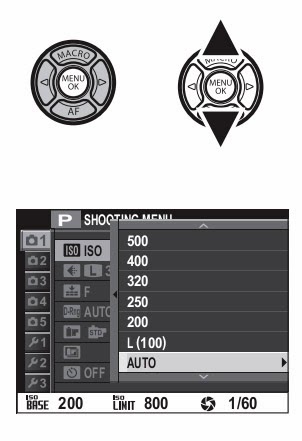
The Fuji X-E2 Auto ISO

When you choose the Auto ISO on the camera the camera automatically chooses a sensitivity between the default and maximum values. Sensitivity is only raised above the default value if the shutter speed required for optimal exposure would be slower than the value selected for MIN. SHUTTER SPEED.

If the value selected for DEFAULT SENSITIVITY is higher than that selected for MAX. SENSITIVITY, DEFAULT SENSITIVITY will be set to the value selected for MAX. SENSITIVITY.

The camera may select shutter speeds slower than MIN. SHUTTER SPEED if pictures would still be underexposed at the value selected for MAX. SENSITIVITY.

I have set my AUTO ISO to have a range of 200 to 6400. The one thing I do go in change regularly is the minimum shutter speed.  I have it set for 1/500 sometimes for quick moving subjects and then maybe change it to 1/60 for inside more fixed subjects.

If you need to control the Aperture and Shutter Speed to get the photo, then let the ISO climb higher. with today's sensors the higher ISO isn't as noisy as in years past.  I think you will agree that the photos above, which are cropped are acceptable noise for shooting at ƒ/8 and 1/1000.


Wednesday, January 29, 2014

Winter Storm and Epic Traffic for Metro Atlanta 2014

Fuji X-E2, 18-55mm, ISO 6400, ƒ/5.6, 1/15
Note: All photos were shot on the Fuji X-E2 and while I was sitting still I would use the Wifi connection and upload these to my Facebook page.

While many people want to judge the south as not knowing how to handle snow, this was not just a snow storm. The main reason for the traffic standing still in the south is the ice.

In the photo above you can see the ice all over this semi-truck and on the road. this is on Georgia 400 around exit 7a.  The truck continued to spin its wheels and slide toward me.

Fuji X-E2, 18-55mm, ISO 6400, ƒ/5.6, 1/15
The guy in the red KIA Sportage was spinning his wheels so much that if he did get traction would have rammed the people in front of him.  Most of the cars with front wheel drive and good tires were moving slowly and taking their time. The front wheels had enough weight from the engines to keep traction.

My trip started with excitement.

Fuji X-E2, 18-55mm, ISO 320, ƒ/5, 1/500 TIME 12:51 pm
I was doing some work down at Chick-fil-A's corporate office. As I went out the door at 12:50 pm I took a photo of their billboard that is on their tour. Many people get up on the platform and get their photo taken with the cows.

Fuji X-E2, 18-55mm, ISO 800, ƒ/5, 1/500 TIME 12:51 pm
Many people also like to have their photo taken with Truett Cathy, the statue that is. If he is at the office he will meet with folks in his office. Well as you can see the cows and Truett had a light dusting of snow.

Fuji X-E2, 18-55mm, ISO 1000, ƒ/5.6, 1/500 TIME 12:54 pm
As soon as I drove out the the parking deck and got on the road I called the office and told them to leave now.  The roads already were slick. I could tell the snow was melting and turning to ice almost instantaneous.

Fuji X-E2, 18-55mm, ISO 6400, ƒ/5.6, 1/80 TIME 15:03 pm
This firetruck is going in the opposite direction to get to wrecks.  This was about halfway through my 11 hour commute.

Fuji X-E2, 18-55mm, ISO 6400, ƒ/5.6, 1/8 TIME 8:48 pm
I am assuming the sign had some lights burned out, but this should say:
JACKKNIFED TRUCK  
PAST HAYNES BRIDGE 
ALL LANES BLOCKED
Fuji X-E2, 18-55mm, ISO 6400, ƒ/5.6, 1/8 TIME 10:45 pm
This photo here is on Holcomb Bridge Road, Roswell between Old Roswell Road and Warsaw Road at 10:45 pm or less than 1.5 miles from my house. It would take me another hour and half to drive that. When I approached Alpharetta Hwy I knew the road would go down a hill and back up. Knowing this was where most problems would be for vehicles, I turned right and no traffic at all for me to go north to Houze Way and take that road through the back of our neighborhood.

I got home at 12:05 am today. There is now color back in my knuckles from them gripping the steering wheel for 11 hours.  Seeing a semi-truck sliding towards you and you cannot do anything is enough to give someone a cardiac arrest.  Thankfully all those trips to the gym are paying off.

Fuji X-E2, 18-55mm, ISO 6400, ƒ/8, 1/500 TIME 9:10 am
Sitting at home now enjoying my coffee and I can say relaxing as I see this out my front door. There are still many people still on the road stuck until the ice either melts away or DOT clears the roads.

Keep those affected in your prayers until the roads are all cleared.