Showing posts with label Capturing moments. Show all posts

Saturday, May 26, 2012

Photo Tips For Camp Photographers

When you drive into the WinShape Camp at Berry College in Rome, GA you will be greeted by lots of deer. I understand the ratio of deers to students is 8:1.
Friday I spent the day with WinShape summer camp photographers training them to get better photographs.

Here are some camera settings that we all made on the cameras.

Auto ISO on a Nikon
  • Quality of Image. We chose to set the camera to the largest JPEG file at the highest quality setting. (The camp did not provide the software for all the computers to use RAW)
  • Auto ISO. We all then set out cameras to Auto ISO and set our lowest ISO on the camera default preferences of either 50 to 200 ISO. We then set the highest ISO on what the camera is realistically capable of shooting. For most of the cameras this was between ISO 1600 and 6400. Both Canon and Nikon allow you to also set your highest shutter speed.  We set this according to the situation.
  • Shutter speeds (Using auto ISO) The camera will raise the ISO to get the optimum shutter speed and will drop the shutter speed once it hits the maximum ISO.
    • If shooting under fluorescent or sodium vapor lights we recommended that shoot at 1/100 shutter speed, unless they had to shoot sports.
    • For shooting sports we recommended setting 1/2000 shutter speed
    • For general shooting we recommended 1/250 shutter speed
  • White Balance
    • We recommended getting a custom White Balance as the primary choice
    • Our second choice was to use a preset like Fluorescent, Daylight or tungsten for example
    • When we were changing lighting that affects white balance often we recommended using Auto White Balance
  • Aperture
    • For general shooting we recommended to not shoot wide open but use f/4 or f/5.6 so that you subject is in focus
    • When your subject can cooperate a little more with you then we recommended shooting wide apertures if you choose for artistic reasons. This is when f/1.4 is more appropriate. We have found the trend of too many shooters buying 50mm f/1.4 lenses and shooting all the time wide open and having very few in focus photos due to the shallow depth-of-field.
  • Inside Flash or when dark. Use a higher ISO to help open up the background. Here is an earlier blog post on how using the higher ISO helps open the background up.
  • Flash outside in daylight. When it is the middle of the day and the sun is straight up you are most likely to get dark circles around the eyes. I call this the raccoon eye look. If you are less than 10 feet away from the subject you can use either your built in flash or hot shoe flash to fill in those shadows. In addition to filling in the shadows you will get a nice catch light in the eyes. You can also use the flash when you back light a subject. (I wrote about this in earlier blog post here)  This helps them from looking directly into the sun and squinting. Since the shadow side of the face is now towards the camera a flash can help balance the light.
Camp staff photographers are discussing ideas that they will be doing with the campers in a couple weeks.
Some of the camp photographers are photography students or recent graduates of photography programs, but not all the photographers were photography majors. Due to the range of talent we showed them settings that would help them get more photos in focus that are properly exposed and with good skin tones.

The staff of one of the boys camps shows their camp cheer that they will be teaching the campers.
After practicing with these settings we then covered the three stages of composition. I will refer you to my earlier blog on this topic about what we covered.  

The last thing we did during our time was go out and practice shooting looking for photos that tell a story. Then we reviewed everyone's best 5 photos for our last hour together.
Staff plays some games with each other after dinner.
If you would like me to come to your organization and do this workshop for you just give me a call. I am doing the workshop in a few weeks for the Boy Scout troop that meets at my church. We meet for class time and then meet four weeks later after they shoot a photo story.

The really cool thing about WinShape camps is the emphasis on relationships. As you can see the staff really enjoy each other and this spills over to the campers.

Thursday, April 26, 2012

Recruiting photography for school that looks natural


The cry of focus groups when they review most educational recruiting pieces seems to always say they want natural looking photos and not setup.

The problem is not setting up photos or trying to just grab what you can to get a natural look, it is hiring the right photographer. Also, it is a team effort of the school setting up the situations by having students, teachers and the right situations with enough time for moments to become "REAL."

Focus groups need the right questions
After having spent the last twenty plus years as a photographer shooting pure photojournalism, where you capture what happens in front of the camera to shooting for advertising pieces, where there are stylists arranging everything in a photo; my experience says most focus groups are asking the wrong questions.

“Do you like the photo?” is not as good of a question to see if the photo was successful as a question like “What did you learn from the photo?” You can even have a photo again on a questionnaire from your recruiting materials and ask, “Does the photo help you see what a typical dorm room looks like?” You could even have a follow up question “What could improve the photo to show you a dorm room?”

The reason I have come to this place about evaluating photos is my experience with truly “real” photographs. I have spent many years shooting “photojournalism” for magazines, newspapers and wire services. You do not change a thing in these photos and you do everything you can use composition, lens choices, lighting and timing to communicate the mood and reality of a situation.

Often a photojournalist’s photos are not “pretty” pictures. Photographers will even use their composition to create more conflict to add to the mood of the photo. Having a focus group evaluate war photos with the typical questions we ask “Did you like the photos?” will give you results which would say the photographers were not successful.

Often what you get by just grabbing shots here and there.

The difference with some planning and adding a light to the scene can make.
Make your photographic coverage strategic

How can you know the right moment to take a picture unless you have a fairly clear idea of what the subject means and what you are after? When you are interested in a subject, you want to learn more about it. You dig below the surface values to the truth beneath. That way you get to know it intimately and are able to photograph it understandingly.

Why are we taking this photo? Are we trying to show teacher to student ratio? Are we trying to show what a dorm room looks like? Are we trying to show diversity and how well everyone gets along on the campus?  You need some understanding of what you are trying to accomplish.

Understanding does not necessarily mean a technical knowledge of the subject. 

It is about seizing the right moment. It might be setup or as in the case I just floated into a meeting and shot.

Understanding is interest, sympathy, curiosity, the human element of the equation.

Are you photographing who you are or what you want to be?
While photojournalism will give you “real” photos, sometimes reality for recruiting will keep your institution on the same path rather than to where you would like to be.

This is where what I call the “sitcom” photography works best. We all know the sitcom isn’t real, but it can create such a reality we are all tuning in to see “Who shot JR?”

Spontaneous moments in a hall with two guys who are obviously close friends will communicate diversity better than sometimes setting something up.  However, it needs to be prevalent on your campus or you will not capture it just because you have a photographer there. Plan for creating moments and letting the photographer have time to just capture things along the way.

This is the type of photography where the school has determined where they want to go and then create communications pieces to help them attain the goal. For example if you want to be more diverse in the future, you will need to show diversity. If you keep it real, you would then research to find those situations where diversity exists already. Then you would photograph those situations and play them prominently in your piece.

While this is setup, I worked hard to get the expressions to sell that they are a community with diversity.
As one person put it “You don’t want to be the lone raisin in a bowl of milk.” If everyone works to help the school to become more diverse it can be done.

As you can see there are a few ways to communicate your message using photographs. The ideal scenario is to have “reality” photos. If you had a photographer go to everything you did this year—then maybe you would get the reality you need.

Shooting at The Citadel and a Roman Catholic high school is easy as compared to the clothing problems introduced in most other schools. 
Sometimes “reality” isn’t what you want to show. The student wearing another competing schools T-Shirt. A student with major over weight issues or skin problems can detract from the message. This is why so often we re-create reality like the sitcom. If properly planned, you will tune in and want to know more about your school.
Capturing joy of students makes students want to come to a place like The Citadel, where they will spend a lot of time being told what they will do.
Photographs are made of light, mood, texture, form, and line. The value of techniques lies in how they are used. Techniques by themselves are barren. To come alive with meaning, they must be employed interpretively. This is where I come in. Give me a call and let’s make your recruiting photos—REAL.

Wednesday, March 21, 2012

Anticipation is key to capturing a decisive moment

Three elements I look for in sports photo: 1) The Ball, 2) The Competition & 3) Expression
One of the more obvious moments in capturing a decisive moment in photography I think is in sports photography.  Most everyone understands what the purpose of the game—scoring points.

I have written in previous posts about what I think are some key elements to some great sports photos. (Click here for that link)

Key ingredients (Most of the time)

1.    The ball
2.    The competition
3.    Expression of the athletes

Decisive moment in sports requires anticipation. I know that the purpose is to score points and the best place to capture this is with a camera placed behind the glass where you can show the goal scoring. What else is helpful is the three elements again: 1) Ball, 2) Competition & 3) Expression.  Had I captured a major break away the slam dunk would be missing the competition because you couldn't see them in the photo. 
To capture these moments requires the photographer to anticipate more than just the ability to recognize the moment when you see it. The action is moving so fast in most sports that if you push the shutter button when you see it, in the time it can take to make the shutter trip to the time it captures the moment it has already passed.

Great sports photographers are the ones who consistently capture peak action. To do this a sports photographer has studied the sport, the team and the players and can anticipate those peak moments.

What about peak action outside of sports?

"the decisive moment, it is the simultaneous recognition, in a fraction of a second, of the significance of an event as well as the precise organization of forms which gives that event its proper expression."

--Henri Cartier-Bresson

Henri Cartier-Bresson is credited with coining the phrase of the “Decisive Moment.” He may have been first to express it this way, but painters like Michael Angelo were painting them long before.  I think one of the greatest examples of this is the painting of the Creation of Adam on the ceiling of the Sistine Chapel.  Many consider this the crowning achievement of all his work. 
The Creation of Adam by Michael Angelo

As you can see in the painting you see Adam almost touching God.  To me this epitomizes the concept of the anticipated moment in photography, which often is the decisive moment.

This is when the anticipation is often greater than the moment itself.  It is like the effort of the basketball player as they are scoring rather than the actual point.
A mother touching her dead son and having her husband and family with her communicates much more about the loss of this soldier.  While there were many other moments that showed parts of the funeral, this communicates the loss and those who must cope with the loss.
While we may wish to capture the moment just before people touch, the touch itself can be just as powerful of a moment.

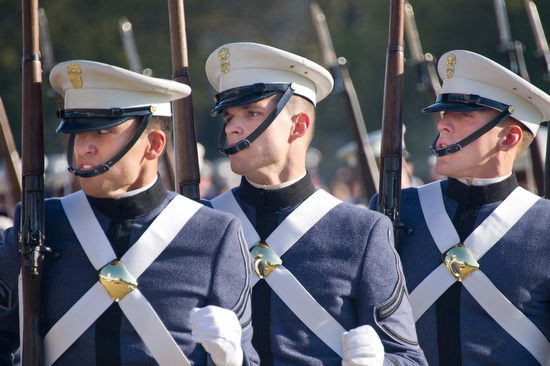
For me this is just an average photo of the Summerall Guards performing on Corp Day Weekend at The Citadel.
I was excited to capture this moment of the Summerall Guards performance. You see they perform this drill in silence and the only way they communicate is through small sounds.  Here you can see them sniffing, which is a small sound they can here next to each other.  I felt like I had captured the expression of the members doing all they could to stay in step and precision with each other.  This to me is a Decisive Moment of the performance of the Summerall Guard.
Moments are quite subtle indeed. I have written before about how the eyes are where true smiles are detected and not in the mouth.

Looking at the eyes of the guy talking and the guy listening lets you see there is a connection going on between them even though they are not looking directly at each other.  The eyes are giving away how this is a real moment and not something posed.

Here you can tell the lady is listening just by looking at her eyes.  There is a look people have when they are attentive with their ears that shows with their eyes.  You must capture these moments carefully by anticipating them.
Compare these two moments:


How do you capture the moment consistently?  You have to first shoot enough to begin with.  Way too many photographers never have learned to first overshoot.  Before you can learn to pick your moments you must first overshoot an event.

What happens when you overshoot?

First of all, over time you will discover that technically a lot of situations just will not work. I remember when I saw things and after a while would pick up the camera and shoot these only to discover later there were things from where I was standing making this impossible to capture.  Next time I saw something similar I was aware of either not making the photo or maybe doing something that would make it possible--like adding a flash.

Second, you realize their is a build up to a moment and then often just after the moment happens that the drop off is quite abrupt.  In sports there is the moment of the score and seldom just after you might see a moment when say a catcher at the home plate looses the ball in the tag and therefore the player is safe.  However for the most part the tagging of the player out is the moment.
Celebration after the touchdown.
Third, you start to see another moment develop shortly after the peak and give you a second great shot.  In sports this is often the jubilee shot.  The celebration after the score or sometimes the defeat you see on the defense or the loosing team after a score.

Last, you learn that moments are happening all the time and you must be on your toes watching and anticipating.

I tried to capture Tommy Bassett in many different moments in a desire to show the complexity of the man.  Here I have Tommy as a serious thinking and concerned person.

Here I think I have a lighter and humorous moment of Tommy with the ladies who formed a cooperative restaurant in Mexico.
Tommy Bassett is interpreting for our trip to visit the coffee farmers in Mexico for Just Coffee.

This is Tommy taking photos and getting contorted to get the right moment and composition.
When I went back through my coverage of my trip to cover the Café Justo in Chiapas, Mexico I realized I had a series of photos of our guide Tommy Bassett and one of the founders of the cooperative.  I also realized that had I wanted to do a story just on Tommy I would have wished I shot even more images of him.

You need to learn to think on your feet and continue to ask what are you trying to say.  What is the story? Then continue to shoot those things that will help you convey to your audience the story.  Remember you need to shoot enough to capture those moments that communicate.  Often these moments will have to be anticipated if you are to capture them.

Take that lens cap off your camera and get out there and start shooting.

Friday, February 17, 2012

Vacation spot?

Do you want to go here and take a horseback ride? If you do then I succeeded.
Telling stories sometimes is about capturing an essence of the place and creating a mood that triggers the soul of the audience. 

I think the best storytellers are those who can take a present moment and capture a nostalgic moment. The moment is so timeless that people are taken to their own memories.
Does this photo trigger memories for you from your summer camps?
I find that many of the memories from our past that we tap into from time to time are not moments of extreme exaggeration with camera angles. The compositions are more simple and straight forward, but yet they are very timeless.

I remember going to camp as a young boy and having fun playing in the pool and as well remembering finding a girl friend. For me this photo triggers those memories. Does it trigger your memories?
Some photos we take can be big picture like the photo of the horses near the lake. Sometimes the photos can be much closer and help bring us into those moments we remember of a horse ride through the woods.
I used a flash to be sure you see the person on horseback. I think her expression captures the relaxation and joy of horseback riding in the woods.
Many times photographers are communicating moments that do not trigger memories, because the audience has never had a similar experience. I believe if the photographer is truly in touch with their emotions when they are photographing and understand how to use light, composition, expressions of subjects and those defining moments they can communicate even to those who have never experienced these moments a desire to want them.

This is truly a snapshot of my daughter when she was 3 years old.  That is some 10 years ago. While I know this is mainly a memory jogger for me of my daughter, I know on some level it will connect with many people because they too have made similar photos like this.  I think the photo works only because I think you can tell my daughter is connecting with me in the photo.  Would I use this photo in a communication package--I don't think so.
You need to start with the snapshot as I did with my daughter.  What in this photo makes me like it so much? It is my daughter and it means something on this level for me. I like the expression of Chelle in the photo as well. I think on one level many people would like the photo.

What is missing for me is that she is a little too far away for me in the photo.  I wanted to get closer and make it work better.  Do I have one showing that I did that, no I don't.  I made this photo for me.  That is perfectly OK to do even for a professional photographer.

I do make a lot of snapshots for me. These are my nostalgic moments. I have learned they don't connect as well as those photos that have taken a little more thought and time to make.
Are you in touch enough with how you feel about a place to capture it? Good communication photos help your audience connect to a location using visual stimulants that make a moment nostalgic and inviting. Hire a photographer who consistently shows this in their portfolio the next time you want to get folks to come to your event.

Saturday, October 23, 2010

"Windows to the Soul"

Reynaldo Cifuentes Velazquez, president of Café Justo - a coffee cooperative. He lives in Salvador Urbina, Mexico.
According to Dr. Martin Seligman, author of Authentic Happiness, there are two kinds of smiles, the "Duchenne smile" and the "Pan American" smile. Here is how Seligman describes the two smiles, "The first called Duchenne smile (after its discoverer Guillaume Duchenne) is genuine. The corners of the mouth turn up and the skin around the corners of your eyes crinkles (the crow's feet). …The other smile, called the Pan American smile (after the flight attendants in television ads for now-defunct airline), is inauthentic."

A Genuine Smile Goes a "Long Way," was published by Vijai P. Sharma, Ph.D in Mind Publication in 2002. Studying a high school year book researcher's divided the class photos into the Duchenne and Pan American smiles, which by the way was almost 50/50. Then they followed up with the two groups at age 27, 43 and 52 and asked about their marriage and life satisfaction.
Father Flor Maria Rigoni is a missionary with the San Carlos Scalabrini and works in the town of Tapachula, Chiapas, Mexico. The pastoral mission of the Scalabrinians is the care of migrants.
The results showed that those with Duchenne smiles were more likely to be married and stay married. The finding was that a habit of genuine smiling may contribute to happiness and better adjustment in life. The researchers considered good looks and found this had no bearing, but genuine Duchenne smile did effect ones happiness in life.

Few people are more beautiful than those with a warm and natural (Duchenne) smile.

As a photographer I have learned how to recognize a natural smile and know how to get it most of the time out of subjects most of the time. Personally I cannot produce a genuine smile on command - yet.
Olga Sánchez Martínez runs an amputee shelter in Tapachula, Chiapas, Mexico.
A trick models use to learn how to control their face expressions and to get the eyes to be expressive is to look in the mirror and use a handkerchief to cover everything below the eyes. Before this can be effective you must know what you are looking for in expressions of the eyes.

Tyra Banks, the famous model and TV producer of America's Next Top Model tell how to learn to smile with your eyes. She did a video for the NY Times Magazine on fame, her career and what every model needs to know. She talks about seven types of smiles in the video.


Tyra says a big mistake people make is smiling with your mouth and not your eyes.

The muscles used to smile with the eyes are involuntary and normally only become engage in an authentic smile.

Photographer can help people to smile for the camera, but only about 50% of the folks will present that genuine Duchenne smile on command. So what do you do for the rest of the folks?
Luis "Pelayo" Manuel Diaz Perez, enjoys the hammick during an afternoon rain in Salvador Urbina, Chiapas, Mexico. Pelayo is a coffee grower and part of www.justcoffee.org a cooperative making it possible for the members to stay in Mexico with their families rather than migrating north.
A real smile arises from your own personal joy. A photographer must get the subject to think about subjects that make them happy. That's why a pre-session consultation is important. During a consultation it's easy to discover the makes them smile naturally. Perhaps it is their families or their hobbies. You'll spot the genuine smile while talking with them. Just make notes and use the subjects when you photograph them. A trick I use is to ask them to tell me the name of the person they have just been talking about; invariably it brings a smile not only to their mouth, but the eyes smile, also.

Remember what Tyra Banks demonstrated where the eyes were smiling and not necessarily was it a big teeth smile to be a real smile.

After a while you will be able to get more than just the Duchenne smile but maybe all the 275 smiles that Tyra eluded to. Most research shows more than 50 types of smiles.

Tommy Bassett, tri-founder of www.justcoffee.org enjoying visit to El Aguila, Mexico to meet with the coffee growers.
Aaron Sorkin, "The West Wing" had Leo say to Bartlett "Act as if ye have faith, and faith shall be given to you. To put it another way, fake it till you make it." It might just be a biblical principle. The writer of Hebrews 13:7 says, "Remember your leaders, those who spoke the word of God to you; consider the outcome of their way of life, and imitate their faith."

The windows to your soul are your eyes so learn to smile with them and not just your mouth, because people are drawn to people who exude happiness.

To many people a smile in a photograph is like location in real estate – it is the most important part of the deal.