Thursday, April 04, 2013

Vacation Photo Tip: Long Lens can compress the scene


Nikon D4, 28-300mm [56mm], ISO 100, ƒ/10, 1/80
We were on our quest to get a good photo of the Hollywood sign by going up the road to the Griffith Observatory in Los Angeles. After parking we immediately took our first attempt here.

Nikon D4, 28-300mm [68mm], ISO 280, ƒ/29, 1/60
Now we move up the road to the observatory. Here the photo is a little better. Had there not been cars and road right behind me I might have backed up a little and used a longer lens. While I like the photo, I still feel that the Hollywood sign is just too far away.

Nikon D4, 28-300mm [190mm], ISO 280, ƒ/29, 1/60
To get the last photo we went further up the mountain. I used a longer focal length and to be sure the Hollywood sign was readable I stopped down to ƒ/29. I like this photo so much I did another one of my wife alone.

Nikon D4, 28-300mm [280mm], ISO 280, ƒ/29, 1/60
One last thing about that latest photo, notice how I zoomed in even more to 280mm focal length. The sign is even closer in feel and based on this if I had shot this with a 600mm it would appear even closer.

Just a couple of posts ago here I recommended composing the background first. This is still the case, but sometime You need to consider bringing the background closer.

Remember this is just the opposite of what they are doing when they shoot TV sitcoms. They are trying to make the most of the small space they often work in and therefore are using moderate to wide angles to expand the set.

Wednesday, April 03, 2013

It is all about perspective


I learned about this phenomenon from Jay Maisel. Look at this photo, which way does the foot print go? In or out?


How about this foot print? Is it in or out?

Actually they are the same photo, just flipped. Your eye expects patterns a certain way and flipping the photo can change the topography.


The above photo of me is how most everyone sees me. I really never felt like it looks like me.


This is the photo as I see myself. What is the difference, it is just flipped or the mirror image that I see each morning in the mirror.

I suggest taking a digital photo of yourself and flip it and see if it feels more like yourself.

I showed this to a few of the students I was teaching lighting to in Kona, Hawaii and they all were amazed. 

Tuesday, April 02, 2013

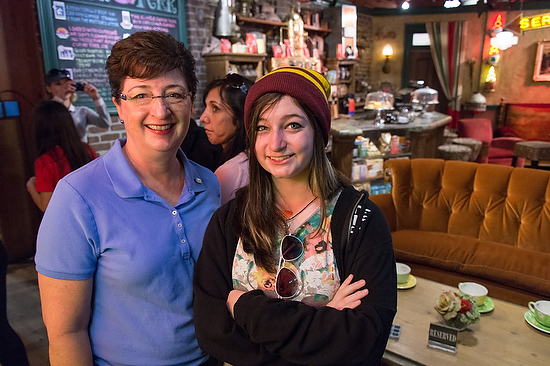
Vacation Photos: Compose Background then add family and friends

Nikon D4, ISO 12,800, ƒ/5, 1/100, 28 - 300mm [No Flash]
Today I was touring the Warner Brothers Studio in Burbank, California. We made a stop to see the set of the Friends TV show set.

While I enjoyed seeing the set and took many photos.  I took this shot and then put my wife and daughter into the photo.

Nikon D4, ISO 12,800, ƒ/5, 1/100, 28 - 300mm [No Flash]

I had my wife and daughter get as close to the camera as possible without totally blocking the background.


The diagram shows how their was neon sign lighting my wife and daughter just over my shoulder.

Had we had more time and no one else in the room with us I might have tried a few other angles.

Nikon D4, ISO 12,800, ƒ/5, 1/100, 28 - 300mm [No Flash]

My tip is simple, first compose the background and then get the people as close to the camera as possible. This means they are most likely between three to five feet from the camera at the most.

Nikon P7000, ISO 128, ƒ/2.8, 1/250, -1 EV flash

Earlier we went to Disneyland. Here I just carried my Nikon P7000. I have a already programs my U1 [User Setting 1] where the flash is -1 EV. So in this last photo I used similar technique and got everyone close to the camera. I popped up the on camera flash and because we are so close to each other the subjects faces don't have those nasty raccoon eyes due to the sun directly overhead.

So the only last tip is to use a flash outside to fill in those shadows. 

Sunday, March 31, 2013

If Photographers had union like the musicians ...

Pam Goldsmith, world renowned violist, works with my daughter giving her tips to improve her playing.
I am in Los Angeles this week on our family vacation. We stopped by our family friend Pam Goldsmith's for a visit.

I was sharing about how photographers talk about the triangle for describing those working as pros. Many years ago that triangle base was not as wide as it is today. The tip still is small and many believe it to be smaller for those really earning a living as a full-time photographer.

Pam Goldsmith then shared how in the Professional Musicians Local 47 they have about 13,000 members of which less than a 1,000 are doing enough gigs to be making a living full-time as a professional musician.

She went on to say she thinks this number is actually smaller than the 1,000 and smaller group than years ago.

If photographers had a union

I am not advocating forming a union for the primary purpose of knowing how many of us are working, but the reason the union was formed was to help people get work in the music industry and for a fair wage.

I think if we had a union we would have similar numbers if not even more members than 13,000. Even if we too helped with regulating rates we still would have dismal numbers of those who have invested time and money to pursue this as a career.

My daughter, wife and I visited with Richard Bugg who works with Meyer Sound. Their sound systems is what was used in the Beijing Olympics and other major productions throughout the world.
Later in the day we went to Richard Bugg's home office studio where my daughter was getting to see what it is like to do sound mixing.  Richard had the Broadway musical Wicked tracks and letting my daughter listen to the different orchestra parts and vocals and how they can be mixed.

What we learned from Richard was to stay employed he had to continue to be flexible and adapt to new situations and apply his problem solving skills to a new situation.

My take away from today

After visiting not just average professionals in the entertainment industry, but the top in their respective fields each of them talked about to get jobs they had to be the best they could be.

Pam talked to us about when playing in orchestra there is a different approach than when in the recording studio for a movie. With the movie you have to be so exact because the editors have the scenes timed down to Milli-seconds. She had to be 110% accurate with the beat.

Richard shared about equipment breaking and fixing equipment in pressure situations.

Richard also talked about how he and my wife's brother Richard Zvonar determined that laptops have stage fright.  They would have sound systems running with their laptops and everything worked great in rehearsal and then they would crash during a performance.

This led them to help design systems that ran separate from the laptops.

Too many times Apple would upgrade an operating system which would crash their software. They would spend so much time trying to fix the problem that this is why the separate systems were designed to work sound design systems. They don't fail.

Again, I hope you see the importance of not just people but equipment must be the best and perfect.

If we had unions photographers would be even more aware of how many call themselves professional photographers and how few really are making it. The difference is in the nuances of details.

Thursday, March 28, 2013

Photography Tax Tips

Bookkeeping??? I just want to shoot


If you don't like keeping track of your spending or budgeting and you just can never see yourself doing this, then read no further.

However, if you want to make money with your camera and do this as a profession you have no choice but to keep track of all your expenses and income or you can go to jail for tax problems. It is just that simple.

Even if you hire an accountant you must keep records to give to them.

I am writing this to help anyone who hates doing this and if you do like it maybe a simple way to do it for now on.

All you have to do for the IRS is show where all your income is coming in from and what are all your expenses. By the way you need to have documentation to back this up in the form of receipts and/or record keeping.

This is what I do for my record keeping for the IRS. 

These are some tips I have to offer for photographers to help with taxes.

First a disclaimer: I am not an accountant or lawyer, so please check anything I say with a Certified Public Accountant.

I recommend using Quicken Home & Business.  Here is a link. This only works on Windows, but you can run this on your Mac.

How to run on a Mac.  

You need to set aside some hard drive space to run a Windows platform.  I use VMware Fusion which costs $49.99.

You will still need to invest in one last software: Windows.  Good news is you can still buy Windows 7 for around $79.99.  Price dropped when Windows 8 came out.

Why I use Quicken Home & Business?

When I got my first computer it came with Quicken and I just started using this back in the 1980s.

I liked a few basic features, which for the most part are the same as the first version I ever used.


The template looks just like your check register. You have box for  Payee, the amount and most importantly the category.

Categories

Quicken helps you setup categories based on IRS Schedule C for your business.  Out of the box you can select the default and be pretty close to being done. My suggestion is to pay a CPA to consult on the categories you need to use for your business.

Now there are a few cool things that Quicken can help automate your book keeping.  One of the best things is many of the credit card companies make it so Quicken can talk to them and download all your transactions. The only thing you will need to do is to be sure the right category is assigned to each transaction. But after the first time with a vendor, the next time it comes up it goes to your last category.

If you use multiple categories for a vendor it will let you choose which one from a pull down menu.

Receipts


You can attach a receipt to any transaction. This is very important for book keeping.

You may also be wondering about what the IRS thinks about digital receipts. The short answer is that digital receipts are as acceptable as a paper copy. According to Rev. Proc. 97-22, the IRS allows taxpayers to save electronic images of documents and destroy the original hard copy.

If you scan your receipts and then attach them to the transaction you are meeting the IRS requirements.


You can see here a scan of a cash receipt. I put this in my Cash Transactions.

Vehicles


Quicken even comes with a Vehicle Mileage built in.

Tips for tracking your mileage.

You will need the odometer reading for the beginning and ending of each year. So, New Years Eve or Day you need to write down the odometer reading.

Think of tracking your mileage like you would do a checkbook transaction. You need to write where you went for business. You need the starting odometer reading and the end reading. If you like you can track your tolls in the same place as well as your parking. I choose to track all my receipts for tolls and parking either my credit card account or cash account.

The IRS will want your total business miles, personal miles and over all mileage for the tax year.

Also keep track of actual vehicle expenses. You can deduct which ever you want–mileage or actual expenses.

If you have a smartphone this is really cool and easy way to track your mileage. I recommend you checking out TripLog for use with your Android Device or iPhone.

TipLog Highlights

  • The most popular GPS mileage tracking app with over 300,000 downloads
  • The only app that AUTO STARTS when connected to power or Bluetooth devices
  • The only mileage tracking app that reads a vehicle's odometer from OBD-II devices
  • Sync and merge data to TripLog Web from multiple devices with Fleet Management
  • The most comprehensive reports compliant to IRS TAX returns


Click on image to see larger

Since I am tracking all my personal and business expenses I can easily see what my actual expenses in a given year are for a vehicle. This is where you might put in the note field which car was at the shop. So you can use actual expenses or mileage for the IRS forms. The good thing is TripLog and Quicken Home & Business helps you decide which is the best to use any given year.

Invoicing

I like the ability to use your logo and customize your invoices with Quicken.
 
To get paid I must invoice by clients for the work I did for them. I have setup a few categories of billables that I use for invoicing.

You can have for example unlimited number of ways to charge for your services. Once created it will automatically drop in all the explanation that you use to describe what you did for them.

If you have taxable items that you invoice for, then you can setup those categories to automatically tax at the rates for your area.

It is quite common to have some billables that are taxable and others that are not. Again, this is a reminder why you need to talk to a CPA to get you setup.
 
Another cool thing with the software, is you can put in the due date for invoices and Quicken will help you know what isn't paid and who is late paying. This is critical information when you are short on cash due to slow payment.     

April 15th

If you have used Quicken Home & Business through the year to track all your expenses and income, then TurboTax Home & Business can import all this data and then basically you just click through questions verify that it is correct.

Filing my taxes has never been easier.

Wednesday, March 27, 2013

Which photo is best? Another Example


Click on photo for a larger view.

This is a series I shot of a little Senara boy in the town of Konadouga, Burkina Faso, which is located in West Africa.

Which of the photos would you pick and why?  Here are larger versions of the composite above:

Photo 1

Photo 2

Photo 3

Photo 4

Photo 5

Photo 6

Photo 7

Photo 8
I think anyone of the photos will work. Yes I do believe they are all good and which one to use depends on what I am wanting to say to people. Now I might crop the photo a little depending on the photo I select and how it will be used.

I could easily see this photo running over two pages of a magazine with the headline and story on the left over the photograph.

I think the furrow of his eyebrows and his hands on the post change so much from photo to photo. The only photo I really feel like makes the child look content and happy is Photo 2. You could argue Photo 3 also he is playful and enjoying himself.

All the other photos he is looking at the photographer inquisitively which can be interpreted many different ways.

For the most part all the ones with the furrow of his eyebrows and tight grip on the pole communicate some type of desperation to me. These look more like the NGO photos trying to raise money for their programs that help children. The expression communicates uneasy feeling which can help the viewer feel responsibility for the child.

I am shooting slightly from above the child a few feet away from him. What I find interesting is in the last photo he raises his chin which makes his eyes look more level to the camera perspective. This in turn puts him more on eye level with the audience.

That last photo could be used where you may have the child making his on plea for help in the copy.

Which photo is best? The first question should be what are you trying to say.

Photographer Tip

When shooting situations like this in the field you have to feel the situation. Then you must know what you are trying to communicate about this person to people who are not hear but will be the audience.

There are two of the journalists questions I think you need to really understand and know what the answers are before you push the shutter release.

What and Why are the two question of the five I would stress.

Here are the five questions a journalist should ask:
  • Who is it about?
  • What happened?
  • When did it take place?
  • Where did it take place?
  • Why did it happen?
Some authors add a sixth question, “how”, to the list, though "how" can also be covered by "what", "where", or "when":
  • How did it happen?
What is going on that you need to communicate to your audience? This helps you pick the situation and moments out of everything that you are seeing and focus on the message.

Why should the audience care? This is a deeper question that I like to ask rather than just why did it happen. This helps me often work to find the peak moment that will engage the audience.
This is why I might crawl on the ground to get my audience eye level with children. When they are eye level with a child this should help them feel like a child, because to see this moment like this would mean being like a child on the ground.

Remember if you don't know why you are pushing the shutter release then no one else will understand either when they see your image.

Tuesday, March 26, 2013

Which photo is best?


I will take a few situations show you the take and help you see why one photo stands out over the rest.

First I am taking the drive of a basketball player to the basket. This is the series of six images shot extremely close in time. They are so close in time that the time from the first to the last image is only one second total time.

Take a moment and go through each photo separately and make your pick first. We may or may not agree, but in the end can you articulate why one photo is the best?

Photo 1

Photo 2

Photo 3

Photo 4

Photo 5
Photo 6

Sports is about competition

Rather than calling these rules lets call this list of mine guidelines. These are things I generally am looking for in a sports photo beyond the technical correctness of the photo.
  1. The ball
  2. Competition
  3. Peak action
I like three photos more than the others. I like 1, 2 and 4, because all three elements are in those photos.

The 3rd photo she is so much in front of the competition they don't really exist and in the 5th and  6th photo she has already blown by the competition therefore she is not overcoming adversity.

Anticipation

The moment before she blows by the player to the basket you can see the defender and the offensive player competing for the space on the floor. Now it is clear to me in photo 2 the offensive player has more desire on her face than the defender.

I think this face expression is the nuance that commentators talk about between the winning team and the loosing team. She wants the win and it shows and the defender's expression is complacent.

I think the pick is definitely between 1 and 2.  Let's look at them side by side.


I like the ponytail of the player up in the back, it gives it more motion than the other photo. I also like the defender's hand looking like it is trying to reach for the ball more in the second photo. I can also feel her next step being the jump step to the basket and completing the move to the basket.

The last thing I would do is the crop a little tighter and my final image would look like this here.


What do you think?

Do you come to the same conclusions? Maybe you can argue for another photo. The point is you really need to be able to break down your photos and talk about why one is better than the other.

A few things happen when you start doing this. First of all you will most likely notice you didn't shoot enough. The photo you want is either before or just after you moments that you do have.

Second, you will start to anticipate sooner the moments. Why is this? You now are training yourself to know what to look for in the photo.

Too many people are shooting just nouns and not complete sentences. Photo 3 is a great example of the noun and not a sentence. Yes you could say she is doing something, but notice the difference of having a competitor in the photograph.

The defensive player helps to tell the rest of the story. In photo 3 you have no idea who they are playing. This could be just her warming up before the game, but the other photos show the competition.

Some might argue to use image 5 or 6 because she is shooting. If I didn't have number 2 I would go with those, but I would much prefer to see the battle on the floor for position than the open shot.

This should be happening with all of your photo shoots, not just sports. There is a moment that is best. Stay tuned for other examples.

Saturday, March 23, 2013

How Photography Helped Me: Part 2

Don Rutledge, pictured here, is the person who helped me to see and understand body language in ways that Social Work didn't teach me. [photo by Bill Bangham]
What I was learning with Photojournalism:

While a freshman in college I got my first SLR camera and began shooting for the school paper and yearbook. I would take my work to my uncle, who was a professional photographer and who worked as a photojournalist to review.

Going through my contact sheets he started to teach me how to improve my images. While I was somewhat learning about body language in Social Work, it was with my uncle and later with Don Rutledge that I would be schooled in the finer points of body language.

Instead of me looking at a movie of me during the day and analyzing my social awkwardness, I was learning by observation of others with my camera.

While many think that those with Asperger's Syndrome lack sensitivity to others and lack empathy, I believe just the opposite. While their outward social skills are lacking they are aware of many things people do not see.

I believe their desire to avoid social situations is they often feel things about others and do not have the innate ability to process and articulate spontaneously these feelings. My experience is that I feel too much and it often can cloud my social skills and make it difficult to respond in a moment. It is much easier for me to avoid situations than to embrace them and learn from them.

Knolan Benfield with an environmental portrait of the pastors of leading congregations in Hickory, North Carolina in 1985.
Knolan Benfield

In 1985, my uncle, Knolan Benfield, was excited to show one of his series of photos of ministers. His excitement and telling me all he had to do to make these photos captured my attention. I had never been interested in what other people do like this before.

Knolan had combined photojournalism with portrait photography using lighting for the first time in his career. He took environmental photos of senior pastors in their church buildings. With each pastor he worked hard to find those architectural settings that made each congregation different.

One of the things he was most excited about was the composition. He had learned from Don Rutledge how to pull the audience into a photo by creating layers. These layers pulled you from front to the back of the photograph.

This is an example of where there are layers from front to back in a photograph helping to create more interest.
One of the things that are quite different in Knolan's portraits from his days as a photojournalist was the use of lights. He almost never used lights in his photos when shooting for magazines.

Knolan combined the existing light with the strobes to help create depth and interest. To do this in 1985 he would get the light settings using a handheld meter and then add a flash to just be a little brighter than the rest of the scene, maybe 1/2 to a full stop difference.

Knolan bought a special film back for his Hasselblad system that would let him shoot a Polaroid to do a test shot. This was revolutionary for him and quite new at the time.

It was early in my career and I was not able to take all this and do it myself until some eight years later in my career.

In the meantime I would leave my first job at a newspaper, where I was perfecting my understanding of how to make a photograph and tell stories, to go and work with Don Rutledge and Joanna Pinneo.

While I was learning how to see social situations using my camera, it would take years of shooting before it started to sink into my personal life.

Sensory Perception

I was naive in my early jobs that when higher up people asked me for my input that I spoke directly and with such candidness that it would hurt me.

Those with Asperger's tend to not see the point of superficial social contact, niceties, or passing time with others, unless there is a clear discussion point/debate or activity. Their allegiance is to truth, not people's feelings.

While those with Asperger's are not good at explaining why he or she did something that appeared to contravene the social codes; but, equally, typical people are not good explaining the exceptions to the codes and reasoning for their social behavior.

Today there is a remarkable DVD that is an encyclopedia of emotions, entitled Mind Reading: The interactive Guide to Emotions. Simon Baron-Cohen and colleagues at the university of Cambridge identified 412 human emotions (excluding synonyms). They examined the age at which children understand the meaning of each emotion, and developed a taxonomy that assigned all the distinct emotions into one of 24 different groups. A multimedia company then developed interactive software that was designed for children and adults to learn what someone may be thinking or feeling.

On the DVD, actors (including Daniel Ratcliffe) demonstrate facial expressions, body language and speech qualities associated with specific emotions.

In essence the DVD does some of what I had to learn on my own through Social Work and Photography.

Problems with Non-Verbal Communication

Adults with Asperger's syndrome may have problems with non-verbal communication, according to the National Institute of Neurobiological Disorders and Stroke. They display awkward body gestures, inappropriate facial expressions and/or an odd stiff gaze. They rarely look people in the eye and do not display any form of joy such as smiling, winking or hugging.

This may sound harsh, but when you have a camera around your neck your odd behavior may look a little more normal. Maybe the way you appear is that you are looking for a photograph. This may be true, but it allows me to study the situation without being as harshly judged.

When I was young I ran around almost all the time in an army uniform playing to be G. I. Joe. The other attachment I had was to this tractor, which I rode everywhere for a few years.
Intense Specialized Interests

According to the Better Health Channel, adults with Asperger's syndrome tend to have very intense time-consuming specialized interests. These individuals usually become experts in one or two areas and excel in their chosen careers because they choose jobs that best fit their interests. They are often referred to as eccentric, which sometimes causes social isolation. An example of an intense specialized interest would be someone who spends long amounts of time studying science and statistics, but has little interest in anything else.

I have an intense interest in photography and specifically using photojournalism to help causes. I tend to read a great deal and study nuances to help me be a better storyteller.

Many people are surprised as to how much I get done. Asperger's has helped me stay on task to do tedious business and marketing tasks. It has helped me to spend time problem solving computer issues related to my photography.

People with Asperger's syndrome are often perfectionists, tend to be exceptionally good at noticing mistakes, and have a conspicuous fear of failure. I have been able to channel this to help me perfect my photography and the fear of failure has kept me busy with marketing. These are some examples of how Asperger's has helped me with my photography business.

The Porfolio

Funny thing that is important in photography more than other professions, is the portfolio. Your work must be at a certain level before you get an interview. This works to the advantage of a person with Asperger's. In general we do not do well in job interviews where you need to sell your abilities to an employer. My work is the first foot in the door, which my personality alone might not make it through.


Resource

Because of the way I am wired, I am very good with picking up anything to do with the computer and photography. Also because of the way I had to teach myself to understand things, I have discovered I make a good teacher. This is due to the way I have had to break things down into parts to then put them back together to construct the whole.

Today I spend a great deal of time problem solving the teaching of technical concepts. I have also discovered over time there are so many ways to approach a problem, because I often approach things different than other do and because of this I know there needs to be more tolerance of others.

I remember crying as a young boy because the model motorcycle I was trying to put together was missing a few steps in the instructions. My mother made me wait to ask my dad if he could help. What happened was no one could figure it out. I spent hours until I found a way to solve the problem.

This emotional feeling of not being able to figure something out and no one could help me was depressing. I keep this in mind when I teach today. I encourage students and let them know I believe in them. I give them space and will come along side them so we together can process the problem.

I realize that if they can figure it out with someone encouraging them that they will feel better about solving it than if someone just gave them the answer. I know that because of how proud I was of that motorcycle when I finished it.

Where I am today on this journey

I love to take on a problem that hasn't been done before. One of my favorite jobs was photographing research projects of engineers and scientists. In those situations you are photographing usually a one of a kind that hasn't been photographed before. You have to figure it out. It is not a cookie cutter solution.

Adults with Asperger's syndrome can be renowned for being honest, having a strong sense of social justice and keeping to the rules. This has been what keeps me focused on storytelling on social justice issues.

Asperger's Sydrome people can acquire The Ability of the Mind abilities using intelligence and experience rather than intuition, which can eventually lead to an alternative form of self-consciousness as they reflect on his or her own mental state and the mental state of others. this is a highly reflective and explicit self-consciousness as similar to that of philosophers.

I have learned to use this awareness to help me be a storyteller of other people's stories.

Friday, March 22, 2013

How Photography Helped Me: Part 1

Stanley on school bus in Kinston, NC

While I have always wanted to be in control for a very long time I wasn't in control.

Asperger's Syndrome

It would not be until my adult years that I understood that I had Asperger's Syndrome. Early on I went for psychological testing because of my behavior in the classroom. They suspected I had Autism, but at that time they didn't want to label me.

You see it was not until 1994 that the American Psychiatric Association recognized Asperger’s syndrome. While I had majored in Social Work in early 1980 it was never talked about. It was when my sister was doing her masters in Social Work that she came across it.

She recognized the symptoms in me.

There were a few things that made her aware I might have it. I didn't talk until I was three years old. I was also socially awkward.

However, on the plus side of the characteristics:
  • Persistent
  • A perfectionist
  • Easily able to identify errors
  • Technical ability
  • In possession of a sense of social justice and integrity
  • Likely to question protocols
  • Accurate
  • Attentive to detail
  • Logical
  • Conscientious
  • Knowledgeable
  • Original in problem solving
  • Honest
  • Likely to thrive on routine and clear explanations
Once you get to know you

I have heard this phrase a lot through my life. The reason is those with Asperger's Syndrome frequently say things without considering the emotional impact on the listener [faux pas].  Also, I tended to include too much detail when speaking on topics.

Those who have chosen to move past these social flaws soon learn to love me because of the many positive attributes that I do have. However, like everyone, I have some rough edges of a personality that don't help me. It would be Social Work and my Photography training that would help me do a better job with my social skills.

Social Work & Photography
But God chose the foolish things of the world to shame the wise; God chose the weak things of the world to shame the strong. [1 Corinthians 1:27 NIV]
I find it quite strange that today I work as a professional communicator. You see my greatest weakness is communication.

While I know I was called to do what I am doing I am reminded of the scripture following 1 Cor 1:27.
... so that no one may boast before him. [1 Corinthians 1:29 NIV]
It was my pursuing the call that I would be led down a path that has me working today as a professional photojournalist.

I went to college to major in Social Work, thinking I was going to be a pastor one day. Here I took these types of courses, which basically helped me to intellectually understand people and social situations. Even with all this training I still was not wired to intuitively grasp the social moments. So I can only say I have been blessed with opportunities that I alone did not merit.

Here are some of the course work required for Social Workers:

Stanley making a monkey face during his college years.
Human Behavior Course—This first or second year course explores the interaction of various factors in human behavior, including biological, social, cultural, environmental and psychological. Discussions focus greatly on individual behavior in a larger social framework. Attention is also given to diverse populations, including minorities, children and the poor, as well as the impact of discrimination and oppression.

Social Work Research Methods Course—Social workers must be able to effectively research both new and existing social data. This course provides the techniques to do both, including performing qualitative and quantitative studies. Students learn to critically interpret, organize and use research findings in everyday practice. This is typically a second year course.

Generalist Social Work Practice Course—Students in this course learn the process of intervention in the social work context. They acquire the skills to evaluate, engage and intervene in social problems. This involves a study of the principles and values of generalist practice through multiple social perspectives. These perspectives include multicultural, groups, families and individuals. Social work roles, professional relationships and service delivery models are also examined.

Social Work Policy Course—Social workers must be familiar with the major administrative, legislative and judicial policies that affect their work. They must also understand how to advocate for policy changes to improve social conditions and empower at-risk groups. Students gain this understanding by exploring the history, organization and philosophies of social policies and their effect on diverse populations. This course is generally taken towards the middle or end of a social work program.

Field Practice Instruction Course—In this course, students apply knowledge gained in the classroom to practical situations that model real-world problems. Students develop skills in oral and written communication, effective supervision and critical assessment. This course may include placement with a social work agency and an additional seminar. It is generally taken towards the end of a social work program.

Photojournalists with Social Work or Psychology degrees

Later in my career I would discover that many of my favorite photographers would have majored in Social Work or Psychology. Don Rutledge and Joanna Pinneo who I worked with in my early years both were psychology majors. Eugene Richards was a social work major and even worked as one for years before becoming a photojournalist.

There will be more about how photography would help me more than Social Work in Part 2